Why did the Soviets continue to use the Majdanek gas chambers postwar?

For more adversarial interactions
User avatar
Stubble
Posts: 2997
Joined: Sun Dec 08, 2024 10:43 am
Location: 5th Circle of Hell

Re: Why did the Soviets continue to use the Majdanek gas chambers postwar?

Post by Stubble »

bombsaway wrote: Fri Jan 23, 2026 5:02 am If you're ok with this we can end it here, if not make a new thread about it, since you were the one who initially diverted with your mention of Ehrenburg.
My comment was meant as a 'lest we forget' kind of deal. The propaganda book absolutely exists after all.

With regard to Majdanek and the Soviet continuing to use the facility, it wouldn't surprise me to learn that they found a few cans of zyklon-B and tried to homicidally gas people in that room, after raping their kids or something. I would see it as an example of every accusation from a communist is a confession. I'm sure the explanation is much more mundane and pedestrian however.

A 'delayed reaction' for me doesn't wash given the results of a single fumigation of the churches that Germar mentions. Personally, I think it is a problem with 'washout' due to very poor improperly preserved film stock.
If I were to guess why no t4 personnel were chosen to perform gassing that had experience with gassing, it would be because THERE WERE NONE.
User avatar
HansHill
Posts: 1346
Joined: Sun Oct 06, 2024 3:06 pm
Location: Arlen, TX

Re: Why did the Soviets continue to use the Majdanek gas chambers postwar?

Post by HansHill »

BA, i have attempted to steelman the case for delayed PB formation. IMO I gave two of the strongest cases possible for this that I could think of, 1) drawing on other semi-documented instances of this seeming delay, and 2) appealing to insufficient iron content (iron being one of the key ingredients), again drawing on actual cases of this occurring in other instances (AB BW 5b with the seeming imbalance between interior / exterior appearance).

IMHO Wetzelrad has addressed these points adequately, and I don't feel those arguments can be re-inforced in any material way, leading me to consider the delayed PB argument as unlikely. I won't say impossible as I would still wish to see a timeline for the Bavarian churches, iron content readings from these locations, as iron represents one third of the PB equation (iron + water + hcn = PB).

It now being unlikely in my mind, means that it would need something significant to substantiate why and what happened and the mechanism. My next port of call would be to explore the PB literature that I am already somewhat familiar with, however I'm satisfied that its not longer worth pursuing and I'm a busy guy. I would point you towards Johannes Meusen, who wrote a paper on PB formation in soil. Another paper was Mansfeld or Mansfield, i can't remember the first name and I don't have access to my notes. Assessing the conditions for delayed reactions would be helpful if its documented in the literature anywhere. Although I personally think this is a fools errand.

This line:
the confusion here evinces the kinetics of PB formation are far from settled
is dishonest imo - there is no "confusion" around PB formation, and certainly not around the kinetics of cyanide particles in masonry. What I think you are referring to is that the instances I cited were ridiculously undocumented and vague (eg - PB appeared "some time" later - this is not a scientific statement so introduces uncertainty, but not confusion around the mechanisms). Like I said above, if you see anything of note in the existing literature I pointed you to, be sure to put it here.

Other possible "non-lethal" explanations of course exist, but all of which are completely unscientific and therefore unfalsifiable. i will offer a few for conversation:

- Accidental opening - Soviet grunts opened the tin not knowing what it was, quickly discarding it and vacating the premises to let it offgas: likelihood - medium

- Fooling around - Soviet grunts on downtime were fooling around and opened the can as a joke or prank: likelihood - low

- Delousing - Soviet officers made a conscious decision to use the existing facilities and inventory in their intended way, ie to delouse clothing: likelihood - medium (however this comes with the caveat that this undermines the Soviet's then understanding of the rooms as genocide zones and zyklon as a genocide weapon, and underscores the common understanding of delousing premises & zyklon by interested parties as necessary and proper.
W
Wetzelrad
Posts: 534
Joined: Wed Feb 26, 2025 6:35 am

Re: Why did the Soviets continue to use the Majdanek gas chambers postwar?

Post by Wetzelrad »

Stubble wrote: Fri Jan 23, 2026 5:31 am Personally, I think it is a problem with 'washout' due to very poor improperly preserved film stock.
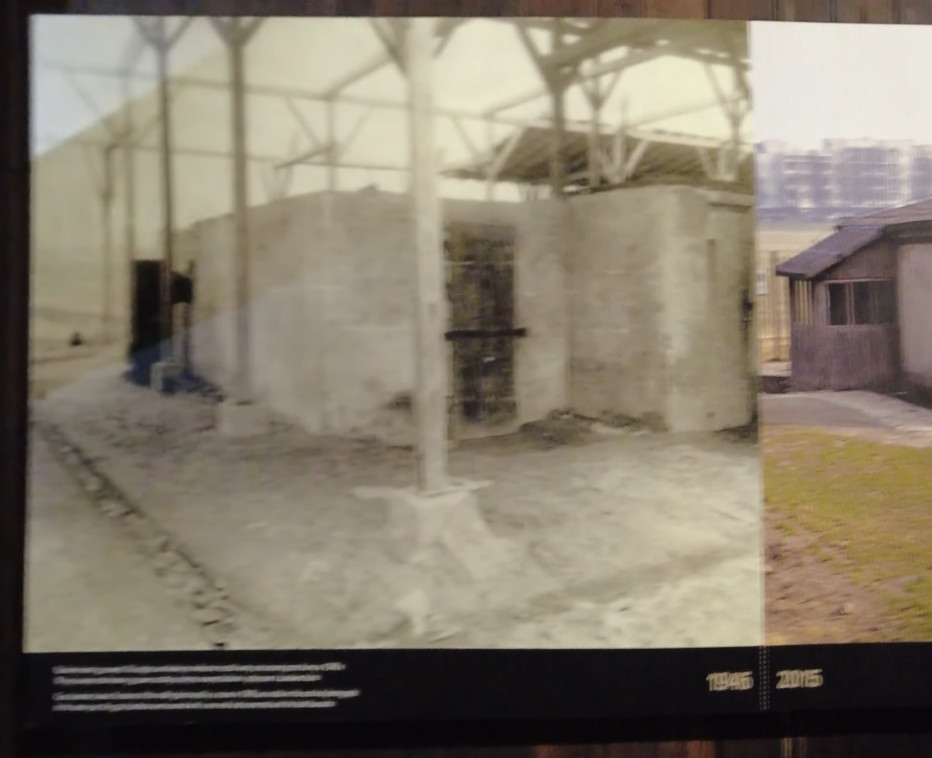
You should watch the 1944 video footage. It is here. Reel 5, timestamp 05:36 til 05:41.
The photo from 1946 is here. Other versions available if needed.
The photo from 2019 is here.

The video is low resolution but exceptionally high bitrate. Good enough to make out a lot of detail on the walls. We can see giant cracks to the left of the door, a square to the right where the door latches, and numerous darker and lighter patches across the walls. All of these match up well to the 1946 photo. If these can be seen, why can't the blue stains?

When comparing the 1946 photo to the 2019 photo, it's obvious that with the passage of time the walls have been repaired and altered in places, but we can still see that even the faint white patches on the exterior corner of cell 14 match up. We also see that the greyish-brownish stains on the bottom of the wall next to the door in the 2019 photo match the contour of where dirt was piled up against the wall in 1946. Again, if these details can be seen, why not the stains?
W
Wetzelrad
Posts: 534
Joined: Wed Feb 26, 2025 6:35 am

Re: Why did the Soviets continue to use the Majdanek gas chambers postwar?

Post by Wetzelrad »

bombsaway wrote: Fri Jan 23, 2026 2:17 am I think it's unlikely the chambers were used for disinfection or homicidal purposes after Soviet capture. Maybe they were fumigated after 44 [...]
The 1944 image is from Soviet liberation footage, so that would mean the Soviets did the fumigation. And if the stains were made by a fumigation between 1944 and 1946, then they should appear in the 1946 photo. They don't, so they can only have been made later.
bombsaway wrote: Fri Jan 23, 2026 2:17 am [...] or the stains took some time to form (the confusion here evinces the kinetics of PB formation are far from settled)
This is grasping an awful lot from a little straw. Is there any other example of Prussian Blue stains taking time before they began to appear? Have any of the Holocaust's chemical experts ever claimed that PB stains could form years after application?
bombsaway wrote: Fri Jan 23, 2026 2:17 am Likely there wasn't a lack of respect, just a general apathy to honest historical inquiry that drove policy around these sites in the post-war period. Within the USSR I don't believe historians were writing very much about the Holocaust, the textbooks were very vague on the details here, it was enough to say the Nazis had death camps which killed millions and in the repressive environment this wouldn't have been questioned.
You can criticize the Soviets in all kinds of ways, but you can't say they didn't at least put up a pretense of believing in mass killings there. They filmed the victims, investigated the physical evidence, wrote a long report full of false claims, built a museum out of it, put up a plaque for 2 million victims, printed propaganda flyers, etc. Yet at some point in 1946 or later they used Zyklon at the main gas chamber, which seriously calls into question that pretense.

What kind of museum to a site of mass murder would bring the murder weapon back to the scene of the crime and employ it there once again?
W
Wetzelrad
Posts: 534
Joined: Wed Feb 26, 2025 6:35 am

Re: Why did the Soviets continue to use the Majdanek gas chambers postwar?

Post by Wetzelrad »

HansHill wrote: Fri Jan 23, 2026 12:32 pm IMHO Wetzelrad has addressed these points adequately, and I don't feel those arguments can be re-inforced in any material way, leading me to consider the delayed PB argument as unlikely. I won't say impossible as I would still wish to see a timeline for the Bavarian churches, iron content readings from these locations, as iron represents one third of the PB equation (iron + water + hcn = PB).
My position on this is that the stains in the Protestant church were not actually delayed or very much delayed, unless some evidence to the contrary can be produced, whereas the stains in the farm-building-turned-restaurant were some other chemical misidentified as Prussian Blue. With the benefit of 2026 internet, you can search for examples of blue stained paint and find that it is a not uncommon phenomenon resulting from chemical processes not involving cyanide. The "consulting expert" simply guessed and got it wrong, understandably.

(Separately, since the internet in 2026 is such a wealth of information, someone should do a deep dive to seek out more examples of PB stains. The better to bolster Rudolf who did not have access to as much when he wrote TCOA.)
b
bombsaway
Posts: 1642
Joined: Sun Sep 29, 2024 2:23 am

Re: Why did the Soviets continue to use the Majdanek gas chambers postwar?

Post by bombsaway »

Wetzelrad wrote: Fri Jan 23, 2026 1:52 pm What kind of museum to a site of mass murder would bring the murder weapon back to the scene of the crime and employ it there once again?
A museum that didn't really respect the history but this is also clear from the stated death tolls. What's the point here?
User avatar
HansHill
Posts: 1346
Joined: Sun Oct 06, 2024 3:06 pm
Location: Arlen, TX

Re: Why did the Soviets continue to use the Majdanek gas chambers postwar?

Post by HansHill »

bombsaway wrote: Fri Jan 23, 2026 6:58 pm
Wetzelrad wrote: Fri Jan 23, 2026 1:52 pm What kind of museum to a site of mass murder would bring the murder weapon back to the scene of the crime and employ it there once again?
A museum that didn't really respect the history but this is also clear from the stated death tolls. What's the point here?
Any particular reason you would say "didn't respect the history", over "didn't respect the..."

- Evidence
- Crimescene
- Investigation

?
b
bombsaway
Posts: 1642
Joined: Sun Sep 29, 2024 2:23 am

Re: Why did the Soviets continue to use the Majdanek gas chambers postwar?

Post by bombsaway »

HansHill wrote: Fri Jan 23, 2026 7:30 pm
bombsaway wrote: Fri Jan 23, 2026 6:58 pm
Wetzelrad wrote: Fri Jan 23, 2026 1:52 pm What kind of museum to a site of mass murder would bring the murder weapon back to the scene of the crime and employ it there once again?
A museum that didn't really respect the history but this is also clear from the stated death tolls. What's the point here?
Any particular reason you would say "didn't respect the history", over "didn't respect the..."

- Evidence
- Crimescene
- Investigation

?
No. All of those are implied.
User avatar
HansHill
Posts: 1346
Joined: Sun Oct 06, 2024 3:06 pm
Location: Arlen, TX

Re: Why did the Soviets continue to use the Majdanek gas chambers postwar?

Post by HansHill »

Noted :mrgreen:
User avatar
Archie
Site Admin
Posts: 1403
Joined: Thu Sep 12, 2024 6:54 am

Re: Why did the Soviets continue to use the Majdanek gas chambers postwar?

Post by Archie »

Here's one passage from CoA that seems to suggest the possibility of a lag. Unclear how long we're talking though.
Even in an alkaline environment, it must be expected that rust, in the presence
of perceptible cyanide concentrations, will be quite slowly transformed into
iron(III) cyanide and finally into iron(II) cyanide.225 The last step required for
the formation of Iron Blue, however, the combination of iron(II) cyanide with
iron(III), will not occur due to the lack of dissolved iron(III) ions. In a strong
ly alkaline environment, an increasing concentration of iron(II) cyanide,
which is chemically stable, can slowly accumulate. It might be said to remain
in a stand-by position, pending a drop in the pH value
. (HH#2, 194)
Incredulity Enthusiast
User avatar
Stubble
Posts: 2997
Joined: Sun Dec 08, 2024 10:43 am
Location: 5th Circle of Hell

Re: Why did the Soviets continue to use the Majdanek gas chambers postwar?

Post by Stubble »

Might be productive to look for early pictures from the other chambers and see if any migration of pb can be observed over time.

I'm still incredulous at the idea of 2 years. I stand ready to be surprised.

I'll see if there are any photos from stuthoff around the date of capture to compare with current photos.
----------------------------------
God dammit.

Is there a window in the Stutthof delousing chamber, and, was the window and frame removed and replaced with, barbed wire?

Why, why does everything always have a rabbit trail down which one may run and get lost.

Also, I have found nothing to indicate any dleayed formation of pb, but, finding a dated picture is proving difficult.

Sorry.

Update, it isn't a window. Some jackass hung barbed wire in a frame not unlike a screen door, but, with huge mesh, made from barbed wire, at the two doorways at the delousing chamber as what I can only assume is an art installation...
If I were to guess why no t4 personnel were chosen to perform gassing that had experience with gassing, it would be because THERE WERE NONE.
User avatar
HansHill
Posts: 1346
Joined: Sun Oct 06, 2024 3:06 pm
Location: Arlen, TX

Re: Why did the Soviets continue to use the Majdanek gas chambers postwar?

Post by HansHill »

Archie wrote: Sat Jan 24, 2026 12:48 am Here's one passage from CoA that seems to suggest the possibility of a lag. Unclear how long we're talking though.
Even in an alkaline environment, it must be expected that rust, in the presence
of perceptible cyanide concentrations, will be quite slowly transformed into
iron(III) cyanide and finally into iron(II) cyanide.225 The last step required for
the formation of Iron Blue, however, the combination of iron(II) cyanide with
iron(III), will not occur due to the lack of dissolved iron(III) ions. In a strong
ly alkaline environment, an increasing concentration of iron(II) cyanide,
which is chemically stable, can slowly accumulate. It might be said to remain
in a stand-by position, pending a drop in the pH value
. (HH#2, 194)
I think this is the missing link, thanks Archie. And Rudolf to the rescue yet again. Is there anything this man cannot do! It seems I was wrong above to focus on the presence / absence of Iron as inhibiting factor, but rather it may well have been the pH.

Let me take another go at it! What Rudolf is talking about here is that PB formation under very high alkalinity will be inhibited. Dr Green agrees with this, as evidenced in his postscript to "The Chemistry Is Not The Science":
On the other hand a high pH makes the formation of a necessary precursor to Prussian blue less likely..
To put a finer point on this, I'd like to clarify here that when Green says "high" he means "very high", in the order of >11, as suggested by Rudolf in his 1998 address to Green "Some Considerations about the Gas Chambers of Auschwitz and Birkenau":
This means that at pH-values beyond 11 (to be found in freshly mixed mortars and concrete) the complexing step is unlikely, because the iron complexes are no longer stable.
If we assume that the delousing facilities in question were built (but more importantly finished and most importantly, plastered) in late 1942, then I think this timeline works for the alkalinity to be inhospitable to PB formation until some time early 1946. Mainstream, non-Holocaust source to support the idea of high alkalinity of fresh plaster: https://kentplasterers.co.uk/best-paint ... w-plaster/

I think people like Fred and Wetzelrad are a bit more firm on the timeline of these facilities, so interested for them to review and interpret this new argument!
B
Booze
Posts: 210
Joined: Tue Mar 18, 2025 11:35 pm

Re: Why did the Soviets continue to use the Majdanek gas chambers postwar?

Post by Booze »

Wetzelrad wrote: Sun Jan 18, 2026 10:25 am Camp Majdanek was occupied by the Soviets in 1944. They declared it an "extermination camp" in which 1.5-2 million people were murdered, they turned it into a museum... and then they decided to continue using the ostensible "gas chambers"?

Is it really believable that they would treat a site of mass murder this way?

A video from 1944 and a photo from 1946 show that the dark blue cyanide stains on the exterior of what they designated chamber III and cell 14 were not yet present, meaning someone must have used Zyklon there long after the war was over.

Image

For what purpose do you think they used Zyklon at this location postwar? Surely they would not have used it to kill people!?
I saw a video on YouTube several years ago showing that Russians were experimenting with cans of Zyklon after liberation of a camp and to my recollection it was Majdanek. I have always thought it possible that the staining of the walls of the undressing room took place post-war.
W
Wetzelrad
Posts: 534
Joined: Wed Feb 26, 2025 6:35 am

Re: Why did the Soviets continue to use the Majdanek gas chambers postwar?

Post by Wetzelrad »

bombsaway wrote: Fri Jan 23, 2026 2:17 am Likely there wasn't a lack of respect, just a general apathy to honest historical inquiry that drove policy around these sites in the post-war period.
bombsaway wrote: Fri Jan 23, 2026 6:58 pm A museum that didn't really respect the history but this is also clear from the stated death tolls. What's the point here?
You're contradicting yourself, but thanks anyway for confirming what I've written here.
W
Wetzelrad
Posts: 534
Joined: Wed Feb 26, 2025 6:35 am

Re: Why did the Soviets continue to use the Majdanek gas chambers postwar?

Post by Wetzelrad »

Archie wrote: Sat Jan 24, 2026 12:48 am Here's one passage from CoA that seems to suggest the possibility of a lag. Unclear how long we're talking though.
Even in an alkaline environment, it must be expected that rust, in the presence
of perceptible cyanide concentrations, will be quite slowly transformed into
iron(III) cyanide and finally into iron(II) cyanide.225 The last step required for
the formation of Iron Blue, however, the combination of iron(II) cyanide with
iron(III), will not occur due to the lack of dissolved iron(III) ions. In a strong
ly alkaline environment, an increasing concentration of iron(II) cyanide,
which is chemically stable, can slowly accumulate. It might be said to remain
in a stand-by position, pending a drop in the pH value
. (HH#2, 194)
To respond to this, I read through long sections of TCOA searching for anything about lengths of time. I think it's safe to say that the problem we are discussing was not contemplated or discussed by Rudolf, so it is very difficult to apply his book here. Even so, here is my lengthy response, embedded in a spoiler tag. Bear in mind that I do not have a chemistry background.
Spoiler
First let me point out that in the few instances where Rudolf gives a quantitative length of time for PB formation, it is very short: "within 48 hours" (p.190), "after 30 min", "after a few minutes" (p.194), "in minutes" (p.196). In the longest case, Rudolf ran a 120-day experiment in which PB did not visibly form (p.327f). All of this is suggestive that the normal time span for this process is minutes, maybe days, not years.

Second we should consider Schwarz/Deckert 1929, a study which actually measured how much HCN lingered in cement and concrete after fumigation and ventilation. Note that Rudolf in discussing this characterizes "three days" as a "longer period of time" (p.224), which again suggests the quantity of time under consideration. In testing "Cement Mortar, well-dried and set", the HCN concentration was found to fall continuously until they stopped testing, reaching 15% of the initial HCN concentration at 104 hours. Rudolf worked out a formula and chart for the cement data, as pictured (p.225):
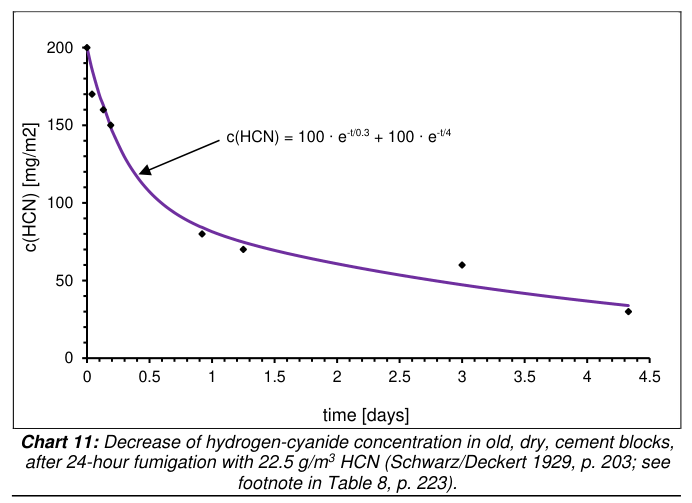
falling HCN chart 11.png
falling HCN chart 11.png (39.25 KiB) Viewed 91 times

The HCN concentration in "Concrete, still somewhat fresh" was similarly found to drop by half within 22 hours and further after. Presented as a table (p.224):
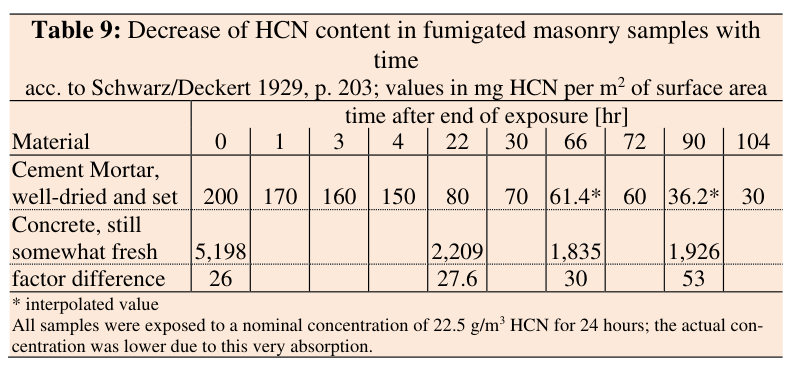
falling HCN table 9.png
falling HCN table 9.png (67.17 KiB) Viewed 91 times

Rudolf expresses some reservations in this data, and I have more. Only four data points are given for concrete, and since the fourth one shows an increase there must have been measurement error or imprecision.

Still, it does suggest a curve which flattened quickly. Rudolf interprets this as a possible indication of the HCN having been converted to other forms. He writes "their HCN content doesn’t seem to drop anymore at all after some 3 days. It seems to have been chemically bound." (p.225) I'm not sure this follows logically. If the HCN was chemically bound then it was no longer strictly HCN. And that would mean the high HCN content measured might to a great extent have represented cyanide compounds which were reverting back to HCN. Or perhaps this is merely a semantic problem that can be disregarded.

Let me now return to the above quote where Rudolf wrote PB precursors could "remain in a stand-by position, pending a drop in the pH value". How long could those precursors actually remain? To my surprise, it does seem possible that they could stick around for years, even if Rudolf doesn't say so explicitly. This is because hexacyanoferrate(II) (and also calcium cyanide, I believe) will remain highly stable as long as the wall remains highly alkaline and at least a tiny bit humid. In that environment the PB precursors are "favored" over HCN. For what it's worth, Grok AI seems to confirm these facts.

However there is a big caveat. Prussian Blue is only formed where the concrete has become less alkaline. Concrete does not dealkalize in uniform. It dealkalizes along a zone of carbonation which very gradually moves from the surface to the interior. Where and when carbonation occurs, what was alkaline becomes more neutral, and all these precursors should begin to revert to HCN except where they convert to PB.

Since we are discussing surface stains, we are concerned with the part of the wall that was carbonized first. Since the wall did not form PB by 1944 or even 1946, it would seem that any near-surface cyanide compounds reverted to HCN and diffused into the environment.

Alternatively, maybe there is some mechanism by which cyanides in the center of the wall could be brought to the outer layers and concentrated in a narrow spot, but this remains unexplained and opens other difficult questions, like why didn't the stains appear on the interior side?

This is probably the extent to which we can go with TCOA. Someone else's writings or photographic material from another location could take this discussion further, but I can't find anything that would be relevant.

Summary: Delayed PB formation seems unlikely for several reasons, foremost being that concrete carbonizes from the outside in, and it is precisely the process of carbonation which dealkalizes the alkaline environment needed for hexacyanoferrate(II) to remain stable, and it is precisely the outside (i.e. the surface) which the stains later appeared on. However this is purely a judgement of probability. I can't eliminate it entirely.
Post Reply