Why did the Soviets continue to use the Majdanek gas chambers postwar?

For more adversarial interactions
W
Wetzelrad
Posts: 534
Joined: Wed Feb 26, 2025 6:35 am

Why did the Soviets continue to use the Majdanek gas chambers postwar?

Post by Wetzelrad »

Camp Majdanek was occupied by the Soviets in 1944. They declared it an "extermination camp" in which 1.5-2 million people were murdered, they turned it into a museum... and then they decided to continue using the ostensible "gas chambers"?

Is it really believable that they would treat a site of mass murder this way?

A video from 1944 and a photo from 1946 show that the dark blue cyanide stains on the exterior of what they designated chamber III and cell 14 were not yet present, meaning someone must have used Zyklon there long after the war was over.

Image

For what purpose do you think they used Zyklon at this location postwar? Surely they would not have used it to kill people!?
User avatar
HansHill
Posts: 1346
Joined: Sun Oct 06, 2024 3:06 pm
Location: Arlen, TX

Re: Why did the Soviets continue to use the Majdanek gas chambers postwar?

Post by HansHill »

To play devil's advocate here: do we know which month in 1946 this photo was taken? And do we have any subsequent photos, for example 1947 onwards? It is possible that the PB formation was delayed somewhat.

Two points here, both from Rudolf TCOA:

1) In the instance of the second Bavarian Church PB case, TCOA section 1.3, no exact timeline is given but is says:
The congregation
had renovated the deteriorating
church at great expense during the
previous year
, but now they faced a
disaster. Huge blue stains were found
to have formed in all parts of the
plastered interior of the church.
He states that the fumigation took place "a few weeks" after the initial refurbishment, so it could be that the delayed reaction was prolong to the subsequent year.

2) In note 17 within the same section, we see the following:
Carl Her-
mann Christmann reports the case of a farm building belonging to an 18th century monas-
tery; the farm building was sold to a farmer following deconsecration, and the farmer then
used it as a barn. Approximately 20 years ago, an investor converted the beautiful Baroque
building into a luxury holiday restaurant. The existing interior plaster was repaired and
painted white. After some time, blue stains appeared in the white paint; the stains were iden-
tified by a consulting expert as Iron Blue. The expert assumed that the former owner must
have fumigated the building with hydrogen cyanide between 1920 and 1940, which then
caused the stains 40-50 years later. Personal communication from C.H. Christmann accord-
ing to his recollection on July 13, 1999; Mr. Christmann was unfortunately unable to relocate
the source of the information.
It it could be the case that fumigations genuinely did finish in 1944, and the PB formation was not apparent until mid / late 1946.
s
slob
Posts: 19
Joined: Mon Mar 24, 2025 1:01 pm

Re: Why did the Soviets continue to use the Majdanek gas chambers postwar?

Post by slob »

HansHill wrote: Sun Jan 18, 2026 3:36 pm To play devil's advocate here: do we know which month in 1946 this photo was taken? And do we have any subsequent photos, for example 1947 onwards? It is possible that the PB formation was delayed somewhat.

Two points here, both from Rudolf TCOA:

1) In the instance of the second Bavarian Church PB case, TCOA section 1.3, no exact timeline is given but is says:
The congregation
had renovated the deteriorating
church at great expense during the
previous year
, but now they faced a
disaster. Huge blue stains were found
to have formed in all parts of the
plastered interior of the church.
He states that the fumigation took place "a few weeks" after the initial refurbishment, so it could be that the delayed reaction was prolong to the subsequent year.

2) In note 17 within the same section, we see the following:
Carl Her-
mann Christmann reports the case of a farm building belonging to an 18th century monas-
tery; the farm building was sold to a farmer following deconsecration, and the farmer then
used it as a barn. Approximately 20 years ago, an investor converted the beautiful Baroque
building into a luxury holiday restaurant. The existing interior plaster was repaired and
painted white. After some time, blue stains appeared in the white paint; the stains were iden-
tified by a consulting expert as Iron Blue. The expert assumed that the former owner must
have fumigated the building with hydrogen cyanide between 1920 and 1940, which then
caused the stains 40-50 years later. Personal communication from C.H. Christmann accord-
ing to his recollection on July 13, 1999; Mr. Christmann was unfortunately unable to relocate
the source of the information.
It it could be the case that fumigations genuinely did finish in 1944, and the PB formation was not apparent until mid / late 1946.
I know absolutely nothing, but I asked Grok, and......

If there was blue stained walls on a building from the use of zyklon b, and you painted over those walls, how long would it take for the blue stains to reappear on these freshly painted walls?


Prussian blue (ferric ferrocyanide) is the blue compound sometimes formed when hydrogen cyanide (from Zyklon B) reacts with iron compounds naturally present in building materials like plaster, mortar, or brick. This staining is most famously visible in some delousing chambers (used for killing lice on clothing, with long exposure times and high concentrations), but not consistently in structures claimed as homicidal gas chambers.The key point for your hypothetical: Prussian blue is not a migrating or "bleeding" substance like some dyes or salts that can slowly diffuse upward through layers over time. It is an insoluble, extremely stable pigment—one of the most stable known, resistant to weathering, light, dilute acids, and most solvents. Once formed in or on a surface, it stays put in that location.If a wall already has Prussian blue staining from past Zyklon B exposure:The blue is typically a surface phenomenon or very shallow penetration (millimeters at most into porous materials like plaster or mortar; often just a thin wash-like layer on bricks).
Painting over it with modern paint (e.g., latex, acrylic, or oil-based) would cover it completely at first.
The blue would not reappear through the new paint layer under normal conditions. There is no chemical mechanism for the insoluble Prussian blue crystals to dissolve, migrate upward through the paint film, and redeposit visibly on the surface again. It doesn't "bleed" or leach like water-soluble stains (e.g., nicotine or rust) can in some cases.

Supporting evidence from chemistry and real-world observations:Prussian blue is used as a permanent artist's pigment precisely because it doesn't fade, migrate, or bleed significantly over decades or centuries.
In delousing chambers with visible blue staining (e.g., at Majdanek or certain Birkenau buildings), the color remains on the original surfaces but does not penetrate deeply or re-emerge after any surface covering.
No credible chemical or forensic sources describe Prussian blue spontaneously reappearing through overlying paint layers years later. If the paint is thick enough and properly applied, the stain stays buried indefinitely.

In short: The blue stains would not reappear on the freshly painted surface at all, or at best only if the paint layer is extremely thin, damaged, or peels off (exposing the original stained material underneath). There is no timescale (weeks, years, decades) on which buried Prussian blue would "come back" through intact paint by itself.This is a stable, fixed compound—not a dynamic one that continues reacting or migrating long after formation.
User avatar
Stubble
Posts: 2997
Joined: Sun Dec 08, 2024 10:43 am
Location: 5th Circle of Hell

Re: Why did the Soviets continue to use the Majdanek gas chambers postwar?

Post by Stubble »

Germar published a paper on the formation of iron blue at the church after the renovation, did he not? I'll see if I can find the paper and link it back. It should be specific about the timetable thus leaving little room for questions.
If I were to guess why no t4 personnel were chosen to perform gassing that had experience with gassing, it would be because THERE WERE NONE.
W
Wetzelrad
Posts: 534
Joined: Wed Feb 26, 2025 6:35 am

Re: Why did the Soviets continue to use the Majdanek gas chambers postwar?

Post by Wetzelrad »

HansHill wrote: Sun Jan 18, 2026 3:36 pm To play devil's advocate here: do we know which month in 1946 this photo was taken?
I haven't been able to find any data on the photo. The museum may have simply guessed that it's from 1946 because 1946 is the year the roof was damaged enough that they decided to replace it.
HansHill wrote: Sun Jan 18, 2026 3:36 pm And do we have any subsequent photos, for example 1947 onwards?
None that I've been able to find.
HansHill wrote: Sun Jan 18, 2026 3:36 pm It it could be the case that fumigations genuinely did finish in 1944, and the PB formation was not apparent until mid / late 1946.
I'm highly skeptical of this. I'm not aware of delayed formation in any of the other known blue stained gas chamber locations. If this is really possible, I would expect at least to have seen growth in a blue stain in some location, but as far as I'm aware no one has ever found a difference between historical photographs like this.

The examples you share from TCOA are not very useful since they're only described vaguely. It is not said when the stains at the Protestant church first appeared, just when they caused "excitement". That was in the "spring". Since construction projects tend to proceed slowly in general, we might imagine that the stains were actually noticed long before that but the plastering experts took their time in returning. Even ignoring that possibility, there is a minimum of merely two months between the fumigation and the excitement. Lastly, the church was freshly plastered and then fumigated, quite different from a concrete building that was fumigated repeatedly for years, then left alone and unaltered for years.

The case of the farm building is more interesting because of the huge time gap that is asserted, but it really demands a source and more information before making comparisons on a detail like this. And again it was plastered and then painted, quite different from Majdanek.

Moreover, these stains at Majdanek are localized to a very small area right outside the gas chamber doorway -- as if someone had placed an open can of Zyklon there. See image for my proposal. It is not as if the cyanide was slowly making its way through the wall by diffusion because there is no matching stain on the interior of either of these walls, and cell 14 isn't even a gas chamber.
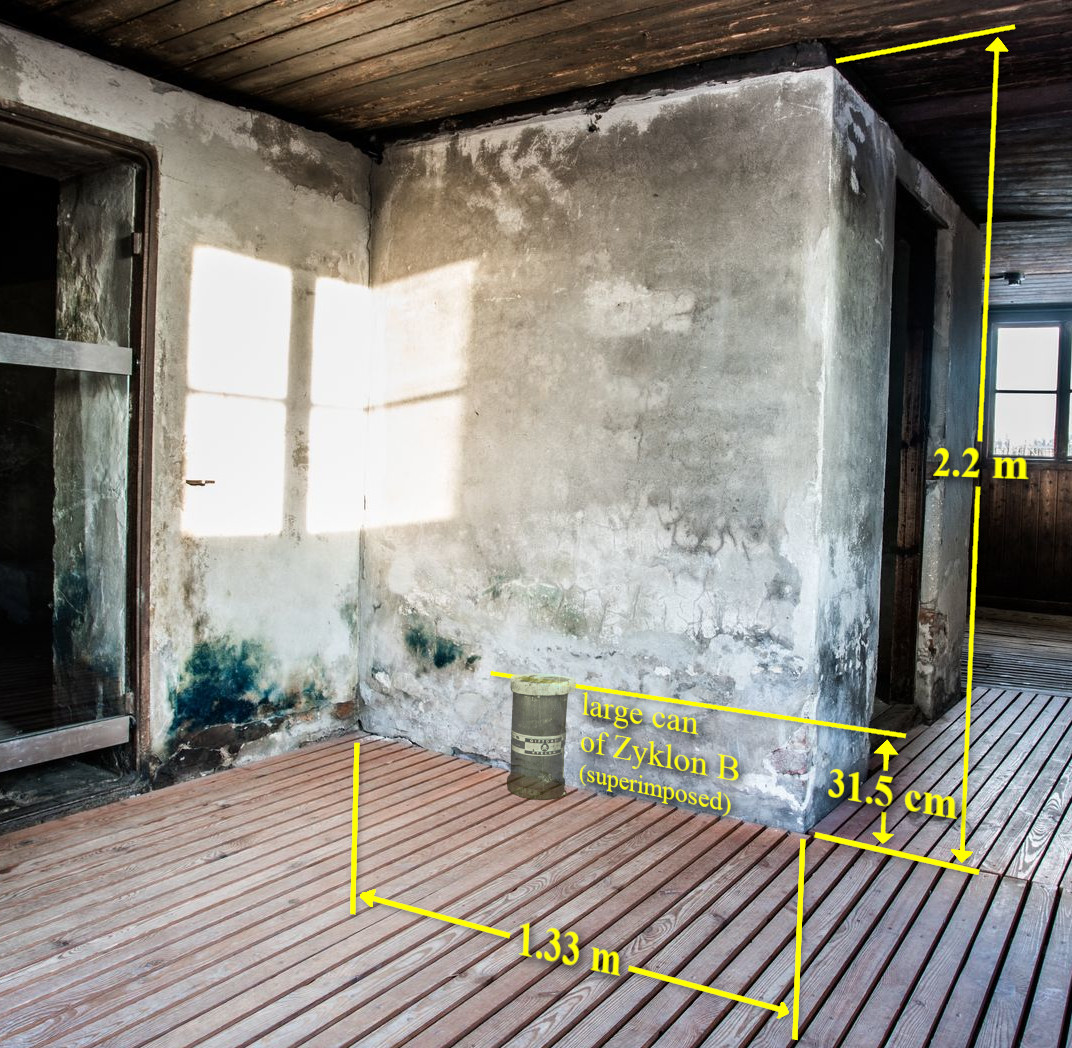
Image
Stubble wrote: Sun Jan 18, 2026 3:49 pm Germar published a paper on the formation of iron blue at the church after the renovation, did he not? I'll see if I can find the paper and link it back. It should be specific about the timetable thus leaving little room for questions.
That would be helpful. As would any other well-documented example.
User avatar
HansHill
Posts: 1346
Joined: Sun Oct 06, 2024 3:06 pm
Location: Arlen, TX

Re: Why did the Soviets continue to use the Majdanek gas chambers postwar?

Post by HansHill »

Cross-posting for continuity:

viewtopic.php?p=21140#p21140
W
Wetzelrad
Posts: 534
Joined: Wed Feb 26, 2025 6:35 am

Re: Why did the Soviets continue to use the Majdanek gas chambers postwar?

Post by Wetzelrad »

Since I'm not an expert on chemistry or building materials, I'll allow that some of my ideas could be off. But, to my knowledge, delayed Prussian Blue formation is not something that anyone on either side of this debate has attempted to deal with, with the exception of the two incidents quoted by HansHill. For that reason I'm inclined to disregard the idea entirely. Slob's quotation from Grok is helpful here because it makes two points:

1) Prussian Blue is a stable compound. The only way for it to form is by the presence of unstable cyanides. It is very unlikely that unstable cyanides would linger inside a wall in significant amounts.

2) It makes a misleading claim, no doubt derived from anti-revisionist literature, that Prussian Blue only has shallow penetration. In other words, anti-revisionists of the past rejected the idea of wall penetration. Therefore to make the argument that HansHill has made they will have to contradict some of their own past arguments.

If delayed PB formation is chemically possible, then it has implications for every gas chamber location, so it should have entered the debate a long time ago.
W
Wetzelrad
Posts: 534
Joined: Wed Feb 26, 2025 6:35 am

Re: Why did the Soviets continue to use the Majdanek gas chambers postwar?

Post by Wetzelrad »

Let's put the delayed PB formation theory aside. I was hoping someone on the other team would give their thoughts on what happened here. Did the occupants on or after 1946 try using this building explicitly called a "disinfestation facility" for its intended purpose of disinfestation? Doesn't this demonstrate a severe lack of respect and belief in the claim that it was used to gas thousands if not hundreds of thousands of people?
b
bombsaway
Posts: 1642
Joined: Sun Sep 29, 2024 2:23 am

Re: Why did the Soviets continue to use the Majdanek gas chambers postwar?

Post by bombsaway »

Wetzelrad wrote: Thu Jan 22, 2026 8:47 pm Let's put the delayed PB formation theory aside. I was hoping someone on the other team would give their thoughts on what happened here. Did the occupants on or after 1946 try using this building explicitly called a "disinfestation facility" for its intended purpose of disinfestation? Doesn't this demonstrate a severe lack of respect and belief in the claim that it was used to gas thousands if not hundreds of thousands of people?
I think it's unlikely the chambers were used for disinfection or homicidal purposes after Soviet capture. Maybe they were fumigated after 44 or the stains took some time to form (the confusion here evinces the kinetics of PB formation are far from settled)

Likely there wasn't a lack of respect, just a general apathy to honest historical inquiry that drove policy around these sites in the post-war period. Within the USSR I don't believe historians were writing very much about the Holocaust, the textbooks were very vague on the details here, it was enough to say the Nazis had death camps which killed millions and in the repressive environment this wouldn't have been questioned. Jewish centered extermination camps, on the other hand, were inconvenient for authorities so they blatantly neglected this aspect of the history, generalizing the killing.
User avatar
Stubble
Posts: 2997
Joined: Sun Dec 08, 2024 10:43 am
Location: 5th Circle of Hell

Re: Why did the Soviets continue to use the Majdanek gas chambers postwar?

Post by Stubble »

bombsaway wrote: Fri Jan 23, 2026 2:17 am
Within the USSR I don't believe historians were writing very much about the Holocaust, the textbooks were very vague on the details here, it was enough to say the Nazis had death camps which killed millions and in the repressive environment this wouldn't have been questioned.
Ladies and gentlemen, for your consideration, I give you, 'The Black Book of Soviet jewry'

https://archive.org/details/TheBlackBookOfSovietJewry

Written by the jewish bolshevik propagandist that brought you other jewels like 'kill'...
Spoiler
ImageHere are excerpts from three letters found on dead Germans. Inspector Reinhardt wrote to Lieutenant Otto Schirach: "[...] I have found six Russians in the area. They last far longer than Frenchmen. Only one of them has died. [...] Their upkeep costs nothing and we must not tolerate that these animals, whose children are possibly killing our children right now, get to eat German bread. Yesterday I whipped lightly two Russian beasts who secretly drunk up skim milk meant for pigs [...]" A certain Otto Essmann wrote to Lieutenant Helmut Wiegand: "We now have some Russian prisoners of war. These fellows feed on worms by the airstrip and throw themselves at buckets of dirty water. I have seen them eating weeds. It is hard to believe that these are human beings..." Slavers - they would like to enslave our people. They take some Russians home, mistreat them, make them lose their wits by hunger, to the point that they eat grass and worms, and then a repulsive German with a stinking cigar can philosophise: "Are these perhaps human beings?" We know everything. We remember everything. We have understood: Germans are not human beings. Henceforth the word German means to us the most terrible curse. From now on the word German will trigger your rifle. We shall not speak any more. We shall not get excited. We shall kill. If you have not killed at least one German a day, you have wasted that day. If you think that instead of you, the man next to you will kill him, you have not understood the threat. If you do not kill the German, he will kill you. If you cannot kill your German with a bullet, kill him with your bayonet. If there is calm on your part of the front, if you are waiting for the fighting, kill a German before combat. If you leave a German alive, the German will hang a Russian and rape a Russian woman. If you kill one German, kill another - there is nothing more amusing for us than a heap of German corpses. Do not count days; do not count miles. Count only the number of Germans you have killed. Kill the German - this is your old mother's prayer. Kill the German - this is what your children beseech you to do. Kill the German - this is the cry of your Russian earth. Do not waver. Do not let up. Kill."
Edit: I made a slip up, I capitalized jew...

My bad.
Last edited by Stubble on Fri Jan 23, 2026 4:47 am, edited 1 time in total.
If I were to guess why no t4 personnel were chosen to perform gassing that had experience with gassing, it would be because THERE WERE NONE.
b
bombsaway
Posts: 1642
Joined: Sun Sep 29, 2024 2:23 am

Re: Why did the Soviets continue to use the Majdanek gas chambers postwar?

Post by bombsaway »

Stubble wrote: Fri Jan 23, 2026 2:41 am
Ladies and gentlemen, for your consideration, I give you, 'The Black Book of Soviet Jewry'

This is funny because Wetzelrad asked about the Soviets, which I assume refers to government officials.

The government at large had this reaction to the BIg Black Book
The book was partially printed in the Soviet Union by the state Yiddish publisher Der Emes; however, the entire edition, the typefaces, as well as the manuscript, were destroyed. First the censors ordered changes in the text to conceal the specifically anti-Jewish character of the atrocities and to downplay the role of some Ukrainians who worked as Nazi police officers. In 1948 the Soviet edition of the book was scrapped completely. The collection of original documents that Ehrenburg handed down to the Vilnius Jewish Museum after the war was secretly returned to him upon the Museum's termination in 1948.[6] The JAC was also disbanded, its members purged at the outset of the state campaign against the "rootless cosmopolitans".[7]
You've studied the Holocaust for a long time and still don't understand the government was ideologically oppositional to a fundamental aspect of the orthodox narrative, which is that Jews were specifically targeted.

Do you want me to make a separate thread about this?
User avatar
Stubble
Posts: 2997
Joined: Sun Dec 08, 2024 10:43 am
Location: 5th Circle of Hell

Re: Why did the Soviets continue to use the Majdanek gas chambers postwar?

Post by Stubble »

That discussion should go in another thread as not to derail this one, yes.

Regardless, The Soviet Black Book of jewry was written by a literal jewish bolshevik propagandist.

I'll grant that he wasn't an historian. He was, a propagandist...
Spoiler
yes, I'm aware that the Soviet didn't like 'the jews' hogging their atrocity propaganda as they didn't want it to be ethnic
If I were to guess why no t4 personnel were chosen to perform gassing that had experience with gassing, it would be because THERE WERE NONE.
b
bombsaway
Posts: 1642
Joined: Sun Sep 29, 2024 2:23 am

Re: Why did the Soviets continue to use the Majdanek gas chambers postwar?

Post by bombsaway »

Stubble wrote: Fri Jan 23, 2026 4:44 am That discussion should go in another thread as not to derail this one, yes.

Regardless, The Soviet Black Book of jewry was written by a literal jewish bolshevik propagandist.

I'll grant that he wasn't an historian. He was, a propagandist...
Spoiler
yes, I'm aware that the Soviet didn't like 'the jews' hogging their atrocity propaganda as they didn't want it to be ethnic
Yes, and his superiors liked everything he said except for the Holocaust related stuff. This is the point you're ignoring. I'll make another thread if you're interested enough in the conversation. Last time I did that you didn't really follow up with the conversation. It might be a ploy to get out of defending a point that you don't really want to.
User avatar
Stubble
Posts: 2997
Joined: Sun Dec 08, 2024 10:43 am
Location: 5th Circle of Hell

Re: Why did the Soviets continue to use the Majdanek gas chambers postwar?

Post by Stubble »

I'm not ignoring it, I'm pointing at him and a literal atrocity propaganda book he penned.

How is this, we can leave it here and say 'Soviet State Policy was that the hitlerite fascist barbarian animals murdered innocent flowers of the Russian people who didn't do nuffin''.

Or we can go around the circle in another thread.

Whatever thread I'm being accused of abandoning, please bump it and I will pay my due.
If I were to guess why no t4 personnel were chosen to perform gassing that had experience with gassing, it would be because THERE WERE NONE.
b
bombsaway
Posts: 1642
Joined: Sun Sep 29, 2024 2:23 am

Re: Why did the Soviets continue to use the Majdanek gas chambers postwar?

Post by bombsaway »

Stubble wrote: Fri Jan 23, 2026 4:55 am I'm not ignoring it, I'm pointing at him and a literal atrocity propaganda book he penned.

How is this, we can leave it here and say 'Soviet State Policy was that the hitlerite fascist barbarian animals murdered innocent flowers of the Russian people who didn't do nuffin''.

Or we can go around the circle in another thread.

Whatever thread I'm being accused of abandoning, please bump it and I will pay my due.
That's fair but I would add to that, they were also oppositional - not just neutral - to the narrative that the Jews were specially targeted in this killing campaign.

If you're ok with this we can end it here, if not make a new thread about it, since you were the one who initially diverted with your mention of Ehrenburg.

The post you did not reply to is here

https://codohforum.com/viewtopic.php?p=20268#p20268
Post Reply