HansHill wrote: ↑Sun Jan 18, 2026 3:36 pm
To play devil's advocate here: do we know which month in 1946 this photo was taken?
I haven't been able to find any data on the photo. The museum may have simply guessed that it's from 1946 because 1946 is the year the roof was damaged enough that they decided to replace it.
HansHill wrote: ↑Sun Jan 18, 2026 3:36 pm
And do we have any subsequent photos, for example 1947 onwards?
None that I've been able to find.
HansHill wrote: ↑Sun Jan 18, 2026 3:36 pm
It it could be the case that fumigations genuinely did finish in 1944, and the PB formation was not apparent until mid / late 1946.
I'm highly skeptical of this. I'm not aware of delayed formation in any of the other known blue stained gas chamber locations. If this is really possible, I would expect at least to have seen
growth in a blue stain in some location, but as far as I'm aware no one has ever found a difference between historical photographs like this.
The examples you share from TCOA are not very useful since they're only described vaguely. It is not said when the stains at the Protestant church first appeared, just when they caused "excitement". That was in the "spring". Since construction projects tend to proceed slowly in general, we might imagine that the stains were actually noticed long before that but the plastering experts took their time in returning. Even ignoring that possibility, there is a minimum of merely two months between the fumigation and the excitement. Lastly, the church was freshly plastered and then fumigated, quite different from a concrete building that was fumigated repeatedly for years, then left alone and unaltered for years.
The case of the farm building is more interesting because of the huge time gap that is asserted, but it really demands a source and more information before making comparisons on a detail like this. And again it was plastered and then painted, quite different from Majdanek.
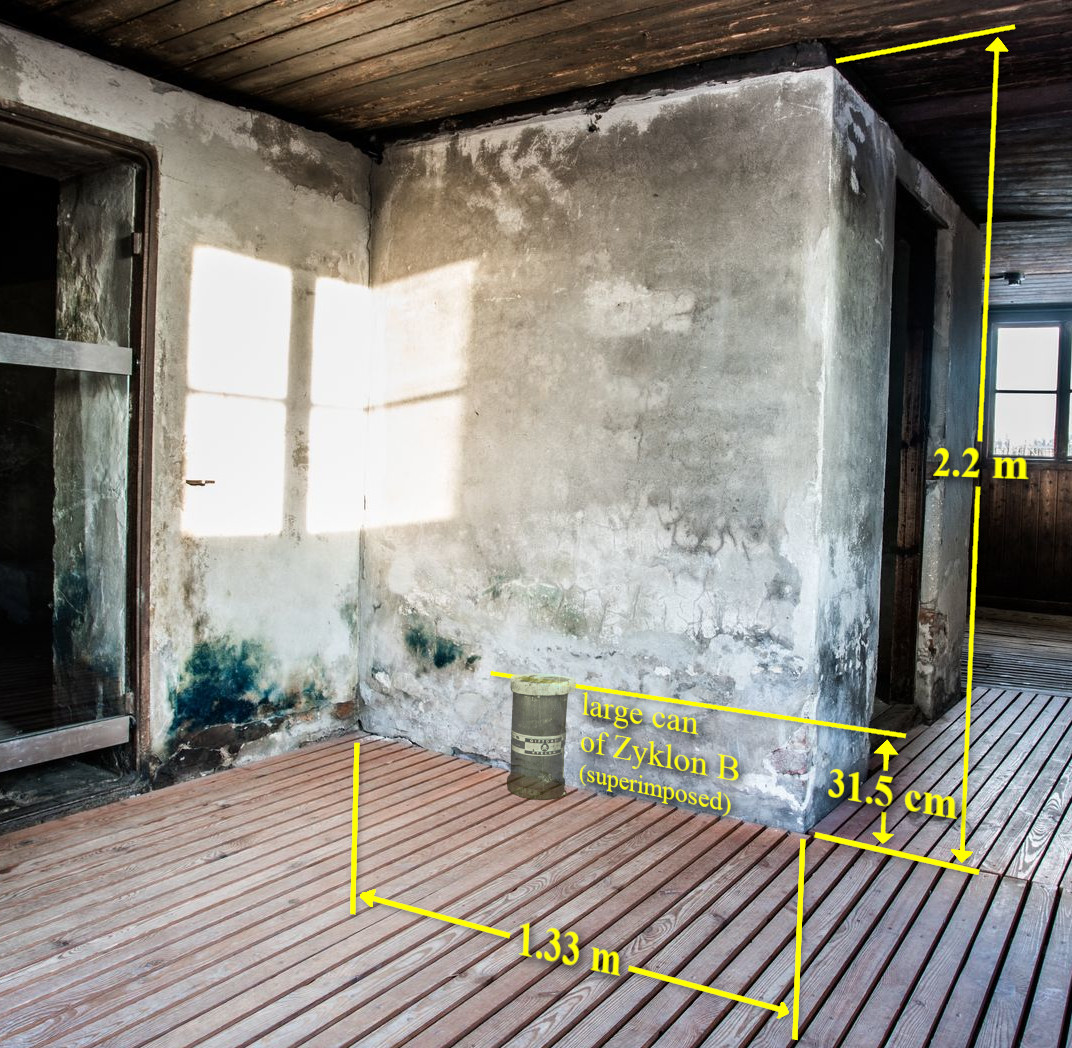
Moreover, these stains at Majdanek are localized to a very small area right outside the gas chamber doorway -- as if someone had placed an open can of Zyklon there. See image for my proposal. It is not as if the cyanide was slowly making its way through the wall by diffusion because there is no
matching stain on the interior of either of these walls, and cell 14 isn't even a gas chamber.
Stubble wrote: ↑Sun Jan 18, 2026 3:49 pm
Germar published a paper on the formation of iron blue at the church after the renovation, did he not? I'll see if I can find the paper and link it back. It should be specific about the timetable thus leaving little room for questions.
That would be helpful. As would any other well-documented example.


 Here are excerpts from three letters found on dead Germans. Inspector Reinhardt wrote to Lieutenant Otto Schirach: "[...] I have found six Russians in the area. They last far longer than Frenchmen. Only one of them has died. [...] Their upkeep costs nothing and we must not tolerate that these animals, whose children are possibly killing our children right now, get to eat German bread. Yesterday I whipped lightly two Russian beasts who secretly drunk up skim milk meant for pigs [...]" A certain Otto Essmann wrote to Lieutenant Helmut Wiegand: "We now have some Russian prisoners of war. These fellows feed on worms by the airstrip and throw themselves at buckets of dirty water. I have seen them eating weeds. It is hard to believe that these are human beings..." Slavers - they would like to enslave our people. They take some Russians home, mistreat them, make them lose their wits by hunger, to the point that they eat grass and worms, and then a repulsive German with a stinking cigar can philosophise: "Are these perhaps human beings?" We know everything. We remember everything. We have understood: Germans are not human beings. Henceforth the word German means to us the most terrible curse. From now on the word German will trigger your rifle. We shall not speak any more. We shall not get excited. We shall kill. If you have not killed at least one German a day, you have wasted that day. If you think that instead of you, the man next to you will kill him, you have not understood the threat. If you do not kill the German, he will kill you. If you cannot kill your German with a bullet, kill him with your bayonet. If there is calm on your part of the front, if you are waiting for the fighting, kill a German before combat. If you leave a German alive, the German will hang a Russian and rape a Russian woman. If you kill one German, kill another - there is nothing more amusing for us than a heap of German corpses. Do not count days; do not count miles. Count only the number of Germans you have killed. Kill the German - this is your old mother's prayer. Kill the German - this is what your children beseech you to do. Kill the German - this is the cry of your Russian earth. Do not waver. Do not let up. Kill."