Interesting inputs, thanks
One other part of the same video you took a section of to make a shorter video, Recall he was standing in front of the B1 gas chamber telling the audience that B1 was not a Zyklon B gas chamber with this sign literally staring him in the face 2 ft away.
Majdanek this and that
- Fred Ziffel
- Posts: 331
- Joined: Sun Dec 01, 2024 11:02 am
Re: Majdanek this and that
- Attachments
-
- Maj gas chamber sign.JPG (194.56 KiB) Viewed 428 times
I do not believe anything one is not allowed to question
Re: Majdanek this and that
Yeah, their own revisionism constantly comes into conflict with their own exhibits. This article, which until recently was part of their website but now returns a 404 error, also contradicts Mrozik's tour.
Article: B1 has "evidence of iron cyanide compounds" and "an opening for adding Zyklon B"
Mrozik: B1 has no "blue stains left by Zyklon B" and "not Zyklon B but carbon monoxide was used"
Sign: "the victims were killed with Zyklon B supplied through a hole in the ceiling"
But perhaps now is a good time to browse their updated website. One thing that jumps out to me is this page which lists off barracks. It describes Barrack 52, which is where the Soviets reported finding Zyklon B and carbon monoxide, as "warehouses for tools and cleaning equipment". So the Germans did not store the poison gas next to the bullets or the phenol or any other homicidal devices, but in with sanitation equipment like we would expect. I wonder how many inmates had access to this building and knew what was inside it.
There could be some interesting materials in the published archives on their website. I read through the camp document collection. There's an announcement about the establishment of the post office, a follow-up requesting a Polish-speaking censor, an order for one bottle of rum/spirits to be added to (guards'?) rations for the month, complaints about excessive coal consumption and other broken rules, and more like these.
One document from 6 January 1943 describes quarantine procedures. Part of it, pertaining to civilian construction workers, reads:
Article: B1 has "evidence of iron cyanide compounds" and "an opening for adding Zyklon B"
Mrozik: B1 has no "blue stains left by Zyklon B" and "not Zyklon B but carbon monoxide was used"
Sign: "the victims were killed with Zyklon B supplied through a hole in the ceiling"
But perhaps now is a good time to browse their updated website. One thing that jumps out to me is this page which lists off barracks. It describes Barrack 52, which is where the Soviets reported finding Zyklon B and carbon monoxide, as "warehouses for tools and cleaning equipment". So the Germans did not store the poison gas next to the bullets or the phenol or any other homicidal devices, but in with sanitation equipment like we would expect. I wonder how many inmates had access to this building and knew what was inside it.
There could be some interesting materials in the published archives on their website. I read through the camp document collection. There's an announcement about the establishment of the post office, a follow-up requesting a Polish-speaking censor, an order for one bottle of rum/spirits to be added to (guards'?) rations for the month, complaints about excessive coal consumption and other broken rules, and more like these.
One document from 6 January 1943 describes quarantine procedures. Part of it, pertaining to civilian construction workers, reads:
This probably refers to B42, which was completed by the winter of 1942, and which did have the ability to delouse clothing within hours in its temperature chambers. Civilian delousing is an angle we haven't talked about before. Note how the civilians are deloused before entering, not after exiting for the day. Evidently the Germans were more concerned about typhus getting into than out of the camp.All civilian workers receive their identification tags as before and proceed to the delousing area; they hand in their own clothing—bundled together—and attach their identification tags to the surrendered garments. The civilian workers are then immediately taken to bathe and receive the undergarments and clothing provided by the administration. After work ends, the workers get back their own clothes and mark the issued items with their identification tags.
- Fred Ziffel
- Posts: 331
- Joined: Sun Dec 01, 2024 11:02 am
Re: Majdanek this and that
Interesting!
I wonder if the Polish construction contractors workers were subject to the same delousing procedures when they showed up for work at Majdanek?
I wonder if the Polish construction contractors workers were subject to the same delousing procedures when they showed up for work at Majdanek?
I do not believe anything one is not allowed to question
- Fred Ziffel
- Posts: 331
- Joined: Sun Dec 01, 2024 11:02 am
Re: Majdanek this and that
#7 of the Majdanek photo guide is up on Themtube
4 points:
I did not know there were so many dogs at Majdanek by the size of the kennel
What was that pile of coal doing there? Staging area for the cremation facility? Ovens were coke fire units
The soviets making a new gate and relocating the little guard house.
A horse drawn wagon. Is this the one the inmates working at the crem pulled?
Link to video:
4 points:
I did not know there were so many dogs at Majdanek by the size of the kennel
What was that pile of coal doing there? Staging area for the cremation facility? Ovens were coke fire units
The soviets making a new gate and relocating the little guard house.
A horse drawn wagon. Is this the one the inmates working at the crem pulled?
Link to video:
I do not believe anything one is not allowed to question
Re: Majdanek this and that
Presumably this was the most convenient place to store coal for the whole camp, and of course the cart was how they delivered it on a daily basis.Fred Ziffel wrote: ↑Mon Sep 07, 2026 2:06 pm What was that pile of coal doing there? Staging area for the cremation facility? Ovens were coke fire units
One of the photos of the coal field is also hosted here on their website. Evidently the photo faces east and, once you know what you're looking at, it's clear there's actually several huge piles of coal there.
The coal piles also appear in the September 1944 aerial photo, and the dirt paths around them indicate pretty heavy traffic in that area.
Relating to this is the coal document (p.13) I previously mentioned. It doesn't get much into specifics, but it does tell us that coal was rationed and distributed.
Spoiler
Concerning matters of January 23, 1944.
[...]
1.) Coal Distribution [Kohlen-Ausgabe].
Coal consumption in the last 4 weeks has been so high that further consumption at this level is impossible. It must be repeatedly observed that heating is often done recklessly, so that fires are to be feared.
The administration has drawn up a distribution plan for the purpose of coal rationing [Kohlenrationierung]. In the future, the individual departments will only receive the amount of coal to which they are entitled according to the distribution plan [Ausgabeplan], which is to be received daily.
The reception times are set as follows:
All departments incl. kitchens and the SS-Totenkopfsturmbann (excluding the protective custody camp): from 9 a.m. to 1 p.m.,
Department III: from 1:00 p.m. to 2:00 p.m.
The scheduled times must be strictly adhered to so that the distribution of coal can proceed in an orderly manner.
[...]
1.) Coal Distribution [Kohlen-Ausgabe].
Coal consumption in the last 4 weeks has been so high that further consumption at this level is impossible. It must be repeatedly observed that heating is often done recklessly, so that fires are to be feared.
The administration has drawn up a distribution plan for the purpose of coal rationing [Kohlenrationierung]. In the future, the individual departments will only receive the amount of coal to which they are entitled according to the distribution plan [Ausgabeplan], which is to be received daily.
The reception times are set as follows:
All departments incl. kitchens and the SS-Totenkopfsturmbann (excluding the protective custody camp): from 9 a.m. to 1 p.m.,
Department III: from 1:00 p.m. to 2:00 p.m.
The scheduled times must be strictly adhered to so that the distribution of coal can proceed in an orderly manner.
The same document above also has a paragraph about horse-drawn carriages.Fred Ziffel wrote: ↑Mon Sep 07, 2026 2:06 pm A horse drawn wagon. Is this the one the inmates working at the crem pulled?
Spoiler
3.) Travel Orders for Horse-Drawn Carts.
From now on, horse-drawn carts may no longer leave the camp for the city, etc., without a travel order. I have delegated the issuing of travel orders to the head of administration.
From now on, horse-drawn carts may no longer leave the camp for the city, etc., without a travel order. I have delegated the issuing of travel orders to the head of administration.
Re: Majdanek this and that
The Majdanek Museum seems to be adding more to their online archives over time. They are now up to 72 files just in the camp administration category.
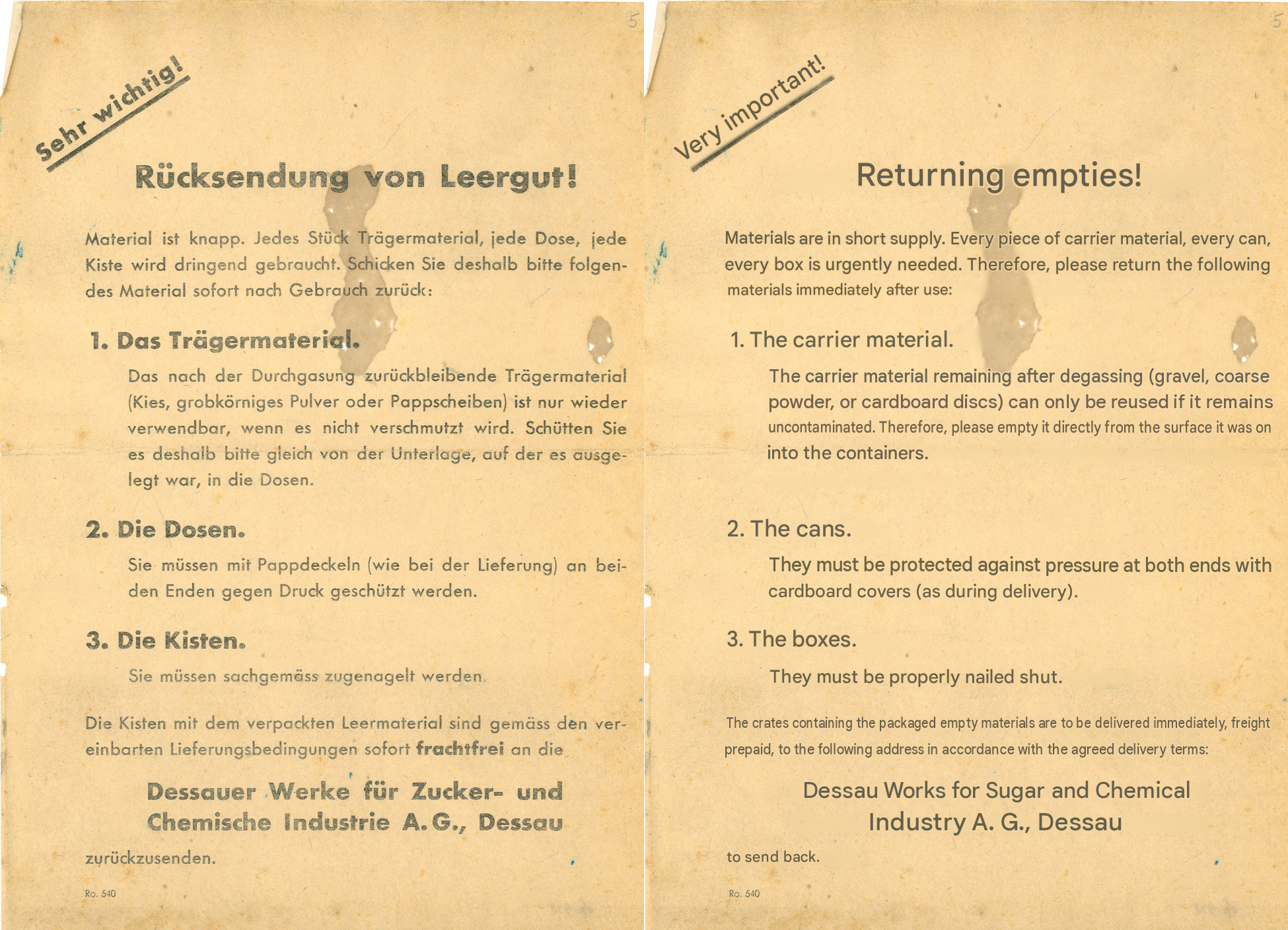
One file is a collection of documents relating to Zyklon B, including labels and shipping info, apparently dating to 10 July 1944, just two weeks before the Red Army arrived. Among them is a paper giving directions on how to return empty cans plus pellets for recycling, deemed "very important!" Not only that, this act of return is described as being in the "delivery terms", so it was evidently mandatory.
This is relevant to gassing claims generally because it could not be followed if the pellets were contaminated with human waste, or water, or otherwise disposed of. I am aware of no gassing witness with even the faintest hint of knowledge that cans and pellets had to be returned.
Here is the full text and the scan, translated.
The same file also has some scribbled handwritten pages that someone ought to take a look through. I see the word "Gasmaske" at the top of the first.
There are several files on prisoner jobs. One of them has a bunch of pages on daily work crews. I see nothing in there about cremation or gassing, though there must have been a cremation unit at one time.
I'm only scratching the surface of what they've uploaded.
One file is a collection of documents relating to Zyklon B, including labels and shipping info, apparently dating to 10 July 1944, just two weeks before the Red Army arrived. Among them is a paper giving directions on how to return empty cans plus pellets for recycling, deemed "very important!" Not only that, this act of return is described as being in the "delivery terms", so it was evidently mandatory.
This is relevant to gassing claims generally because it could not be followed if the pellets were contaminated with human waste, or water, or otherwise disposed of. I am aware of no gassing witness with even the faintest hint of knowledge that cans and pellets had to be returned.
Here is the full text and the scan, translated.
Spoiler
Very important!
Returning empties!
Materials are in short supply. Every piece of carrier material, every can, every box is urgently needed. Therefore, please return the following materials immediately after use:
1. The carrier material.
The carrier material remaining after degassing (gravel, coarse powder, or cardboard discs) can only be reused if it remains uncontaminated. Therefore, please empty it directly from the surface it was on into the containers.
2. The cans.
They must be protected against pressure at both ends with cardboard covers (as during delivery).
3. The boxes.
They must be properly nailed shut.
The crates containing the packaged empty materials are to be delivered immediately, freight prepaid, to the following address in accordance with the agreed delivery terms:
Dessau Works for Sugar and Chemical Industry A. G., Dessau
to send back.
Ro. 540
Returning empties!
Materials are in short supply. Every piece of carrier material, every can, every box is urgently needed. Therefore, please return the following materials immediately after use:
1. The carrier material.
The carrier material remaining after degassing (gravel, coarse powder, or cardboard discs) can only be reused if it remains uncontaminated. Therefore, please empty it directly from the surface it was on into the containers.
2. The cans.
They must be protected against pressure at both ends with cardboard covers (as during delivery).
3. The boxes.
They must be properly nailed shut.
The crates containing the packaged empty materials are to be delivered immediately, freight prepaid, to the following address in accordance with the agreed delivery terms:
Dessau Works for Sugar and Chemical Industry A. G., Dessau
to send back.
Ro. 540
The same file also has some scribbled handwritten pages that someone ought to take a look through. I see the word "Gasmaske" at the top of the first.
There are several files on prisoner jobs. One of them has a bunch of pages on daily work crews. I see nothing in there about cremation or gassing, though there must have been a cremation unit at one time.
I'm only scratching the surface of what they've uploaded.