Anybody want to help me out getting granular with this? I ran into a post from ppow over on 'x' today and it's no conformal to what I have established for myself previously, so, I'd like some help going through sources to see if it is accurate. The post;
I'm sure much of this has been gone over previously, but, my recall on where everything is in the handbooks or from.other sources isn't forthcoming.
Anyhow, extra eyes are welcome. Thank you. I'm going to go re read 'TRCOA'.
Auschwitz Transport Records
Auschwitz Transport Records
If I were to guess why no t4 personnel were chosen to perform gassing that had experience with gassing, it would be because THERE WERE NONE.
-
Eye of Zyclone

- Posts: 585
- Joined: Fri Apr 04, 2025 3:12 pm
Re: Auschwitz Transport Records
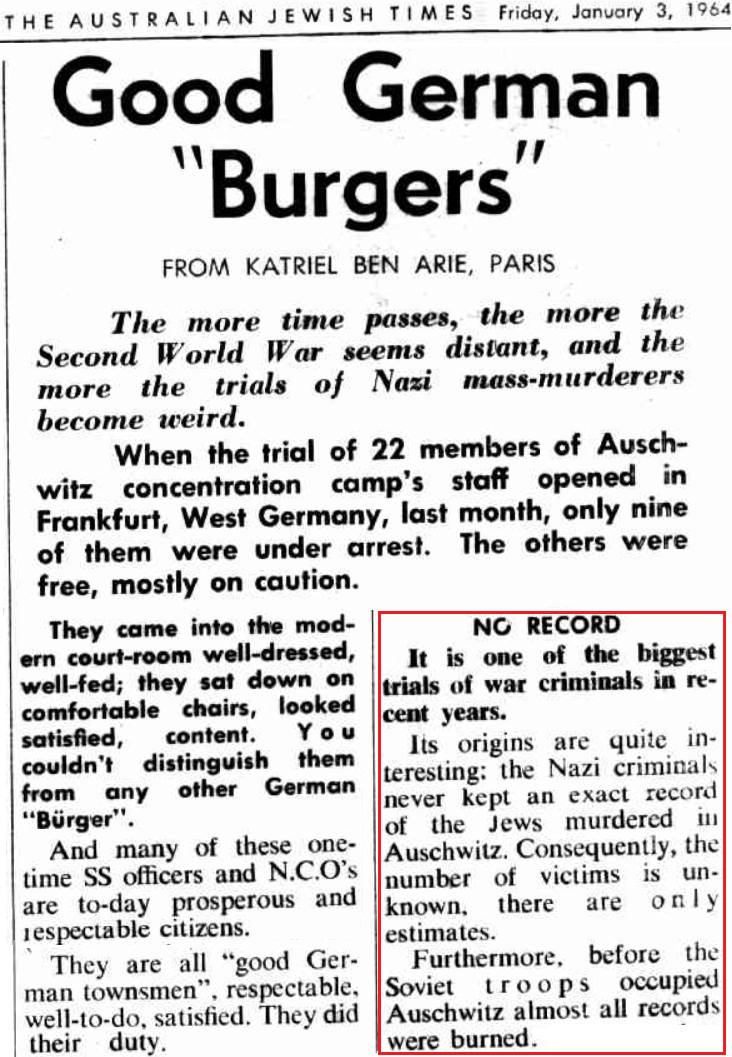
The allegation that the Nazis destroyed most of the incriminating documents is neither more nor less proven than the allegation that the Soviets didn't destroy most of the exonerating documents like the transport records out of the camp with the exception of 317 records for added credibility. Just a matter of political interests and dominant narrative. One fails to see why the Soviets would have kept and stored documents contradicting their own propaganda. The atrocity story of the alleged "Auschwitz murder factory" (Pravda, February 2, 1945) was at the core of Soviet propaganda from day one after all...Stubble wrote: ↑Tue Sep 01, 2026 1:30 am Anybody want to help me out getting granular with this? I ran into a post from ppow over on 'x' today and it's no conformal to what I have established for myself previously, so, I'd like some help going through sources to see if it is accurate. The post;
I'm sure much of this has been gone over previously, but, my recall on where everything is in the handbooks or from.other sources isn't forthcoming.
Anyhow, extra eyes are welcome. Thank you. I'm going to go re read 'TRCOA'.

"Holocaust deniers are very slick people. They justify everything they say with facts and figures."
Re: Auschwitz Transport Records
Fair. Part of the reason I'm digging at this is he says he used Czech's 'Chronicles'. Unless I am mistaken, those lean on Vrba and he just counted cars, so he says. Another reason is that I want to look at source. Access to documents has been widely expanded, and while the transport documents from the archives of Auschwitz itself may have been purged (I haven't located 'roll call sheets' for example) there may have been bills from other sources. These billings were in at least triplicate after all.
If I were to guess why no t4 personnel were chosen to perform gassing that had experience with gassing, it would be because THERE WERE NONE.

Re: Auschwitz Transport Records
Probably the best source would be HH51. It is focused on 1944. Certainly a significant number of Hungarian Jews were transited through and scattered to various camps in Austria and elsewhere. And HH47 and 48 cover the Danuta Czech's work.
https://holocausthandbooks.com/book/pol ... ave-labor/
Revisionists have not presented a full accounting though. Revisionists tend to focus on the deficiencies of the alleged killing and cremation procedure to show that a million people were not killed and cremated at the camp. Tracking outflows is not necessarily as easy as suggested and if the documentation is missing, then it is impossible. Missing documentation as a general phenomenon does not bother Holocaust promoters. They will step right over the trainloads of wood sent daily to the AR camps for which there is no evidence or the huge quantities of coke needed at Auschwitz to cremated all these bodies. Or the missing Zyklon B deliveries. There was interestingly enough a severe Zyklon B shortage corresponding exactly to the Hungarian deportation. The Dessau factory was bombed in spring 1944.
Viktor Frankl is one of the most famous "Auschwitz" survivors, and his book is one of the best-selling Holocaust memoirs of all-time. Yet it turns out he was only in Auschwitz for a few days at most. In Frankl's case it was merely a temporary transit point.
https://holocausthandbooks.com/book/pol ... ave-labor/
Revisionists have not presented a full accounting though. Revisionists tend to focus on the deficiencies of the alleged killing and cremation procedure to show that a million people were not killed and cremated at the camp. Tracking outflows is not necessarily as easy as suggested and if the documentation is missing, then it is impossible. Missing documentation as a general phenomenon does not bother Holocaust promoters. They will step right over the trainloads of wood sent daily to the AR camps for which there is no evidence or the huge quantities of coke needed at Auschwitz to cremated all these bodies. Or the missing Zyklon B deliveries. There was interestingly enough a severe Zyklon B shortage corresponding exactly to the Hungarian deportation. The Dessau factory was bombed in spring 1944.
Viktor Frankl is one of the most famous "Auschwitz" survivors, and his book is one of the best-selling Holocaust memoirs of all-time. Yet it turns out he was only in Auschwitz for a few days at most. In Frankl's case it was merely a temporary transit point.
https://en.wikipedia.org/wiki/Viktor_Fr ... _testimonyIn The Missing Pieces of the Puzzle: A Reflection on the Odd Career of Viktor Frankl, Professor of history Timothy Pytell of California State University, San Bernardino, surveys the numerous discrepancies and omissions in Frankl's "Auschwitz survivor" account and later autobiography, which many of his contemporaries, such as Thomas Szasz, similarly have raised.[33] Frankl's book Man's Search for Meaning devotes approximately half of its contents to describing Auschwitz and the psychology of its prisoners, suggesting a long stay at the death camp. However his wording is contradictory and, according to Pytell, "profoundly deceptive". Contrary to the impression Frankl gives of staying at Auschwitz for months, he was held close to the train in the "depot prisoner" area of Auschwitz, and for no more than a few days. Frankl was neither registered at Auschwitz nor assigned a number there before being sent on to a subsidiary work camp of Dachau, known as Kaufering III. That camp, together with Terezín,[citation needed] is the true setting for much of what is described in his book.
Incredulity Enthusiast
Re: Auschwitz Transport Records
Would illustrating missing documents from single sources by finding secondary sources not be worthwhile? They generated a lot of paperwork, surely some singles exist here and there that were not purged?
I'm also not sure Patrick has accounted for all known outbound here.
Then there are those who were simply processed out of Auschwitz on site, that documentation has gaps as well. Perhaps the Central Archive had more complete records?
Then again, perhaps I'm being naive.
I'm also not sure Patrick has accounted for all known outbound here.
Then there are those who were simply processed out of Auschwitz on site, that documentation has gaps as well. Perhaps the Central Archive had more complete records?
Then again, perhaps I'm being naive.
If I were to guess why no t4 personnel were chosen to perform gassing that had experience with gassing, it would be because THERE WERE NONE.