Spoiler
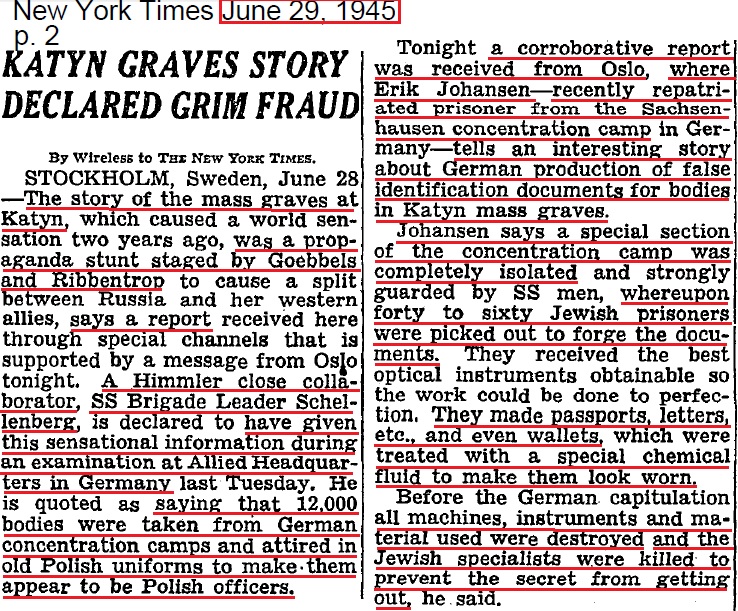
This is not true.
Forged Documents
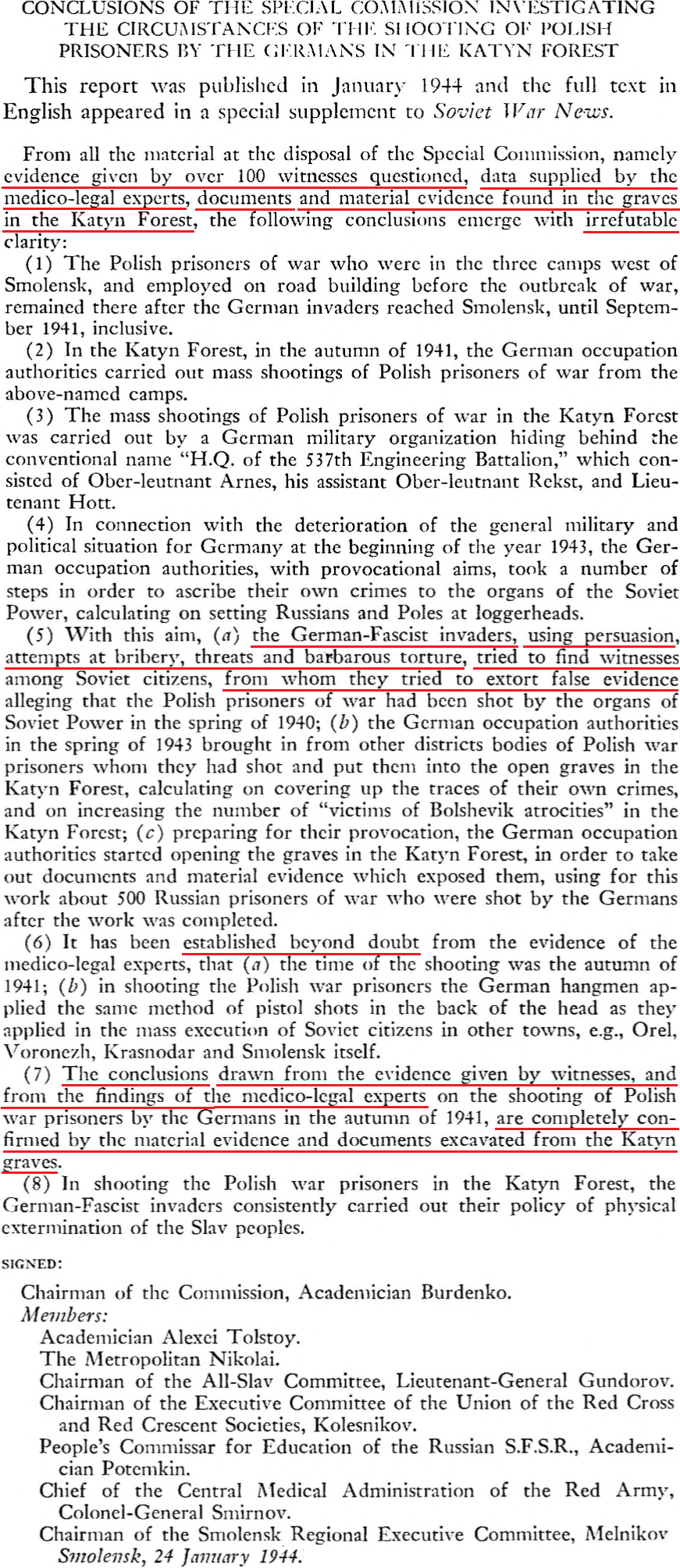
The Soviets did in fact forge multiple documents in connection with the Katyn massacre in order to falsely incriminate the Germans. The executions are now recognized to have occurred in April and May of 1940. The Soviet narrative would obviously require a later timeline, sometime after Barbarossa. This timeline is crucial for understanding the forgeries. The Soviet report on Katyn, USSR-54, cites nine documents supposedly recovered from the bodies and dated later than spring 1940. All of these must necessarily have been forged.
Full English translation of USSR-54: https://www.jrbooksonline.com/cwporter/k1.htm
The last document, number 9, was read to the international press in January 1944 when the Soviets invited them to the Katyn site. W. H. Lawrence of the NYT reported from Smolensk:In addition to the information proven in the documents of the forensic medical report, the time of the shootings of the Polish prisoners of war by the Germans (autumn 1941, not the spring of 1940, as claimed by the Germans), was also established by documents discovered during the excavation of the graves, dating not only from the second half of 1940, but also from the spring and summer (March-June) of 1941.
Among the documents discovered by the forensic experts, the following merit particular attention:
1) on body 92: A letter from Warsaw in the Russian language addressed to the Central Office for Prisoners of War, Moscow, Kuibyshev Street no. 12. In the letter, "Sofia Zigon" inquires the whereabouts of her husband, Thomas Sigon. The letter is dated 12.9.1940. The envelope bears German postage cancellation "Warsaw IX40", and cancellation "Moscow Post Office 9 Expedition 28/IX40", as well a notice written in red ink, in the Russian language, reading "Find camp and deliver 15/XI40" (signature illegible).
2) on body 4: A registered postcard no. 0112 from Tarnopol with cancellation "Tarnopol 12/X40". The manuscript text and address are obliterated.
3) on body 101: Receipt no. 10293 dated 19.XII.1939, issued in camp Koselsk, for pawn of a gold watch accepted by LEVANDOVSKY EDUARD ADAMOVICH. The reverse of this receipt bears a note dated 14 March 1941, stating that the watch had been sold to "Jewelry Trading Trust".
4) on body 46: A receipt issued in Starobelsk camp on 16.XII.1939 for the pawn of a gold watch accepted by ARASZKEVICZ VLADIMIR RUDOLFOVICH. The reverse of the receipt bears a note dated 25 March 1941, stating that the watch had been sold to "Jewelry Trading Trust".
5) on body 71: A devotional image of paper with a picture of Jesus, discovered between pages 144 and 145 of a Catholic prayer book. The reverse of the devotional image bears a legible note with signature "Jadvinja" and date "4 April 1941".
6) on body 46: A receipt issued in camp no. 1ON on 5 May 1941 for the deposit of a sum of money in the amount of 225 rubels accepted by ARASZKEVICZ.
7) on the same body (46): A receipt issued in camp no. 1ON on 6 April 1941 for the deposit of a sum of money in the amount of 102 rubels accepted by ARASZKEVICZ.
8) on body 101: A receipt issued in camp no. 1ON on 18 May 1941 for the deposit of a sum of money in the amount of 175 rubels accepted by LEVANDOVSKY.
9) on body 53: An unforwarded postcard in the Polish language with the address:
Warsaw, Bagatelia 15, house 47,
Irene Kuczinska, date: 20 June 1941.
Sender: Stanislav Kuczinska.
The Russians presented documentary evidence that the prisoners had been alive after March, 1940, and let us read a letter from a Polish prisoner, Stanislaus Kuchinski, written but never mailed to his wife in Warsaw on June 20, 1941, just two days before the German invasion of the Soviet Union began.
USSR-54 also refers to a notebook/diary belonging to Boris Menshagin, the mayor.We saw the body of Kuchinski whose letter to his wife we later read at the commission's office in Smolensk. That letter began "My dear little Sunbeam." The writer expressed his love and affection and gave thanks for the gift recently sent him. It authorized his wife, Irena, to sell his belongings so that she should eat well, and requested her to keep a daily diary for forwarding to him, because he hungered for details of her existence. (NYT, 27 Jan 1944, pg. 3)
This purpose of this notebook was to incriminate the Germans by proving that the Poles were still alive in August 1941. But they weren't alive. Ergo the notebook must have been a forgery.The testimony of Bazilevsky and Jefimow is strengthened by documentary evidence in the form of handwritten notes by MENSHAGIN, in his own handwriting, jotted down in his notebook.
This notebook, containing 17 full pages, was found in the files of the city administration of Smolensk after its liberation. The fact that this notebook belonged to MENSHAGIN, and was also in his handwriting, is confirmed both by the testimony of Bazilevsky, who was well familiar with MENSHAGIN's handwriting, and by graphological reports.
As may be seen from the dates contained in the notebook, the contents concern the period from the early days of August 1941 until November of the same year.
Among the various notes with regards to economic matters (wood, electrical energy, commerce, etc.) there are a number of notes concerning instructions from the commander of Smolensk, made by MENSHAGIN in order not to forget them.
From these notes, it may be clearly seen that the city administration was concerned with a number of matters as the body carrying out all the instructions of the German command.
The first of the three pages of the note book describe the organization of the Ghetto and the system of reprisals to be carried out relating to the Jews.
Page 10, dated 15 August 1941, states: "All escaped Polish prisoners of war are to be arrested and brought to the command post."
Page 15 (without date), states: "Are there any rumours circulating among the populace of shootings of Polish prisoners of war at Kozy Gory (to Umnov)?"
From the initial notes, it may be seen that, on 15 August 1941, the Polish prisoners of war were still in the region of Smolensk, and that they were furthermore being arrested by the German authorities.
The second note proves that the German command, disturbed by the possibility of the existence of rumours among the civilian population about crimes committed by the Germans, gave special instructions to investigate the matter. Umnov, who is mentioned in the note, was chief of the Russian police in Smolensk during the first months of the occupation.
False Witnesses
USSR-54 refers to "the testimonies of the 100 witnesses interrogated by the Commission." These testimonies were necessarily fraudulent. They say for example that they have numerous witnesses that testified the Poles were still alive in September 1941 which we know is not true.
It is also clear the Russians pressured witnesses who'd earlier testified against them. The witness Kiselev (Kiselyoff) had signed a statement for the Germans incriminating the Russians. But he changed his story for the Soviet investigators, claiming the Germans had tortured him to procure his perjured testimony. Witness Zakarov had a similar story.That the Polish prisoners of war remained behind in the camps of the region of Smolensk was confirmed by the testimony of the numerous witnesses, who had seen these Poles in the vicinity of the city of Smolensk in the early months of the occupation until the month of September 1941.
Fraudulent Forensic Claims
The "Forensic Medical Expert Commission" concluded "that the shootings took place during a period approximately 2 years ago, that is, in the months of September-December 1941;" which is of course false, and off by more than a year.
Strangely, they also claim an incorrect number of bodies.
It appears that here they merely took the early figures from German press releases (usually 10,000-12,000). The official German Katyn report listed a lower figure of 4,143 bodies that had been disinterred, and the ultimate number of bodies for this site was only perhaps a couple hundred higher than that. The total number of Polish officers killed was higher than this, but the bodies were not buried at this particular site.The graves were excavated by order of the Special Commission, and in the presence of all members of the Special Commission and the forensic experts. A great number of corpses in Polish uniforms were discovered in the graves. According to the calculations of the forensic experts, the number of corpses amounts, in total, to 11,000.
USSR-54 also mentions "graphological reports" used to authenticate the handwriting on the fake Menshagin diaries.