Hoess's story is inherently anachronistic

For more adversarial interactions
User avatar
Wahrheitssucher
Posts: 849
Joined: Mon May 19, 2025 2:51 pm

Blobel's Flamethrower and the Hoess Chlemno visit

Post by Wahrheitssucher »

bombsaway wrote: Thu Apr 30, 2026 6:17 am …all you guys can do is criticize orthodoxy…
Ha ha ha! :lol: :lol: :lol:

Hilarious.
What an idiotic reply.

TRANSLATION: “How dare anyone apply critical thinking to our jooish, sacrosanct, illogical and deeply non-credible, holocaustal, ‘millions-murdered-by-mass-gassing’ mythology.”

CONCLUSION: Bombsaway is not here for a serious, honest, intelligent discussion.

He is here ONLY to promote the eternal ‘poor, suffering, innocent jooze’ deception.

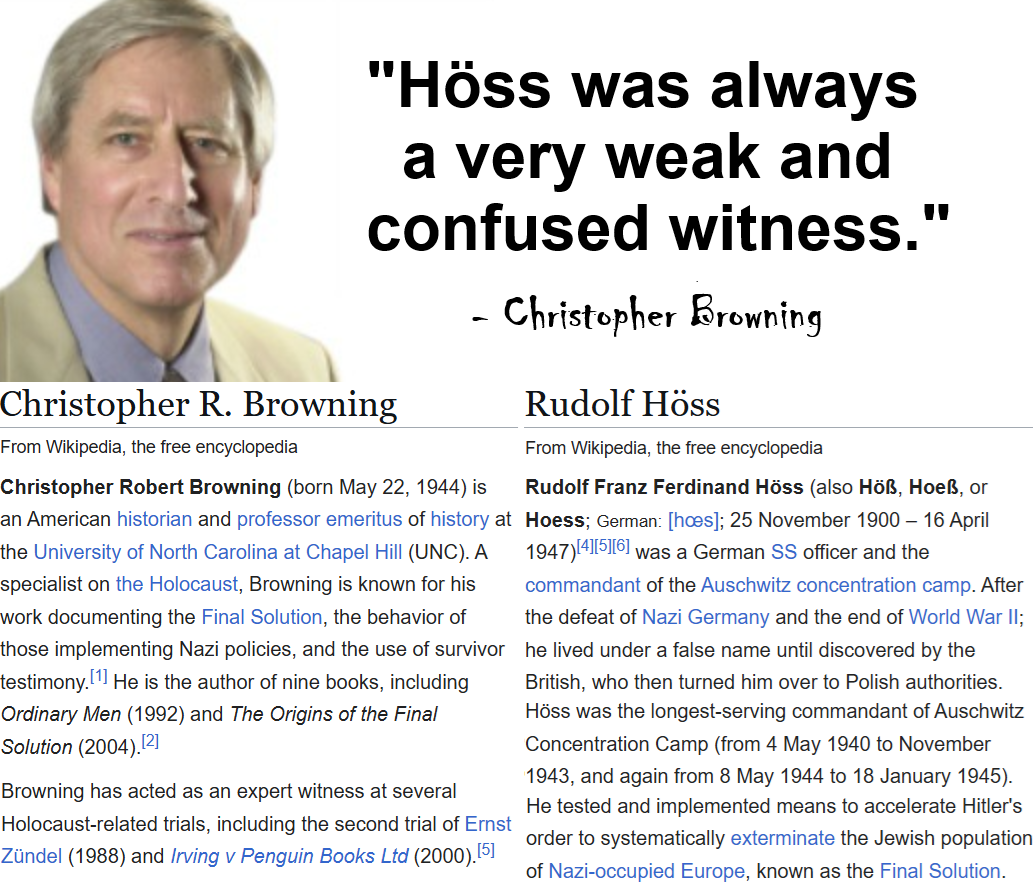
The fact that the coerced testimony of Rudolf Höß is deeply flawed and proves the mass-gassing at Auschwitz story is bollox, is problematic for: a.) all holyH true-believers and for b.) all holyH deceitful promoters.
I think Bombsaway’s replies suggest he is a category b.) person.

REPLY TO THE TROLL:
Yes, Bombsaway, all people who doubt the compulsory, legally protected narrative do apply critical analysis to the holyH’s core parts.
That is completely normal behaviour.
That you suggest that is abberational behaviour proves you are either of low intelligence or are attempting to deceive.
A ‘holocaust’ believer’s problem is not technical, factual, empirical or archeological — their problem is psychological.
b
bombsaway
Posts: 1853
Joined: Sun Sep 29, 2024 2:23 am

Re: Hoess's story is inherently anachronistic

Post by bombsaway »

Archie wrote: Thu Apr 30, 2026 1:16 pm
More AI. Lame.

The problem with that reply is that the official story is still that he did have superior orders. So then that would be accurate, according to current theory, not a distortion for sake "self-exculpation." As I said, it is usually considered a form of Holocaust denial to claim that there wasn't an official top-down policy.

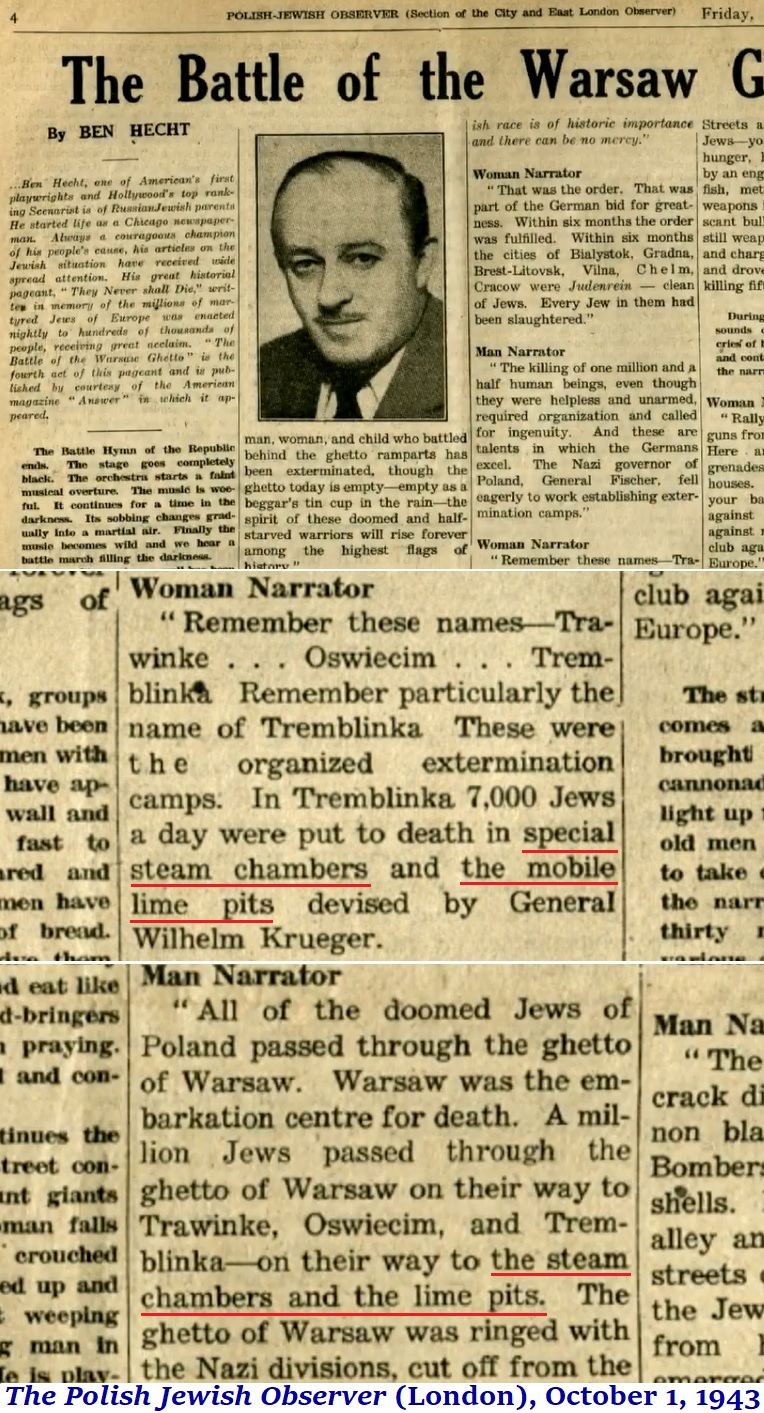
The reason Hoess's testimony "aligns with the narrative" is because the narrative was based on Hoess to a large extent. Details like the 10 gas chambers at Treblinka had already been published in Wiernik in 1944. The basic Auschwitz story is similar to the WRB report and to USSR-8. Hence much of it is regurgitating prior material but from the mouth of the camp commandant, giving it some authority.

The blunders in the statements are simply plot holes. Plot holes are common in made up stories.
Yes but it shows he wasn't the first, which is still important.

Meanwhile your plot holes narrative fails when we see things like his report of a visit to Blobel, where he sees Blobel destroying bodies with a flamethrower. British intercepts show Blobel making a requisition for a flamethrower during this exact period.

This is the kind of stuff you don't touch, you RUN
User avatar
Eye of Zyclone
Posts: 356
Joined: Fri Apr 04, 2025 3:12 pm

Re: Hoess's story is inherently anachronistic

Post by Eye of Zyclone »

bombsaway wrote: Thu Apr 30, 2026 6:35 pm Meanwhile your plot holes narrative fails when we see things like his report of a visit to Blobel, where he sees Blobel destroying bodies with a flamethrower. British intercepts show Blobel making a requisition for a flamethrower during this exact period.
Waw !!! A soldier requisitioning a flamethrower during a war !?! A huge finding !! So incriminating... :roll:

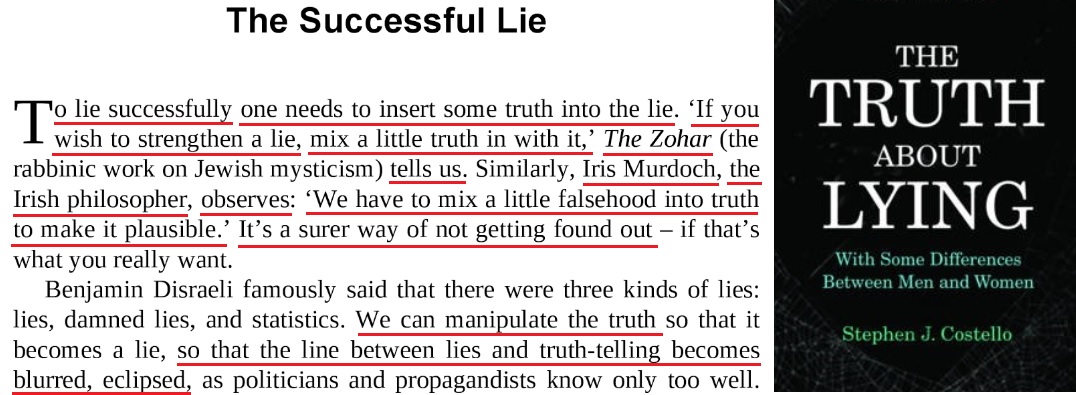
What are the odds that the psychological warriors who wrote the script of Hoess' false confessions didn't spice it up with such verifiable, documented, truthful details in order to make their whole story more credible ??? All good liars know that this is the ABC of a successful lie.

Image
"Holocaust deniers are very slick people. They justify everything they say with facts and figures."
User avatar
Archie
Site Admin
Posts: 1667
Joined: Thu Sep 12, 2024 6:54 am

Re: Hoess's story is inherently anachronistic

Post by Archie »

I have split off a thread for further discussion of the flamethrower thing.
Incredulity Enthusiast
User avatar
HansHill
Posts: 1462
Joined: Sun Oct 06, 2024 3:06 pm
Location: Arlen, TX

Re: Hoess's story is inherently anachronistic

Post by HansHill »

Great thread so far.

Adding some relevant commentary here re the discrepancy in timeline of events, as per Mattogno HH vol 35, section 3:
Spoiler
First of all, we need to look at the date. Höss mentioned repeatedly that the
meeting took place in June, or more generally in the summer of 1941. In his
interrogation on April 1, 1946, he insisted that his summons to Berlin had tak-
en place “before the Russian campaign had started,” “before the date that the
Russian campaign was launched,” which puts it at the first 20 days of June.
However, in the short handwritten statement of March 16, 1946, the meeting
took place “in May 1941.”

In Berlin, Himmler conveyed to the Auschwitz commandant the “Füh-
rerbefehl,” the order to exterminate the Jews – we will see shortly in what
context.

It is a well-known fact that the current orthodox Holocaust narrative tends
to date Höss’s alleged meeting with Himmler a year later, hence in the sum-
mer of 1942, because there are irresolvable anachronistic contradictions for a
date in 1941, which were well-documented by Karin Orth in 1999.

In Höss’s chronology, 1941 is a fundamental year for his reconstruction of
the events, all of which emanate from it. This is not a mere “mistake,” but a
very serious anachronism that all by itself impugns the entire reconstruction.
Here it is worth quoting Steven Paskuly’s incredible comment (his Note 2,
p. 27):

“Contrary to what Richard Breitman contends in The Architect of Genocide,
1991, Höss is not incorrect that it was 1941 that Himmler gave him the order
to prepare for the Final Solution. The evidence that Breitman dismisses is
monumental: the experimental gassings in Auschwitz in September 1941 [see
Section 17]; the gassings at Majdanek by Globocnik in December 1941;[
the reference in the Wannsee Conference minutes to a ‘solution’ having been
found for those unable to work; and the first transport of Silesian Jews
gassed in January 1942 [see Section 21]. These and hundreds of other pieces
of evidence are overlooked by Breitman. Simply put, Breitman is wrong in his
conclusion that it was not until the summer of 1942 that Höss received the or-
der from Himmler.”


These alleged proofs demonstrate exactly that the year 1941 is indispensable
for Höss’s reconstruction, otherwise the execution of the extermination order
in its preliminary stages would precede its issuance
. On the other hand,
Himmler’s order prohibiting the emigration of Jews, which, logically speak-
ing, should precede the supposed extermination, was issued by him only four
months later, on October 23, 1941 (T/394):

“The Reichsführer SS and Head of the German Police has ordered that the
emigration of Jews has to be prevented, effective immediately.”
Paskuly seems to believe that Breitman had advanced his personal hypothesis;
he evidently did not know that experts such as J.-C. Pressac and Robert Jan
van Pelt also favor 1942 as the order year. As for the Auschwitz Museum,
Danuta Czech gave July 29, 1941 as the date (1989, p. 106), hence after the
start of the war against the Soviet Union. In the five-volume history of the
camp, Franciszek Piper still supported 1941 (2000b, p. 60), but in more-recent
studies, the Auschwitz Museum has assumed an ambiguous position, renounc-
ing the supposed meeting in the summer of 1941, yet without indicating a pre-
cise date. Piotr Setkiewicz asserted in this regard (2001, p. 12):
“We do not know exactly when Auschwitz began to be considered as a place
for the mass execution of Jews and as a part of this plan.”
He adds that on July 17, 1942, during his visit to Auschwitz, Himmler ordered
“the acceleration of the operation to exterminate the Jews” (ibid., p. 119). In
2014, Setkiewicz wrote in a work he edited together with Igor Bartosik and
Łukasz Martyniak that on this occasion the Reichsführer SS “gave the orders
to continue expanding the Birkenau camp and intensify the extermination pro-
cess.” A footnote elaborates that “Höss had presumably been informed of
these plans somewhat earlier, because the decision to build bunker II and in-
troduce systematic selection was surely made before Himmler’s July 17-18,
1942 visit”; this decision would have been made “at the beginning of June
1942” (Bartosik et al. 2014, p. 33). Hence, during this period of time, Höss is
said to have received – no one knows from whom, where and under which cir-
cumstances – the infamous “Führerbefehl.” As mentioned earlier, this date
shift to 1942 completely disrupts the whole reconstruction of the genesis and
development of the extermination of the Jews at Auschwitz as laid out in
Höss’s statements
and, historically speaking, in Czech’s Kalendarium. In the
meantime, the historians at the Auschwitz Museum are still busy trying to
come up with a credible alternative explanation as to how the first extermina-
tions were perpetrated without a specific order from Himmler.
Typical Polish wartime and postwar propaganda is Höss’s statement made
during the trial that “among Himmler’s plans was the extermination of Slavic
peoples, primarily the Poles and the Czechs”!
Emphasis mine. It's also worth noting that Mattogno, in this same volume, makes a compelling case for that Hoess' own "knowledge" of the extermination policies and procedures across his various statements, confessions (both handwritten and typeset) along with affidavits, mirror exactly the British "knowledge" of such.

This makes sense from the Revisionist position. This explains for example, how Hoess can casually namedrop an Eastern deathcamp that simply does not exist (“Wolzek”). His interrogators simply did not have much knowledge of Soviet occupied territories to correct him or omit this hilarious fabrication.

User avatar
Eye of Zyclone
Posts: 356
Joined: Fri Apr 04, 2025 3:12 pm

Re: Hoess's story is inherently anachronistic

Post by Eye of Zyclone »

HansHill wrote: Sun May 03, 2026 8:09 pm Emphasis mine. It's also worth noting that Mattogno, in this same volume, makes a compelling case for that Hoess' own "knowledge" of the extermination policies and procedures across his various statements, confessions (both handwritten and typeset) along with affidavits, mirror exactly the British "knowledge" of such.

This makes sense from the Revisionist position. This explains for example, how Hoess can casually namedrop an Eastern deathcamp that simply does not exist (“Wolzek”). His interrogators simply did not have much knowledge of Soviet occupied territories to correct him or omit this hilarious fabrication.
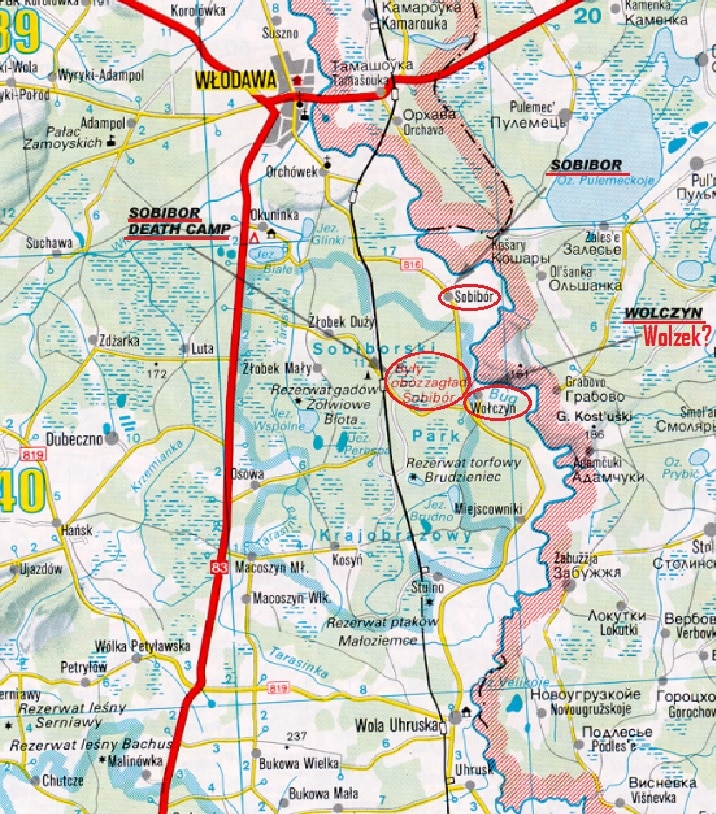
Wolzek was most likely the German-sounding Polish name of the Sobibor transit camp, which was geographically closer to the village of Wolczyn than the village of Sobibor. This tends to show that the Allied psychological warriors who wrote Rudolf Hoess' false confession were in close contact with the Polish government-in-exile in London.

Image
"Holocaust deniers are very slick people. They justify everything they say with facts and figures."
User avatar
HansHill
Posts: 1462
Joined: Sun Oct 06, 2024 3:06 pm
Location: Arlen, TX

Re: Hoess's story is inherently anachronistic

Post by HansHill »

Yes good point Zyclone, that is certainly a possibility. I personally lean more towards Mattogno's explanation:
But this “Wolzek” camp
never existed. Höss or the British and American interrogators who questioned
him did not know it, so this ghost camp also appears in subsequent statements
(April 4, April 5, and May 20, 1946, where Bełżec is confounded with “Bel-
sen”!). The Poles, on the other hand, knew this well already for geographic
reasons, so in Höss’s statements made in Poland, “Wolzek” disappears and
Sobibór takes its place. Van Pelt asserts that “probably Höss referred with
‘Wolzek’ to Sobibor” (van Pelt 2002, Note 6, p. 509), but this does not make
much sense, because these names don’t sound similar, hence it’s unclear how
the two could be confused; in the case of confusion due to assonance, it is
more likely that “Wolzek” was a repeated reference to “Belzek.”

HH Vol 35
The fact that "Belzec" sounds like "Wolzek" due to its suffix, at least to non-Polish speakers, compounded with the fact that "Belzec" was mistakenly referred to as "Belsen" in the early British statements, demonstrates Mattogno's point neatly.

Hoess's knowledge is a mirror of what his captors are likely to have known at the time, not that of a high ranking camp commandant.
Post Reply