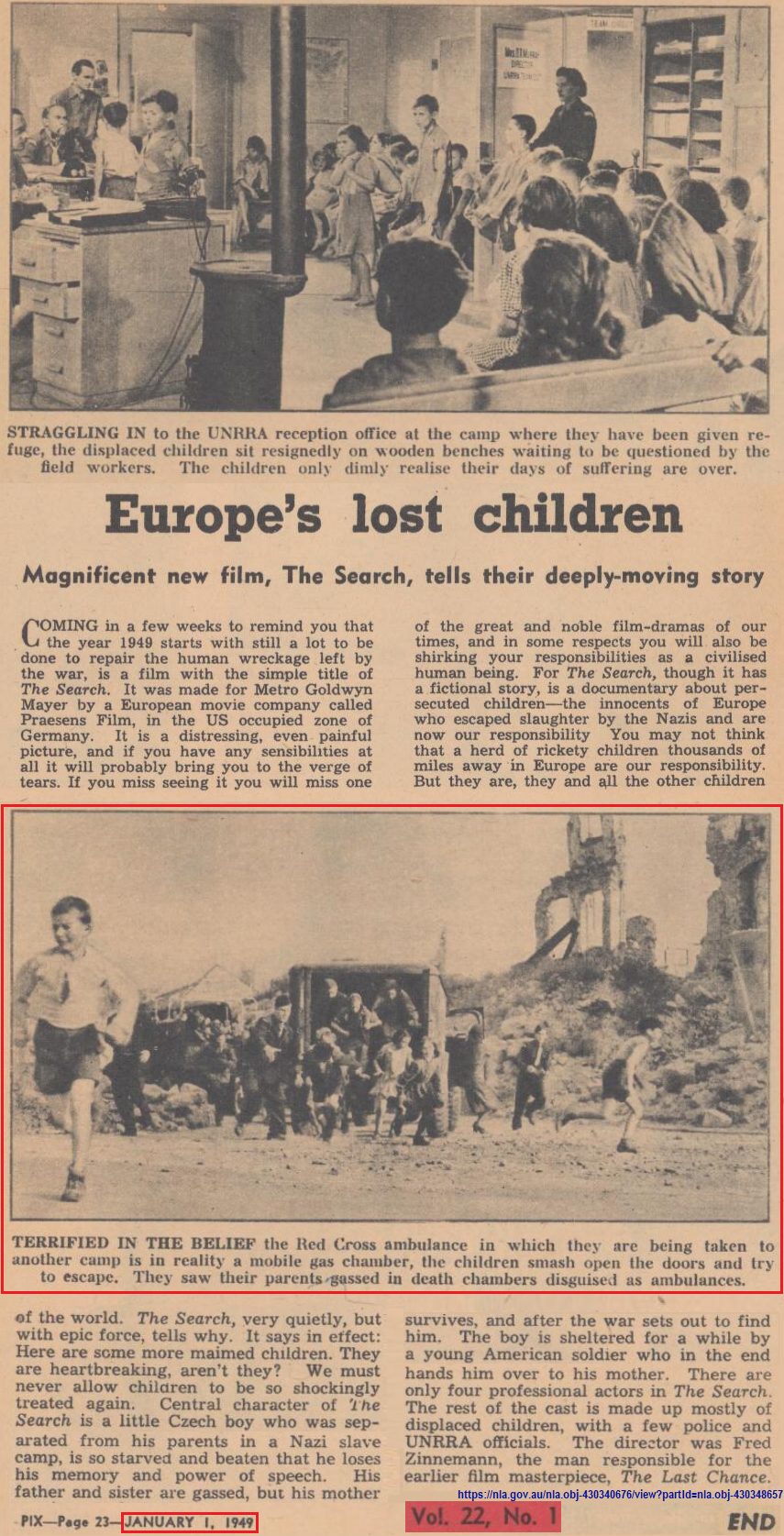
Furthermore, gas vans are not usually associated with Auschwitz. Usually a killing location is said to have used either gas vans or gas chambers, not both, and Auschwitz is very much in the second category.
Therefore it is a remarkably rare and fortuitous event that Benjamin Jacobs (PKA Bronek Jakubowicz) was deliberately shown the driver's compartment of an ambulance gas van in Auschwitz. According to his memoir, this was an ambulance like those driven by other SS doctors, but it had been equipped with a lever in among the other controls with the label "Gas: use only when in motion". In a confession made directly to Jacobs, Auschwitz's 2nd camp dentist Willi Schatz revealed that this lever redirected the vehicle's exhaust into the rear of the vehicle to kill Jews by carbon monoxide poisoning. He himself had operated the vehicle in this way.
Also incredible is that Jacobs remembered Schatz in the context of 1943*, because historians have established that he was assigned to Auschwitz on January 20 or 30, 1944. A strange anachronism.
* Jacobs's memoir does not directly state the date of his meeting Schatz, however, the events of 1943 are described from page 88 until page 152, which was Christmas. 1944 begins on the following page. That is three pages after the Schatz introduction and confession.
Here is the passage from his memoir:
Though described as being "in his midforties", Schatz would actually have been 38 or 39 years old. Though called by "Hauptscharführer", a noncom rank, he was actually an Untersturmführer. Hans Wilhelm Konig was likewise called "Hauptscharführer" despite being an Obersturmführer. The memoir has a lot of these minor mistakes.A few weeks after Dr. [Hans Wilhelm] Konig left, another dentist came to oversee the dental station. Dr. [Willi] Schatz was in his midforties, mild-mannered, friendly, and slightly hunched over. When I recited the camp's required litany, he said that I need not say it for him. Nor did he object to my continuing to treat the guards. But one time he came in very upset. He threw his hat on the chair disgustedly and walked through the dental station, his hand clutched behind his back. "Do you know what they made me do?" he said, looking straight at me, disturbed.
My place was not to reply, but since he looked at me and waited, I said, more out of politeness than curiosity, "What, Herr Hauptscharfuhrer?"
He held out the keys to his ambulance and said, "Go and look at the instrument panel. Then you will see what I mean." His vehicle was parked just a couple of steps from the door. I took his keys and went outside. I opened the driver's door and looked at the instrument panel, which had the usual levers: choke, lights, wipers, heater, and so on. Then I noticed a white lever below with the word Gas on it. Just below that was an inscription: "Achtung, nur im Betrieb gebrauchen" (Caution, use only when in motion). I knew then what it meant.
A shock went through me. I closed my eyes and stepped back. The souls of my mother and my sister were there. Though I knew that these outrageous vehicles existed, seeing one that looked so innocent evoked a new and intolerable pain. It was evidence of the most inhuman and unusual of crimes. It inflicted new and deep wounds. I stood transfixed a while until I regained my composure. The shock of this incident may be at the heart of this book.
I tried to conceal my outrage when I returned. I thought it would be best not to say that I understood what he meant. Although I thought his disgust was real, I could not allow myself to agree with him openly. "Herr Hauptscharfuhrer, I don't know what you meant," I said.
"Did you notice the sign under a handle that says 'Gas: Use only when in motion'?"
I said that I had but claimed I did not understand. I wanted him to tell me. "I saw that lever, Herr Hauptscharfuhrer, but I thought it was a hand accelerator."
"Don't you know what they are doing to you people?" And without waiting for an answer, he became specific. "By pulling this lever, we kill you people! With this lever the driver can divert the exhaust flow to the passenger section of the vehicle. The carbon monoxide then kills everyone in it. That is what we doctors are ordered to do." I looked at his disturbed face. It showed anger and disgust as he poured out his pent-up emotions. He then proceeded to tell me that a lot of our people had already been victims in that very vehicle.
The Dentist of Auschwitz: A Memoir (1995) by Benjamin Jacobs, pp.148-149
The function of the lever was left mysterious. How does a lever in the cab control where exhaust goes? Why would it be labelled, especially in the way that it was? What purpose would the caution warning serve?
And why of all people was a dentist assigned to this task? Surely there were better candidates available, heartless murderous types who wouldn't go and blab to a prisoner. Schatz's confession could have sent him to the gallows. Instead he was tried for selecting incoming prisoners to be gassed and ultimately acquitted. It's not explained in the memoir why Jacobs let Schatz get away with this, when he could have testified against him.
Hopefully some historian will resolve all these questions. When Cameron Munro finds out about this, he can add it to his list of known gas vans.
And just as a matter of clarity, Jacobs at this time was in Fürstengrube, a small subcamp of Auschwitz some 30 km NW. Despite Fürstengrube's seeming insignificance, Jacobs claimed it had regular visits not just by the dentists but also by doctors like Mengele.