Wetzelrad wrote: ↑Sat Feb 21, 2026 8:33 pm
Nessie wrote: ↑Tue Feb 03, 2026 1:45 pm
pilgrimofdark wrote: ↑Tue Feb 03, 2026 1:11 am
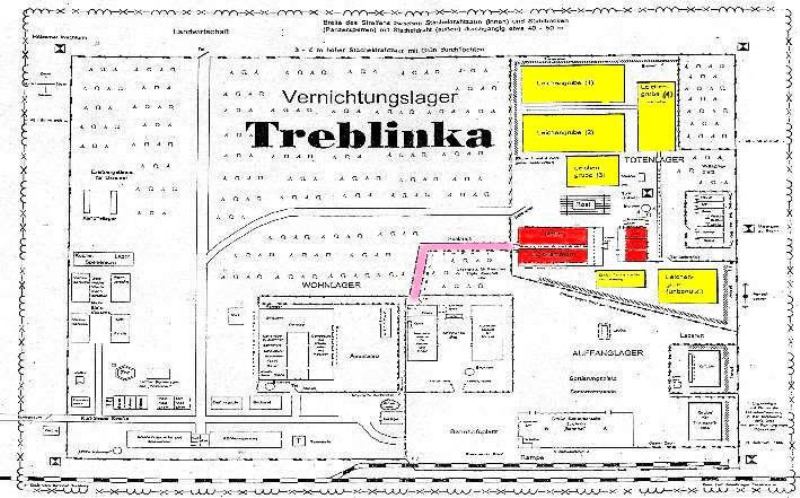
1. Franz drew the wrong shape of the Treblinka camp. Apparently, the Rectangle Treblinka maps were based on "hearsay, rumors, memory disorders, PTSD," so Franz drew a map of Treblinka based on rumors he heard circulating around the Warsaw Ghetto?

As an experiment, ask people to draw a plan of their old school, from memory, locating the buildings and classrooms and outside space such as playgrounds. You will get all sorts of maps, from the dreadful, to well remembered and drawn.
I like this argument. It's almost the exact opposite of what I was planning to write. I can easily recall from memory every place I've ever lived, and it would be easy to draw a map of any of them.
A better comparison would be for you to draw every place you have ever worked. The comparison would be even better, if there were parts of where you worked that you never went to and it had multiple buildings.
The map would not be perfect, but it would correctly show where the corners of the property were or were not right angles and it would have all objects in their correct relative positions and in correct numbers. If I focused in on places I only lived at for less than a year, perhaps those would be less accurate, but I still wouldn't make the glaring mistakes that these witnesses made.
For example I would not invent an entire building, but Jakub Krzepicki invented a crematorium building in his map and story.
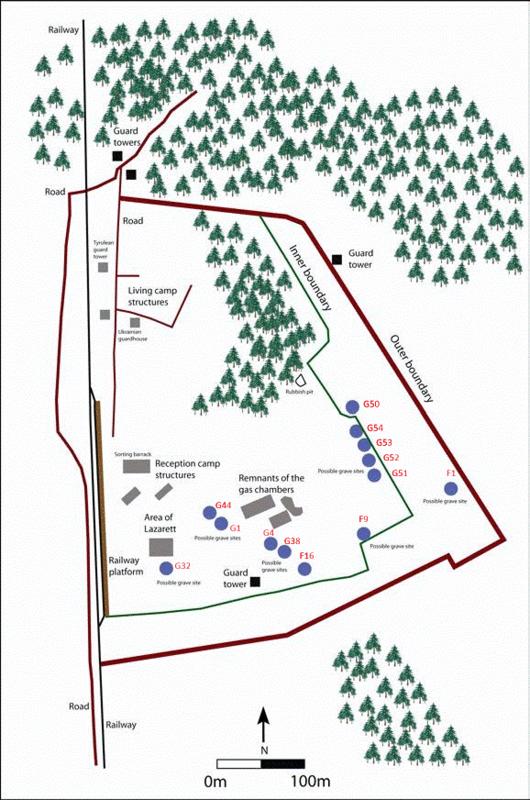
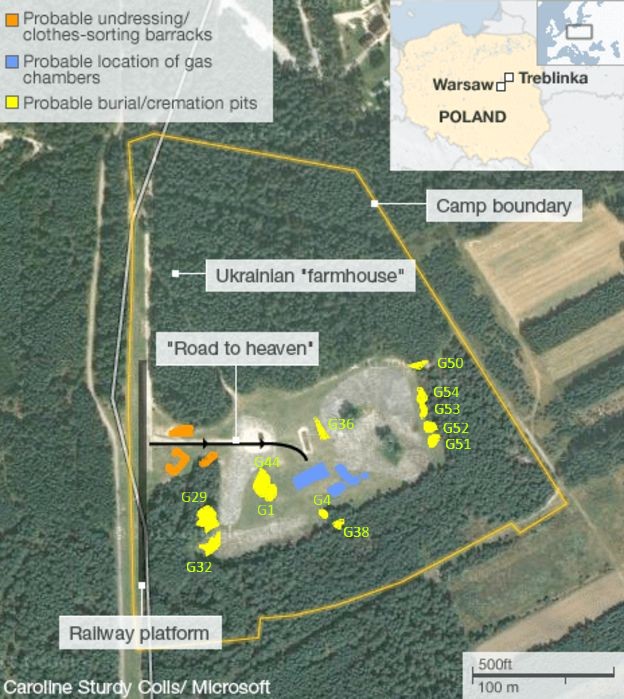
I would not claim something which was on the edge of the property was actually in the middle, and vice versa, which is what Jankiel Wiernik (1944) did with the gas chamber/s and tunnel.
I would not mistake as a rectangle an area which was quite irregularly-shaped, with no parallel boundaries, which is what Wiernik (1946) and numerous others did for Treblinka. I would not imagine that it was a pentagon with five fence boundaries instead of four, like Richard Glazar did.
I would not put a building which was outside a fence inside a fence, as Kurt Franz did by putting the railway platform, undressing place, and tunnel inside the extermination area. Vice versa for Krzepicki with the gas chamber and mass graves, which he illogically portrayed as being outside the fenced corner and therefore open to the rest of the camp. The incorrect positions of the inside fences seems to be a common problem between all these maps.
I would not draw a building parallel to the roadway if it wasn't, or vice versa, which is another common point of contradiction across maps.
These are pretty basic mistakes to make, enough to make me wonder if these witnesses were ever even there.
Imagine you worked for a year, at a place with multiple buildings, under high security, whereby you only had access to a few of the buildings and areas were cut off for you. You are then asked, years, if not a decade later or more, to draw a plan of that place.
Assuming that they were, the mistakes are still glaring enough that I have to question their recklessness with truth and fact.
That is your mere opinion, based on a false comparison, whereby you would draw plans of places you lived at and were every familiar with the entire building.
Wiernik's model of the camp was or is displayed in a museum and used at trial, yet it was comically misshaped and misproportioned, to say the least. Can we trust a historical process that exalted false evidence in this way?
Please explain to me and evidence the link between the ability to make accurate models to scale and truthfulness.
Nessie argues that some people would draw "dreadful" maps of their schools from memory. He has not demonstrated this, but so what?
It makes for a better comparison with what the witnesses did. I would happily bet you that you would get many different standards of plan.
We're discussing evidence that was used to convict an entire nation of abominable crimes, in court and in the court of public opinion. If a person misplaced a playground it would only tell you that they weren't trying very hard. If a person misplaced a gas chamber or a mass grave it suggests ulterior motives. They should have taken the map drawing exercise more seriously if they expected people to believe their very serious accusations.
If the witness only worked at the loading ramps and sorting clothing, it would explain why they were not certain about the placement of the gas chamber. If they were just not very good at drawing and scale, or as you say, they did not put any effort into the drawing, that would explain any misplacement.
You suggest that Wiernik lied, because his buildings are not to scale and because of that, he lied and was likely not even at the camp. The reason why you are doing that, is because you just do not want to believe his evidence about mass murder.
Sanity Check - "Thus, currently revisionists can console themselves by affirming their incredulity..."