
I'm using odysee. Works fine for pdf's.Fred Ziffel wrote: ↑Wed Jan 07, 2026 7:47 am does someone know something better than dropbox? I have a PDF to upload to show you all of a project I am working on
Majdanek this and that
Re: Majdanek this and that
If I were to guess why no t4 personnel were chosen to perform gassing that had experience with gassing, it would be because THERE WERE NONE.
Re: Majdanek this and that
Looking closer at this, it's hardly definitive.Fred Ziffel wrote: ↑Tue Jul 22, 2025 6:13 am At one time the Majdanek State Museum used this photo to claim the window in the B41 L room (Room with blue stains) was not there when the Germans occupied the camp.
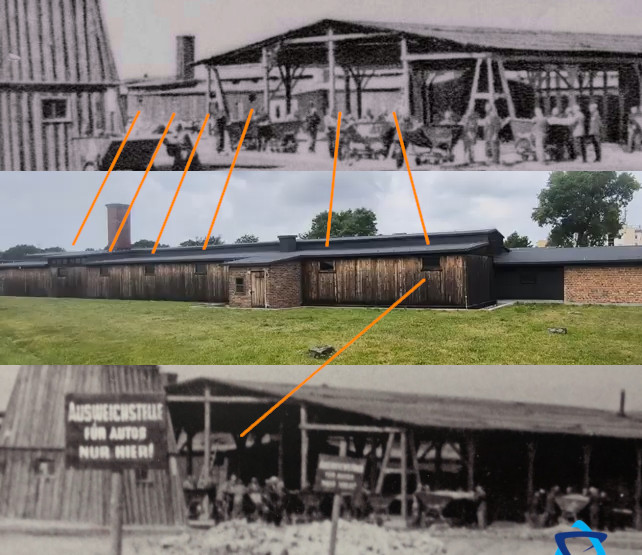
There are six of these windows on this side of the building, but not all are clearly visible in the historical photos.
In the photo dated 1943, only the fourth window is a clear black blotch. The first is visible but seemingly obscured by a shutter or something. The second is almost invisible, blending in with the wall. The third is obscured by a post. Both the fifth and sixth are probably partially obscured by posts and/or are as invisible as the second.
In the other photo, which must be near the same date, only the sixth window is visible, if anything.
It is a huge overstep to go from this to what the museum claims: "Most likely it was added after the war". They could equally claim that these other windows were added after the war with equally as much certainty, but that would be nonsense. It makes more sense that the Germans built the place with evenly-spaced windows to begin with.
Also consider the obvious contradiction in claiming that the Soviets added a window on one side while they in fact removed one or two windows on the opposite wall. Even if we charitably allow that there was some legitimate reason for these changes, it shows a tremendous willingness to alter the state of the supposed crime scene.
Rudolf claims that the window frame has blue stains that prove it was present pre-liberation, but he doesn't have a close-up photo to show for it. The furtherglory blog says the same thing, again without a photo. A photo of those stains would obviously be helpful.
Re: Majdanek this and that
The USHMM has a photo of the bunker captioned: "The furnace to the right was used to create carbon monoxide for gassing prisoners."
https://collections.ushmm.org/search/catalog/pa1042833
So in that case the CO did not come from an engine or from a cylinder but from a furnace. Jews were gassed by a furnace? It seems the USHMM is allowed to make up anything they like in their photo captions. Putting my tax dollars to good use.
https://collections.ushmm.org/search/catalog/pa1042833
So in that case the CO did not come from an engine or from a cylinder but from a furnace. Jews were gassed by a furnace? It seems the USHMM is allowed to make up anything they like in their photo captions. Putting my tax dollars to good use.
Re: Majdanek this and that
At 3:43 in this tour video, you can see heavy blue staining in the entry/exit room adjacent to the undressing room. How did it get there? Was this room originally part of the undressing room, meaning the wall partition was added after liberation?
https://www.youtube.com/watch?t=223&v=5mpWCHoudxc
Also at 4:35 the videographer gives a good look at some blue stains on the outside of chamber B and room 14. Fred, you had proposed that the stains in room 14 might have been caused by Zyklon inside room 14, but are you sure it wasn't stained from the outside? I find this mystery especially curious because it is similar to the phenomenon of localized wall-piercing stains between A2 and B.
https://www.youtube.com/watch?t=223&v=5mpWCHoudxc
Also at 4:35 the videographer gives a good look at some blue stains on the outside of chamber B and room 14. Fred, you had proposed that the stains in room 14 might have been caused by Zyklon inside room 14, but are you sure it wasn't stained from the outside? I find this mystery especially curious because it is similar to the phenomenon of localized wall-piercing stains between A2 and B.
Re: Majdanek this and that
About the sign in the B41 undressing room, the one that said "Eksperimental gas chamber for exterminating prisoners". Mattogno wrote that this was there "As late as 1997". You wrote that it was there until 2005. I can say it was still there in 2007, based on this video and this photo gallery.
Since this page on the Majdanek website tells us that modern renovations began in 2008, it was probably around then that all the old black-and-white signs were replaced. With that, I've produced this photo comparison of the sign before and after. Text graphically altered for reading clarity.

Since this page on the Majdanek website tells us that modern renovations began in 2008, it was probably around then that all the old black-and-white signs were replaced. With that, I've produced this photo comparison of the sign before and after. Text graphically altered for reading clarity.
- Fred Ziffel
- Posts: 332
- Joined: Sun Dec 01, 2024 11:02 am
Re: Majdanek this and that
In regard to CO gassings
Very good point about Tanks? Vehicle engines? Or Did CO come this heater? I shall remember to put this argument in my library and add to the presentation. Make up your mind is what can be said to the museum.
Back in the day when I was communicating with both, I would get two different stories when I asked both the same question.
I will give my position of the heater role of Chamber “A” in the attachment. The pipe sticking out of the door gives the game away. That was a temperature sensor.
On a bit of comedy look, if the Soviet were not so dumb, they could have set up a death shower with the CO tanks. From tanks to shower head since the CO tank is highly pressurized. However, it is absurd since they were fighting a war and not carrying plumbing with them to accomplish this. But the Germans were capable to build such a ruse if the intent was to deceive incoming inmates. Here is an example just for the hell of it. This would not work with Zyklon since it was not under pressure.
Very good point about Tanks? Vehicle engines? Or Did CO come this heater? I shall remember to put this argument in my library and add to the presentation. Make up your mind is what can be said to the museum.
Back in the day when I was communicating with both, I would get two different stories when I asked both the same question.
I will give my position of the heater role of Chamber “A” in the attachment. The pipe sticking out of the door gives the game away. That was a temperature sensor.
On a bit of comedy look, if the Soviet were not so dumb, they could have set up a death shower with the CO tanks. From tanks to shower head since the CO tank is highly pressurized. However, it is absurd since they were fighting a war and not carrying plumbing with them to accomplish this. But the Germans were capable to build such a ruse if the intent was to deceive incoming inmates. Here is an example just for the hell of it. This would not work with Zyklon since it was not under pressure.
- Attachments
-
- saqegergeqrg4.JPG (63.65 KiB) Viewed 9522 times
-
- door pipe and heater maj.JPG (92.96 KiB) Viewed 9522 times
I do not believe anything one is not allowed to question
- Fred Ziffel
- Posts: 332
- Joined: Sun Dec 01, 2024 11:02 am
Re: Majdanek this and that
Window in B41
Agreed more proof (Like a photo) of the window wood frame having blue staining would be nice.
If built after the war. Why does the new window have to be put in up high and same level and type as the rest. Why seemingly the same type and dimensions?
Also, this room is part of a claimed murder weapon and THEY tampered with it. Now we don’t know if indeed it was there. I told you about how the Soviet set up a movie theater in B42? That is what I was told anyways.
I tried to contact Mattogno to ask him that, but was unable. I trust him though, that this is indeed the case. He does not seem to be an author that makes shit up
Luckly, we have the two doors that open inward and the latched on the south door. The folks who do believe the Holobunga cannot get around this argument.
And the two other windows in the Zyklon can display room.
Agreed more proof (Like a photo) of the window wood frame having blue staining would be nice.
If built after the war. Why does the new window have to be put in up high and same level and type as the rest. Why seemingly the same type and dimensions?
Also, this room is part of a claimed murder weapon and THEY tampered with it. Now we don’t know if indeed it was there. I told you about how the Soviet set up a movie theater in B42? That is what I was told anyways.
I tried to contact Mattogno to ask him that, but was unable. I trust him though, that this is indeed the case. He does not seem to be an author that makes shit up
Luckly, we have the two doors that open inward and the latched on the south door. The folks who do believe the Holobunga cannot get around this argument.
And the two other windows in the Zyklon can display room.
I do not believe anything one is not allowed to question
- Fred Ziffel
- Posts: 332
- Joined: Sun Dec 01, 2024 11:02 am
Re: Majdanek this and that
Stains outside “A” chamber
I assume you speak of the stains in this photo on the outside and this other for stains on the inside? I think you have the rooms mixed up. “A” is the long one and B1 and B2 are the smaller ones
1. This area was outside when the Germans occupied this camp as can be seen by photo. Ventilation was the best it could be. Looking at the intensity of the stains, I would wager most times they opened the doors and aired out with cross breeze, the wind was out of the north. If my argument is correct, then you can understand how sensitive this building was when exposed to HCN gas. A lot of HCN gas floated a little bit around this area until it blew away?
2. The stain on outside compared to inside are in two different areas on the wall of Cell 14.
3. I see no reason to disinfect this Cell 14 interior since all they did in this room was turn a valve, turn on a light or leave or take something from the room, People do not spend a lot of time in here.
I assume you speak of the stains in this photo on the outside and this other for stains on the inside? I think you have the rooms mixed up. “A” is the long one and B1 and B2 are the smaller ones
1. This area was outside when the Germans occupied this camp as can be seen by photo. Ventilation was the best it could be. Looking at the intensity of the stains, I would wager most times they opened the doors and aired out with cross breeze, the wind was out of the north. If my argument is correct, then you can understand how sensitive this building was when exposed to HCN gas. A lot of HCN gas floated a little bit around this area until it blew away?
2. The stain on outside compared to inside are in two different areas on the wall of Cell 14.
3. I see no reason to disinfect this Cell 14 interior since all they did in this room was turn a valve, turn on a light or leave or take something from the room, People do not spend a lot of time in here.
- Attachments
-
- Blue inside Rm 14.JPG (225.38 KiB) Viewed 9522 times
-
- 1946 photo of maj bunker.JPG (86.27 KiB) Viewed 9522 times
-
- uuu.JPG (89.55 KiB) Viewed 9522 times
Last edited by Fred Ziffel on Wed Jan 14, 2026 6:26 am, edited 1 time in total.
I do not believe anything one is not allowed to question
- Fred Ziffel
- Posts: 332
- Joined: Sun Dec 01, 2024 11:02 am
Re: Majdanek this and that
Blue stains in little space of B41
That entrance thingy can also be found on B41(2 locations) and in B42 two of these entrances. Not sure why they installed them. One characteristic is there seems there were NO door attached to these 4 doorway entrances. So, the HCN would be able to migrate in there and result in staining.
Remember, originally this room was not set up to be a Zyklon gas chamber, this building is fairly much a mirror image of B42, see drawing.
one more photo in next post of B41 entrance from outside
That entrance thingy can also be found on B41(2 locations) and in B42 two of these entrances. Not sure why they installed them. One characteristic is there seems there were NO door attached to these 4 doorway entrances. So, the HCN would be able to migrate in there and result in staining.
Remember, originally this room was not set up to be a Zyklon gas chamber, this building is fairly much a mirror image of B42, see drawing.
one more photo in next post of B41 entrance from outside
- Attachments
-
- kjlo.JPG (69.23 KiB) Viewed 9521 times
-
- B42 drawing.JPG (122.05 KiB) Viewed 9521 times
-
- B42 entry.JPG (146.32 KiB) Viewed 9521 times
I do not believe anything one is not allowed to question
- Fred Ziffel
- Posts: 332
- Joined: Sun Dec 01, 2024 11:02 am
Re: Majdanek this and that
B41 entry photo
- Attachments
-
- Maj 41 entrance.JPG (114.21 KiB) Viewed 9520 times
I do not believe anything one is not allowed to question
Re: Majdanek this and that
The partition is probably original, then. Ok.Fred Ziffel wrote: ↑Tue Jan 13, 2026 7:52 am Blue stains in little space of B41
That entrance thingy can also be found on B41(2 locations) and in B42 two of these entrances. Not sure why they installed them. One characteristic is there seems there were NO door attached to these 4 doorway entrances. So, the HCN would be able to migrate in there and result in staining.
Re: Majdanek this and that
Your theory seems to be that Zyklon was accidentally released inside cell 14 and Zyklon separately stained the outside of cell 14. Both unlikely events, and both times on the west wall, which is an unlikely coincidence. However you are right that the stains appear in different locations, which favors that it actually is a coincidence of two separate events. Here is a still from the video above showing where blue stains go almost to the ceiling in cell 14. This staining is behind the sign in your photos.Fred Ziffel wrote: ↑Tue Jan 13, 2026 7:47 am 1. This area was outside when the Germans occupied this camp as can be seen by photo. Ventilation was the best it could be. Looking at the intensity of the stains, I would wager most times they opened the doors and aired out with cross breeze, the wind was out of the north. If my argument is correct, then you can understand how sensitive this building was when exposed to HCN gas. A lot of HCN gas floated a little bit around this area until it blew away?
2. The stain on outside compared to inside are in two different areas on the wall of Cell 14.

However I'm still highly skeptical of the idea that blue stains could form on an exterior wall from airing out. Can a stain be produced while the HCN is rapidly diffusing away? I'm not aware of that happening anywhere else, but maybe it's chemically possible, I don't know.
The other problem is that HCN is not heavier than air, so I wouldn't expect it to only stain the bottom of the wall. But since the stains inside chamber A/III also concentrate low to the ground on all walls, it could be the same here, even if that phenomenon is inexplicable to me.
An alternate theory could be that this was another accidental release. Maybe a single open can on the ground could create that stain, even outdoors.
Here also is a photo comparison between the inside and outside of gas chamber A/III.

The stains here don't match. Maybe there's something on the inside, but the intensity is 10x on the outside. That tells me either there was a Zyklon spill outside, or there was implausibly good exposure conditions during airing out, or else it is normal for wall-piercing stains not to visually match. That last possibility is something we can prove or disprove with other locations.
I realize all this is really tertiary to the Holocaust, but it can inform future debate about blue staining. I'm particularly curious to know why the supposed Zyklon holes at Birkenau Crema II are not stained blue, not even around the exposed rebar.
Re: Majdanek this and that
I guess rain could be a factor in airing out. If rain splashed on to the exterior wall, maybe that would capture some HCN and create a stain?
- Fred Ziffel
- Posts: 332
- Joined: Sun Dec 01, 2024 11:02 am
Re: Majdanek this and that
See photos
I marked the stains Stain 14 and Stain “A”
You are correct that Stain “A” could have been a result of diffusion through the wall. We can see this at the shared wall of “A” and B2. Wall thickness is a known 20cm. Lets leave this for a moment.
Let us look at “Stain 14”
I ask, how did this stain get on this wall here? The wall is thinner (20cm?) than the “A” Chamber wall that is a known 50cm.
2 possibilities:
It came from the inside due to HCN exposure and diffused to the outside? As in the “A” and B2 wall
Or
The outer wall of Cell 14 (or Room 14) was exposed to HCN? The only source of HCN is coming from “A” chamber doorway opening adjacent to the Cell 14 wall.
My argument is:
Look at the area of the of the blue staining (Stain 14) on the other inside of the Cell 14 wall. My photo shows there is NO blue staining on the inside wall if Cell 14 opposite of the “Stain 14” on the other side. That indicates to me the source of the blue staining (Stain 14) did not originate from the inside of Cell 14.
How did those blue stains get inside Cell 14?
My guess is the worker closed the North Door of “A” Chamber. Worked his way back to the South Door all the while spreading out the poison pellets. He reaches the South Door and then closes it and locks it. At this point, he has an Empty Can of Zyklon B. What does he do with the empty can of Zyklon B? Well one option would be to put the empty can inside Cell 14. You know, out of site, out of mind. We’ll take care of it later.
If you go on Google Earth (Not Google Maps), someone called Surgey Rudavin, bless his heart, took a 360 of the room. You can see some blue staining on the B1 side, more than the “A” side, almost no staining even though this is a shared wall with “A” Chamber. Since B1 has no blue staining inside the room, this tells me the HCN exposure originated from inside Cell 14. Empty cans were also placed here at this spot.
The opened empty cans of Zyklon sit in there and the fumes escape from the cans and stain the walls. Mattogno himself wrote that cans of Zyklon were found inside Cell 14. Mattogno, Concentration Camp Majdanek, P. 143.
Therefore, I say empty cans of Zyklon B stained the walls on the inside, and on the outside wall, “Stain 14” was due to HCN gas coming out of the “A” Chamber and because of that, “Stain A” was also a result of HCN gas escaping out the doorway of “A” Chamber.
See next post more photos of Cell 14
I marked the stains Stain 14 and Stain “A”
You are correct that Stain “A” could have been a result of diffusion through the wall. We can see this at the shared wall of “A” and B2. Wall thickness is a known 20cm. Lets leave this for a moment.
Let us look at “Stain 14”
I ask, how did this stain get on this wall here? The wall is thinner (20cm?) than the “A” Chamber wall that is a known 50cm.
2 possibilities:
It came from the inside due to HCN exposure and diffused to the outside? As in the “A” and B2 wall
Or
The outer wall of Cell 14 (or Room 14) was exposed to HCN? The only source of HCN is coming from “A” chamber doorway opening adjacent to the Cell 14 wall.
My argument is:
Look at the area of the of the blue staining (Stain 14) on the other inside of the Cell 14 wall. My photo shows there is NO blue staining on the inside wall if Cell 14 opposite of the “Stain 14” on the other side. That indicates to me the source of the blue staining (Stain 14) did not originate from the inside of Cell 14.
How did those blue stains get inside Cell 14?
My guess is the worker closed the North Door of “A” Chamber. Worked his way back to the South Door all the while spreading out the poison pellets. He reaches the South Door and then closes it and locks it. At this point, he has an Empty Can of Zyklon B. What does he do with the empty can of Zyklon B? Well one option would be to put the empty can inside Cell 14. You know, out of site, out of mind. We’ll take care of it later.
If you go on Google Earth (Not Google Maps), someone called Surgey Rudavin, bless his heart, took a 360 of the room. You can see some blue staining on the B1 side, more than the “A” side, almost no staining even though this is a shared wall with “A” Chamber. Since B1 has no blue staining inside the room, this tells me the HCN exposure originated from inside Cell 14. Empty cans were also placed here at this spot.
The opened empty cans of Zyklon sit in there and the fumes escape from the cans and stain the walls. Mattogno himself wrote that cans of Zyklon were found inside Cell 14. Mattogno, Concentration Camp Majdanek, P. 143.
Therefore, I say empty cans of Zyklon B stained the walls on the inside, and on the outside wall, “Stain 14” was due to HCN gas coming out of the “A” Chamber and because of that, “Stain A” was also a result of HCN gas escaping out the doorway of “A” Chamber.
See next post more photos of Cell 14
- Attachments
-
- Stain A and 14.JPG (127.85 KiB) Viewed 9447 times
-
- Bunker Maj North south doors.JPG (56.71 KiB) Viewed 9447 times
-
- asdfasdfasdf.JPG (249.33 KiB) Viewed 9448 times
Last edited by Fred Ziffel on Fri Jan 16, 2026 7:00 am, edited 2 times in total.
I do not believe anything one is not allowed to question
- Fred Ziffel
- Posts: 332
- Joined: Sun Dec 01, 2024 11:02 am
Re: Majdanek this and that
more images of interior of Cell 14 Majdanek
and shared wall of "A" and B2
and shared wall of "A" and B2
- Attachments
-
- wall on B2 and A.JPG (73.64 KiB) Viewed 9449 times
-
- Surgey 1.JPG (200.78 KiB) Viewed 9449 times
-
- surgey 2.JPG (187.41 KiB) Viewed 9449 times
I do not believe anything one is not allowed to question