Archie wrote: ↑Thu Jan 15, 2026 4:10 am
I was expecting to see more of an attempt to develop the positive evidence for the Holocaust. Instead of that, we see here a lot of Nessie's signature "proof by assertion" and question-begging.
What you in fact see, is my argument that the Holocaust is far better evidenced that you will ever admit. I used how well the witnesses actually corroborate and how both accused and victim agree on the crime committed, as an example of that.
Gathering evidence to determine what is sufficiently corroborated and what is not, is how history is normally investigated. That is not proof by assertion or question begging. It is so-called revisionists who step away from the normal standard of historical evidence gathering, to produce a chronology of events with a conclusion. They try to argue the events did not happen and then fail to provide an evidenced proven conclusion.
For all of the effusive praise heaped upon "the historians" in this essay, the author seems to have little familiarity with the mainstream secondary literature as none of it is really discussed or referenced. The sources cited are drawn mostly from online tertiary sources (Google search?). These are little more than compilations of the conventional narrative, presented under the assumption that the reader is already convinced.
The best case for the Holocaust, is the evidence it happened.
In terms of the presentation, critiques of revisionism are given too much emphasis (starting with this I think was an especially odd choice) and the chosen targets are surprising and/or not well represented. It is puzzling why the author has decided to dedicate so much space to discussing the 50 year old Butz book. Or why he felt the need to rebut a random meme from Twitter, as if this were a good representation of informed revisionist thought.
If you spent any time on X, you would know that the documents and claim 271k died, is widely promoted and shared, as supposed evidence the Holocaust did not happen. I used Butz, because he has a concise chapter on "what happened to them?". They both represent so-called revisionists frankly pathetic attempts to revise the history of the Holocaust, with evidence.
Overall, the author appears to have a limited grasp of the literature on both sides of the debate.
I can provide many more examples of where historians can evidence what happened and so-called revisionists cannot.
The structure of the case is more or less as follows:
1) The mainstream history is well-established and based on strong evidence
2) To overturn this history, revisionists would have to supply evidence that "proves that something different took place."
2a) The author implicitly assumes that "prove something different took place" means prove that the Jews survived/were resettled
3) Revisionist have failed to do this
Therefore the mainstream history is true
You got it.
I would not object to framing the issue rhetorically in terms of the need for a constructive history of events, but the author pushes way too far with this in an attempt to side-step huge swathes of relevant evidence. Below would be my primary objections.
Thin on Positive Evidence
The biggest problem here by far is that the author largely skips over point 1 in the argument (which should have been the focus) and jumps straight into a critique of revisionists. In an essay of limited length, it is also wise to point readers to additional resources, where the arguments introduced in the essay are addressed more thoroughly. This is generally not done here. Only the demographic argument was given much attention.
Point 1, in the introduction, was to explain how the main events of the Holocaust are evidenced and proven and to reinforce that point, I provide two examples where evidence gathering failed to prove claims being made.
Part 2 compares a so-called revisionist investigation, with one made by historians, whereby Butz suggests, and fails to evidence population movements and the historians go into great detail and evidence and prove population movements.
Parts 3 to 7 all explain how well evidenced the Holocaust is, with examples.
It is claimed that we should have expected to find 5-6 million Jews in camps and ghettos at the end of the war. That is a wildly high figure. Germany almost certainly never had that many Jews under their control. The author further assumes all the Jews would have stayed put and ignores the difficulties of determining the number of Jews behind the Iron Curtain.
Nazi reports such as Wannsee and Korherr, along with ghetto and camp population records and records from the occupied and aligned nations, prove that the Nazis and Allies, such as the Romanians and Serbians, did arrest at least 6 million Jews. Millions more bought their way out, or fled, either into the Soviet Union, or to countries such as the UK or outwith of Europe.
It stands to reason that of the millions of Jews who were sent to the ghettos and camps, some will have died, but by 1944, millions should have still been alive, if the Nazis were not mass murdering them.
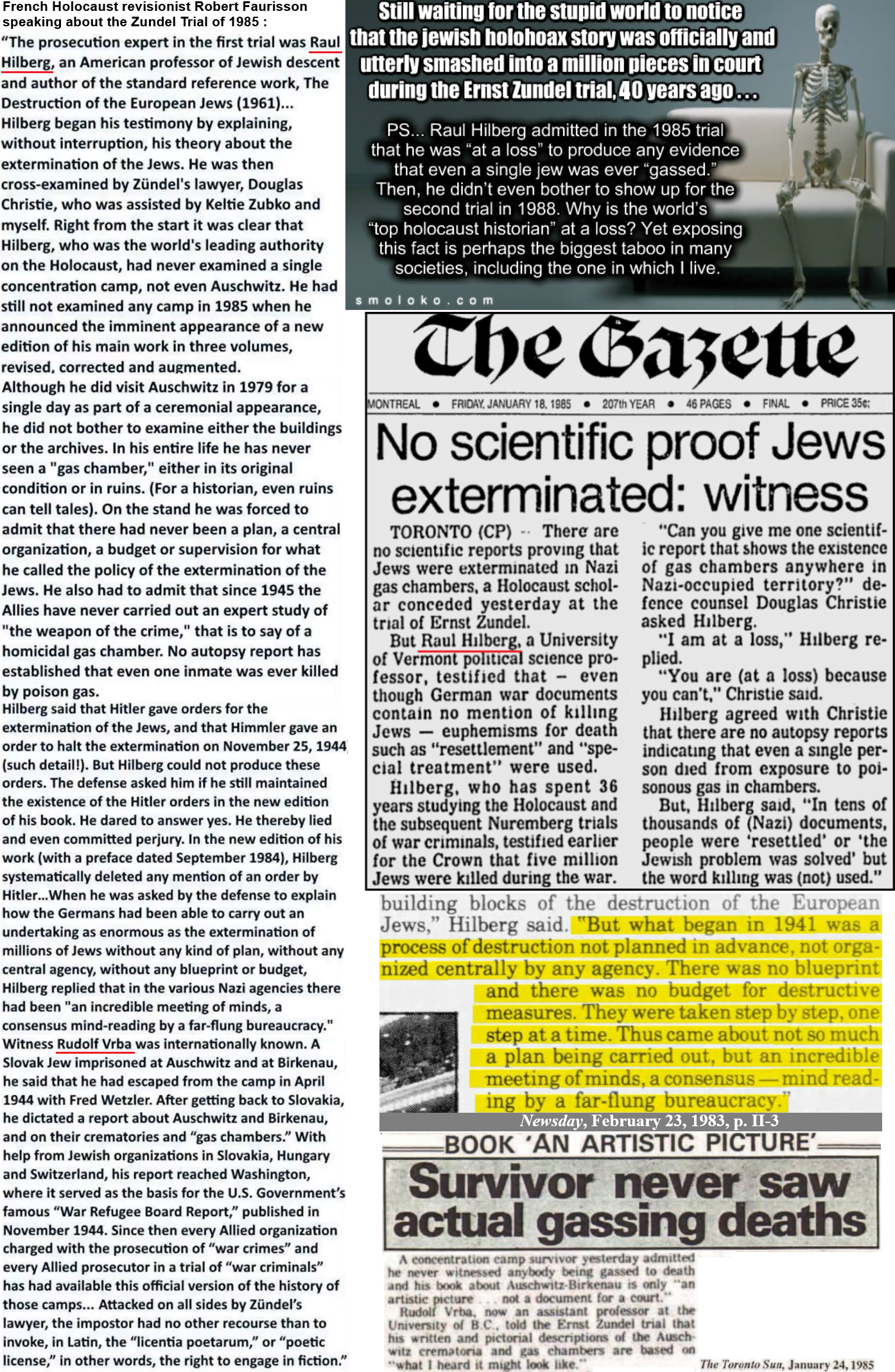
The defense of the testimonial evidence is very brief and inadequate given the importance of that topic.
"There are bound to be inconsistencies in the details, such as how many were gassed and how long cremations took, as people are proven to poor at many estimations and memory fades."
That just doesn't cut it. The discussion of physical evidence is also very brief and undeveloped (mostly proof by assertion).
Scientific testing of people's memory and ability to estimate, is how we know that witnesses will not accurately recall the details of events, such as how long something took to do and how many people it involved. If I had linked to the physical evidence, you would have accused me of a document dump.
Demand for a Full Alternative History
It is simply not true that documentation regarding Jewish migration during and after the war (i.e, proof of survival) must be provided in order to overturn the mainstream history. This is a textbook argument from ignorance, and it inappropriately precludes the possibility that something may be indeterminate due to inadequate documentation.
Unless you can revise the history, with evidence, you have failed to revise that history. When you cannot evidence hundreds of thousands of Jews, who are proven to have arrived at TII, leaving that camp, you are failing to revise its history.
If revisionist critiques of the homicidal gas chambers are correct, this in fact would show that "something else" occurred for the simple reason that it would establish that the mainstream story did not occur (or is extremely unlikely to have occurred).
That is history with no conclusion. You are suggesting a non-history is acceptable. Unless you can prove that "something else occurred" then you have failed and your conclusion an event did not happen is incorrect.
Critique of Revisionism
The author evaluates revisionism almost solely by the standard of proving Jewish survival. This is simply a way of dodging numerous relevant points that deserve to be addressed.
Much else could be said, but I see no need to repeat familiar points (witness studies, Poles vs Soviets, 100% of the witnesses, etc).
https://codohforum.com/viewtopic.php?t=382
https://codohforum.com/viewtopic.php?t=443
I revise so-called revisionism by its failure to provide a chronological, evidenced narrative. For example, if you suggest nowhere near 5-6 million Jews were arrested. OK, so start with a country and evidence its Jews were not arrested. If you do that, you have revised the history of their arrests. Denmark and Finland would not be good examples, as the majority of their Jews are evidenced to have not been arrested. But they are examples of how to evidence Jews not being arrested.
Sanity Check - "Thus, currently revisionists can console themselves by affirming their incredulity..."