If I were to say something positive about Hilberg, I would say that he clearly put a great deal of effort into his book and he clearly had an encyclopedic knowledge of the Nuremberg documents. However, when it comes to the contested aspects of the story such as the final solution and gas chambers, this is precisely where he comes up very, very short. My own view is well-expressed by Arthur Butz in Hoax which discusses the leading "mythologists" at that time in the mid 1970s.
He takes up the same theme again in chapter 8.If a scholar, regardless of his specialty, perceives that scholarship in acquiescing, from whatever motivation, in a monstrous lie, then it is his duty to expose the lie, whatever his qualifications. It does not matter that he collides with all “established” scholarship in the field, although that is not the case here, for a critical examination of the “holocaust” has been avoided by academic historians in all respects and not merely in the respect it is treated in this book. That is, while virtually all historians pay some sort of lip service to the lie, when it comes up in books and papers on other subjects, none has produced an academic study arguing, and presenting the evidence for, either the thesis that the exterminations did take place or that they did not take place. If they did take place then it should be possible to produce a book showing how it started and why, by whom it was organized and the line of authority in the killing operations, what the technical means were and that those technical means did not have some sort of more mundane interpretation (e.g. crematories), who the technicians involved were, the numbers of victims from the various lands and the timetables of their executions, presenting the evidence on which these claims are based together with reasons why one should be willing to accept the authenticity of all documents produced at illegal trials. No historian has undertaken anything resembling such a project; only non-historians have undertaken portions. (Butz, original preface)
Ok. Let's look at some specifics from Hilberg's book.No such person has come forward with a critical study of the question or with any work actually arguing any particular side of the extermination question and presenting the evidence, which supports the thesis. The closest thing to such a work is the book by Reitlinger, who is at least willing to take explicit note of some of the anomalies that develop in presenting the story of the “holocaust,” but Reitlinger is not a historian but an artist and art collector. He has written several books, the most significant being his three volume study of the history of dealings in objects of art, The Economics of Taste. After Reitlinger, Hilberg manages a tiny bit of a critical attitude, but Hilberg is a professor of political science at the University of Vermont, and his doctorate is in public law and government.
The books by Reitlinger and Hilberg recognize, to a very inadequate but nevertheless perceptible degree, a responsibility to convince the skeptic. The other extermination mythologists do not make any effort whatever to show that the exterminations happened; they just assume we all know it happened and then they take it from there. This is the case with the remaining three of the five leading extermination mythologists – Nora Levin, Leon Poliakov, and Lucy S. Dawidowicz.
The "Final Solution"
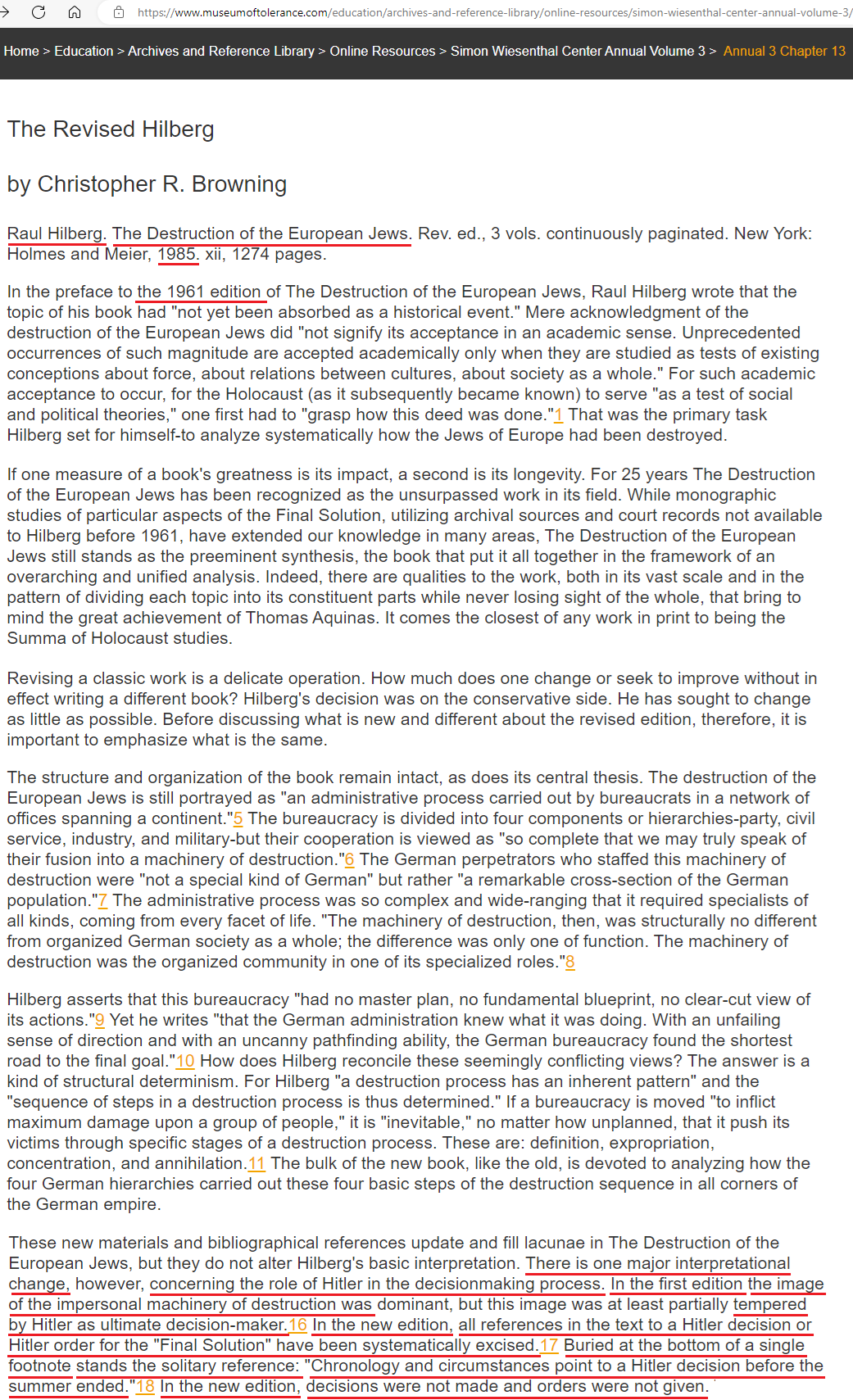
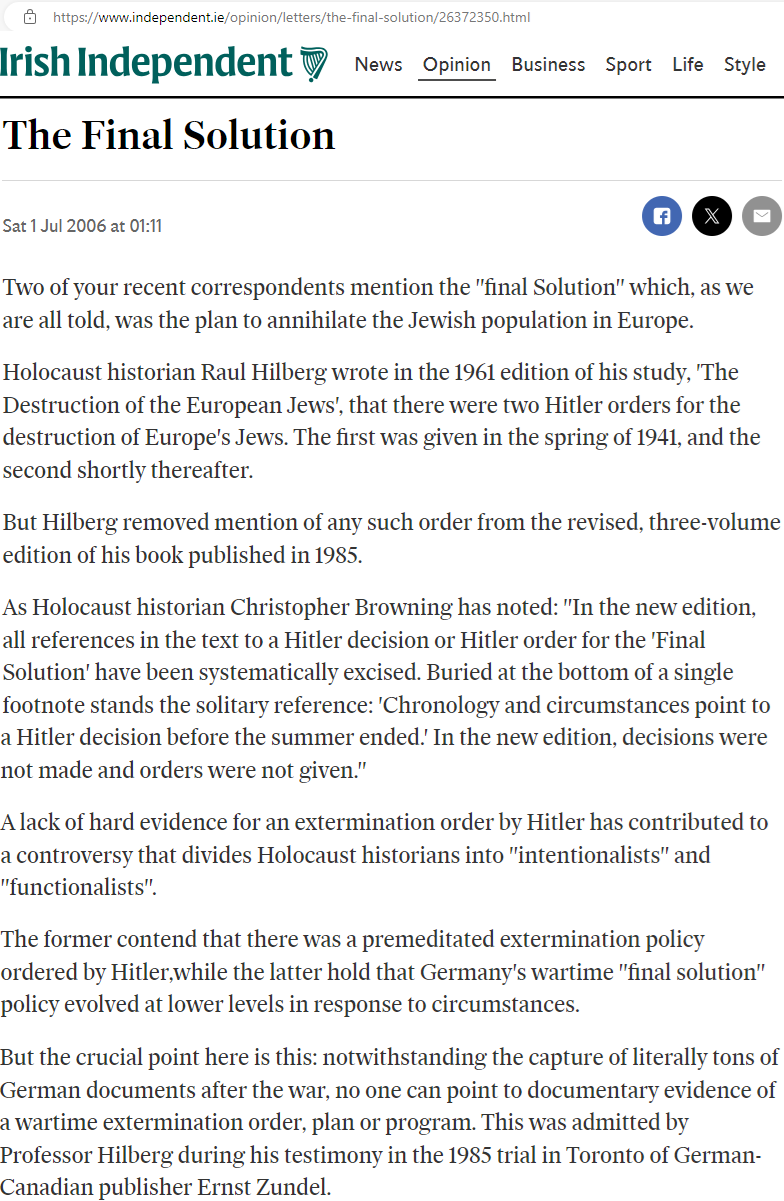
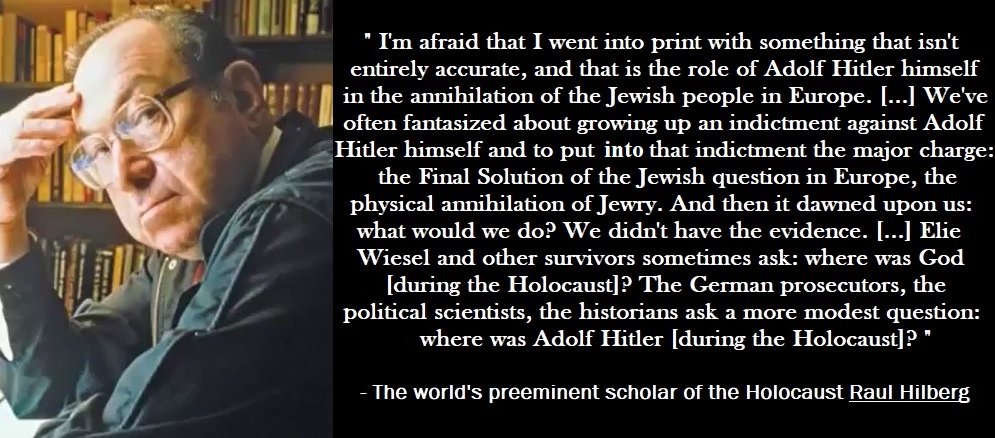
In his first edition, Hilberg claimed that Hitler ordered the final solution in the summer of 1941.
Hilberg was grilled over this during the first Zundel trial and was asked to produce these orders he refers to. Hilberg removed the references to "Hitler orders" in the 1985 revised edition of his book.In German correspondence the killing phase was referred to as the “final solution of the Jewish question.” The word “final” in this context has a double meaning: In its narrow sense, it meant that the aim of the destruction process had now been clarified. During the concentration stage it was still conceivable to shove the Jews out of Europe to some other continent or to let them languish in ghettos. The decision to take measures for the total annihilation of European Jewry shut out any such alternative. In this sense the direction and aim of the destruction process were finalized. But the phrase “final solution” has a wider, more significant meaning. In Himmler’s words, it meant that the Jewish problem would never have to be solved again. Definitions, expropriations, and concentrations can be undone. Killings cannot. The killing phase was irreversible; hence it gave the entire destruction process its character of finality.
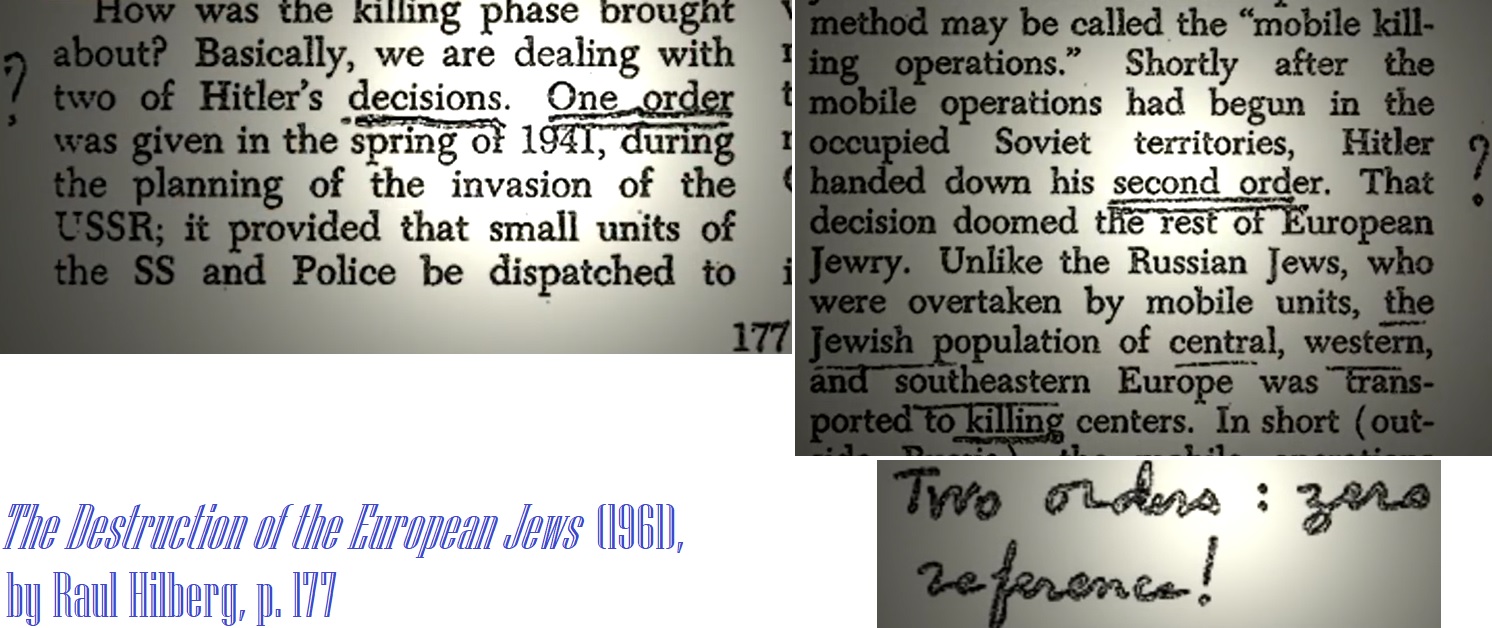
How was the killing phase brought about? Basically, we are dealing with two of Hitler’s decisions. One order was given in the spring of 1941, during the planning of the invasion of the USSR; it provided that small units of the SS and the Police be dispatched to Soviet territory, where they were to move from town to town to kill all Jewish inhabitants on the spot. This method may be called the “mobile killing operations.” Shortly after the mobile operations had begun in the occupied Soviet territories, Hitler handed down his second order. That decision doomed the rest of European Jewry. (pg 177)
We see however that he assigned great importance to the Goering decree of July 1941 and regarded it as being an extermination order.
I will note here that this sort of view seems to have fallen out of fashion among cutting edge anti-revisionists who favor a later "final solution" dating. Obviously the documentation is not as good as we are told if the mainstream scholars can't even agree on when it was ordered.On July 31, 1941, six weeks after the invasion of the USSR had started, the order was given. It was signed not by Hitler but by Göring, and the recipient of the order was Heydrich.
[...]
The order of July 31 marks a turning point in anti-Jewish history. With the dispatch of that order, the centuries-old policy of expulsion was terminated and a new policy of annihilation was inaugurated. As such, the cryptic Göring letter has had an importance which far transcends the brief span of the German destruction process. (pg. 262)
The Gas Chambers
Despite the immense size of Hilberg's book (nearly 800 pages of double-columned text in small font), the material on the gas chambers is surprisingly brief. In the section on "Killing Center Operations," Hilberg relies on Rudolf Hoess extensively, with much of his text being extended paraphrases of Hoess's statement. Hilberg in general seemed to have a preference for documents, but when it comes to the gas chambers the post-war affidavits do the heavy lifting. Below are the footnotes where Hoess is cited repeatedly on the crucial gas chamber pages.
Pg 564: 2 footnotes
Pg 565: 2 footnotes
Pg 570: 1 footnote
Pg 571: 2 footnotes
Pg 572: 1 footnote
Pg 575: 1 footnote
Pg 576: 2 footnotes
That's 11 footnotes for pages 564-576. Surprisingly, Hilberg even seems to accept Hoess's summer 1941 dating (whereas Reitlinger and most others have argued that Hoess must have meant 1942). "In the summer of 1941 Höss was summoned to report (over the head of his chief Glücks) to Himmler for personal orders. (pg 564). He does cite documents as well, but many of these are related to general info about Zyklon and the corporate structure of IG Farben, DEGESCH, etc which Hilberg seems to find incriminating even though there's nothing inherently sinister about it. He claims, "The amounts [of Zyklon] required by Auschwitz were not large, but they were noticeable. Almost the whole Auschwitz supply was needed for the gassing of people; very little was used for fumigation" (pg 570). His source here is an affidavit by Dr. Bendel. Decades later, Pressac would argue the exact opposite, that very little of the Zyklon was used for homicidal gassings.
On the AR camps gassings, Hilberg says they gassed people with carbon monoxide from a diesel motor. "Wirth and his crew immediately and under primitive conditions began to construct chambers into which they piped carbon monoxide from diesel motors. (pg 562)" Footnote: "Affidavit by OStuf. Kurt Gerstein, April 26, 1945, PS-1553"
On physical evidence, the book is very weak. Objectively speaking. If anyone disagrees, feel free to quote passages to the contrary.
Conclusion
Hilberg's book is useful for general background and it is indispensable for understanding the evolution of Holocaust historiography. And if you have a lot of free time you could go through it and collect the bits that are most relevant to the debate (documents like NO-365, etc). But if you are looking for a book that addresses revisionist challenges efficiently it seems to me a very poor choice due to the approach, which is not sufficiently critical, as well as the length. Large sections of the book cover topics like prewar Jewish policy that are only of tangential relevance to the claims contested by revisionists, and, as mentioned, key topics like the gas chambers are just not addressed in satisfactory detail. To refer people to Hilberg as a counter to revisionism is, imo, dishonest. People who do this are merely trying to imply that the book contains a lot of proof when it doesn't, and they are banking on the fact that 99% of people will not be willing to read Hilberg's thick and very dry tome.