1. this room was neither a gas chamber or a delousing closet
2. the other side of the wall and even the corner was in the open air so no possibility of diffusion like we find from "A" Chamber to B2 Chamber.
3. Emptied open cans of Zyklon B were found in this room. I speculate that after emptying the can in "A" chamber, the worker put the empty can in this room. Fumes from the empty cans turned these walls blue? Therefor gives an idea of just how easy these walls turned blue?
4. More blue staining here in this room than in B1 Chamber
5, Same building materials, Same time period built: Aug 1942 to Sept 1942, and arguable same people built the building
Majdanek Museum needs to give it up
Majdanek this and that
- Fred Ziffel
- Posts: 332
- Joined: Sun Dec 01, 2024 11:02 am
Re: Majdanek this and that
- Attachments
-
- this is b1.JPG (144.42 KiB) Viewed 5404 times
-
- B2 staining.JPG (45.64 KiB) Viewed 5404 times
-
- retweetru.JPG (66.45 KiB) Viewed 5404 times
I do not believe anything one is not allowed to question
- Fred Ziffel
- Posts: 332
- Joined: Sun Dec 01, 2024 11:02 am
Re: Majdanek this and that
Yesterday I was having a conversation with Grok about Chamber "A" at Majdanek
I posted this photo and asked where the ceiling holes or even traces from past ceiling holes are?
Grok's reply?: "The traces in concrete eroded over time and you can no longer see them"
I pointed out "What about the traces you can see at the Auschwitz Crem 1 on floor and walls from former toilet stalls and separation walls built in 1944
Also
I asked Grok. ID the doorway symbol in the red rectangle on this April 1942 drawing
I had to ask Grok to ID the doorway two more times but Grok gave me information on the doors at Crem 2 and 3, Grok simply would not reply to Crem 1 doorway symbol. See drawing, I used to ask
If anyone ask Grok this, let me know the reply
I posted this photo and asked where the ceiling holes or even traces from past ceiling holes are?
Grok's reply?: "The traces in concrete eroded over time and you can no longer see them"
I pointed out "What about the traces you can see at the Auschwitz Crem 1 on floor and walls from former toilet stalls and separation walls built in 1944
Also
I asked Grok. ID the doorway symbol in the red rectangle on this April 1942 drawing
I had to ask Grok to ID the doorway two more times but Grok gave me information on the doors at Crem 2 and 3, Grok simply would not reply to Crem 1 doorway symbol. See drawing, I used to ask
If anyone ask Grok this, let me know the reply
- Attachments
-
- 1942 urns.JPG (127.32 KiB) Viewed 5358 times
-
- No holes in A chamber.JPG (140.48 KiB) Viewed 5358 times
I do not believe anything one is not allowed to question
Re: Majdanek this and that
Mattogno claims that B41 and B42 were "mirror images" of each other. This seems to be true when comparing their floorplans, with the only major exception being that B42 had a clothing delousing section where B41 had a larger shower and hallway. I find this difference odd. Why not build both barracks the same? Do you have any idea about this?
Mattogno doesn't explain it. In describing an older plan for an H-shaped delousing facility, he says the side which corresponded to B41 was "intended for inmates". To me it seems apparent that both buildings were intended for inmates. If anything B41 was the one better suited for disinfecting property as part of Operation Reinhardt. B42 was the one with a room specifically labelled for clothing to be returned to washed inmates.
In their separate universe, the Majdanek Museum claims that B41 was the men's bathhouse and B42 was the women's bathhouse, with this supposed distinction being part of the selection process. This is truly illogical, because it would mean women's clothing was deloused and returned to them while it was the men that were gassed. Reversing their assignments would make more sense, since if the extermination theory is true women should be more likely to be gassed.
I'm looking for any evidence that this building gender assignment actually existed. It would make sense, if incoming inmates were first brought to the delousing facility, to separate inmates one gender to each building, but currently I am unsuccessful in finding any evidence for it.
Actually Mattogno points out that the women's section of the camp had or was planned to have a similar facility, described in documents as "two delousing barracks" for "delousing the newly arrived inmates and for keeping articles of clothing clean". This was called Building IX. Since this facility was intended for the women's section it could not have had the gender assignments of B41 and 42. In fact it could eliminate the need to delouse women at B41 and 42, leaving both for men. That two barracks were planned could be taken to suggest that one was meant for inmates (like B42) and the other moreso for clothing (like B41?).
Mattogno doesn't explain it. In describing an older plan for an H-shaped delousing facility, he says the side which corresponded to B41 was "intended for inmates". To me it seems apparent that both buildings were intended for inmates. If anything B41 was the one better suited for disinfecting property as part of Operation Reinhardt. B42 was the one with a room specifically labelled for clothing to be returned to washed inmates.
In their separate universe, the Majdanek Museum claims that B41 was the men's bathhouse and B42 was the women's bathhouse, with this supposed distinction being part of the selection process. This is truly illogical, because it would mean women's clothing was deloused and returned to them while it was the men that were gassed. Reversing their assignments would make more sense, since if the extermination theory is true women should be more likely to be gassed.
I'm looking for any evidence that this building gender assignment actually existed. It would make sense, if incoming inmates were first brought to the delousing facility, to separate inmates one gender to each building, but currently I am unsuccessful in finding any evidence for it.
Actually Mattogno points out that the women's section of the camp had or was planned to have a similar facility, described in documents as "two delousing barracks" for "delousing the newly arrived inmates and for keeping articles of clothing clean". This was called Building IX. Since this facility was intended for the women's section it could not have had the gender assignments of B41 and 42. In fact it could eliminate the need to delouse women at B41 and 42, leaving both for men. That two barracks were planned could be taken to suggest that one was meant for inmates (like B42) and the other moreso for clothing (like B41?).
- Fred Ziffel
- Posts: 332
- Joined: Sun Dec 01, 2024 11:02 am
Re: Majdanek this and that
See color code for room layout showing B41 and B42 layout from Eric Hunts video on Majdanek. They are close to being mirror image, except B41 had delousing closets inside the building, B41 did not
Men's? Women's
My look at this is in the B42 shower room, the 3 windows are up high to prevent perverts from looking in. Compare shower room window placement on B41 that are down low and 6 of them, and B42 that are up high. Windows were a form of lighting back then is my guess. Imagine having 6 window waist level for the woman's shower
also
The male population was greater than the female population. So if you look at the B41 shower room there were 2 dunking tubs and in B42 there is just one. Don't let the number of shower head fool you, B42 also had 40 shower heads. Someone tore off the wall one water temp adjuster and 1/2 the shower head plumbing are missing, One shower head at the Dallas Museum
There would be no reason that men could not use the B42 shower room when not in use by women. If I was the commander of a camp full of dirty people, that is what I would have done. Yes. priority to incoming inmates.
Men's? Women's
My look at this is in the B42 shower room, the 3 windows are up high to prevent perverts from looking in. Compare shower room window placement on B41 that are down low and 6 of them, and B42 that are up high. Windows were a form of lighting back then is my guess. Imagine having 6 window waist level for the woman's shower
also
The male population was greater than the female population. So if you look at the B41 shower room there were 2 dunking tubs and in B42 there is just one. Don't let the number of shower head fool you, B42 also had 40 shower heads. Someone tore off the wall one water temp adjuster and 1/2 the shower head plumbing are missing, One shower head at the Dallas Museum
There would be no reason that men could not use the B42 shower room when not in use by women. If I was the commander of a camp full of dirty people, that is what I would have done. Yes. priority to incoming inmates.
- Attachments
-
- da shower head at Dalla Museum.JPG (107.9 KiB) Viewed 5239 times
-
- B42 bathh.JPG (133.9 KiB) Viewed 5239 times
-
- 67jrds.JPG (126.77 KiB) Viewed 5239 times
-
- color comparison of b41 and b42.JPG (182.23 KiB) Viewed 5239 times
I do not believe anything one is not allowed to question
Re: Majdanek this and that
That makes sense. Appropriately high windows. Another thing I wonder about is the so-called "Rosengarten Selection Square", which the museum says was just outside those windows. That is, just west of B42. I question what evidence they found to make this claim.
Photos show it was merely a grassy patch on the far side of the building. I see no obvious advantage to doing a selection there. It would be illogical to walk inmates around the side of the barracks only to then walk them back to the front again for bathing or gassing. In the gassing theory I think it would make more sense if selection took place on the road. In the disinfection theory, since the entrances were already at the back (north) of the barracks, this direction of travel is quite plausible.
Photos show it was merely a grassy patch on the far side of the building. I see no obvious advantage to doing a selection there. It would be illogical to walk inmates around the side of the barracks only to then walk them back to the front again for bathing or gassing. In the gassing theory I think it would make more sense if selection took place on the road. In the disinfection theory, since the entrances were already at the back (north) of the barracks, this direction of travel is quite plausible.
Re: Majdanek this and that
Here is an English translation of an August 1942 plan for the bunker and pole support roof behind B41. The construction office referred to this project as Building XIIA. In this and other documents it is described as a disinfestation facility with delousing chambers. After the Germans left it became "gas chambers".
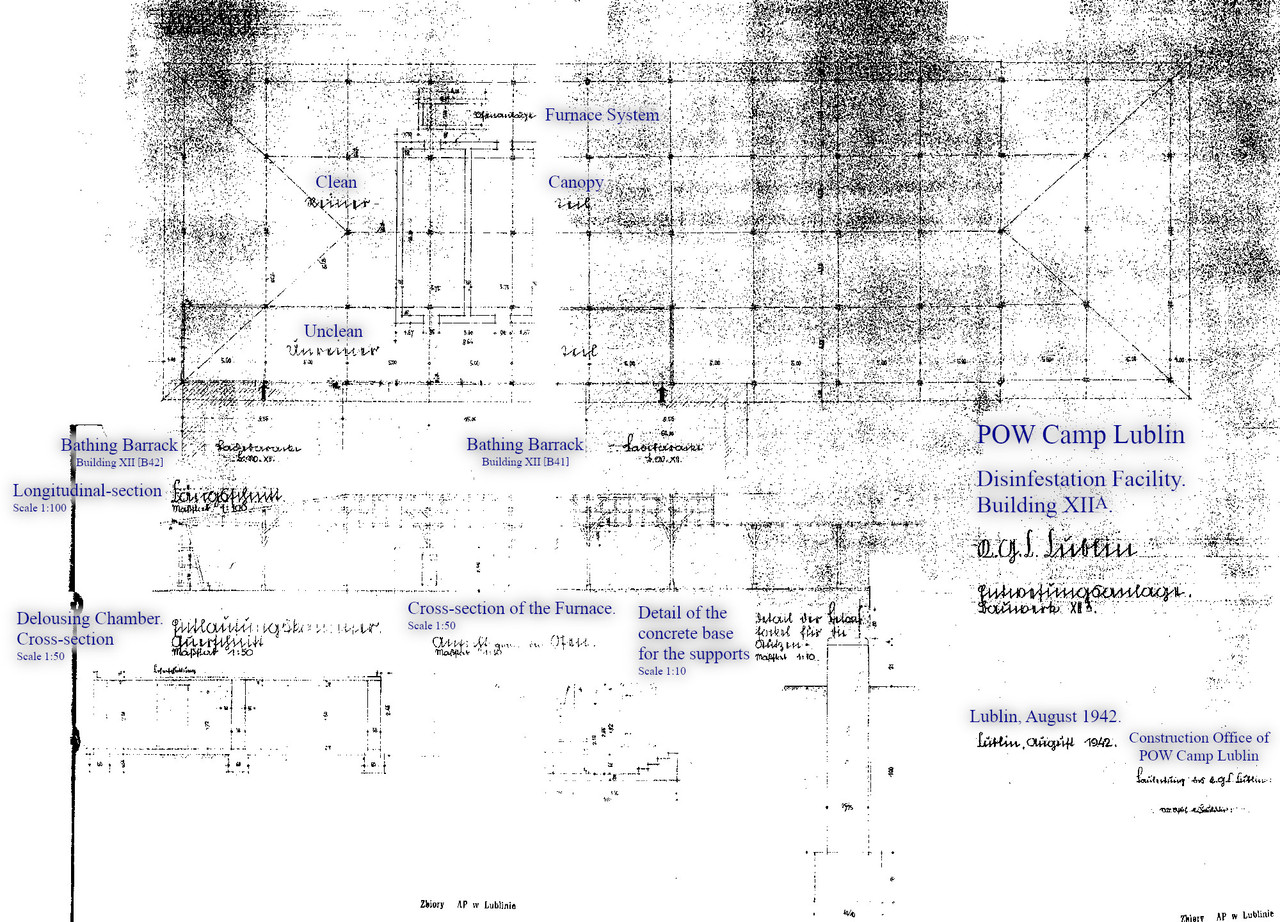
I think this is an effective way of showing that this place was built for a hygenic purpose. The roof's purpose was to air out clothing and other effects that went through disinfestation in the bunker. There are "clean" and "unclean" sides labelled. The crude arrows coming from the bathing barracks may indicate the flow of dirty clothing, since we know from the floorplan for barrack 42 that its north side was its unclean and undressing side.
Unfortunately the quality of the original image is poor. This is Concentration Camp Majdanek's Document 31. If anyone has a better quality scan, that would be helpful.
Some of my labels may need correction. "Canopy" is an unlikely translation for what appears to be "zeil", which is for some reason written twice on the drawing. At center, "Detail of the concrete" is correct, but whatever word comes after it is indecipherable to me. Corrections welcome.
I think this is an effective way of showing that this place was built for a hygenic purpose. The roof's purpose was to air out clothing and other effects that went through disinfestation in the bunker. There are "clean" and "unclean" sides labelled. The crude arrows coming from the bathing barracks may indicate the flow of dirty clothing, since we know from the floorplan for barrack 42 that its north side was its unclean and undressing side.
Unfortunately the quality of the original image is poor. This is Concentration Camp Majdanek's Document 31. If anyone has a better quality scan, that would be helpful.
Some of my labels may need correction. "Canopy" is an unlikely translation for what appears to be "zeil", which is for some reason written twice on the drawing. At center, "Detail of the concrete" is correct, but whatever word comes after it is indecipherable to me. Corrections welcome.
Re: Majdanek this and that
Weeks ago I asked the Google AI some questions about Crematorium 1.Fred Ziffel wrote: ↑Fri Oct 31, 2025 3:55 pm Yesterday I was having a conversation with Grok about Chamber "A" at Majdanek
I posted this photo and asked where the ceiling holes or even traces from past ceiling holes are?
Grok's reply?: "The traces in concrete eroded over time and you can no longer see them"
I pointed out "What about the traces you can see at the Auschwitz Crem 1 on floor and walls from former toilet stalls and separation walls built in 1944
Also
I asked Grok. ID the doorway symbol in the red rectangle on this April 1942 drawing
I had to ask Grok to ID the doorway two more times but Grok gave me information on the doors at Crem 2 and 3, Grok simply would not reply to Crem 1 doorway symbol. See drawing, I used to ask
If anyone ask Grok this, let me know the reply
I questioned why we cannot see any indications in the floor slab that it was busted up in order to install the oven flue system which is said to run under the floor and underground to the chimney.
It answered by saying that after installing the flue system the entire floor of the building was re-poured.
Then I asked the same question about the plumbing drains that would have been needed for the toilets when it was converted into a bomb shelter. The answer it gave was there were no toilets, so there would be no indication that the floor was busted up a second time to install toilet drains.

Re: Majdanek this and that
I have always assumed the two sides were for men and women.Wetzelrad wrote: ↑Fri Dec 05, 2025 5:12 am ...
In their separate universe, the Majdanek Museum claims that B41 was the men's bathhouse and B42 was the women's bathhouse, with this supposed distinction being part of the selection process. This is truly illogical, because it would mean women's clothing was deloused and returned to them while it was the men that were gassed. Reversing their assignments would make more sense, since if the extermination theory is true women should be more likely to be gassed.
I'm looking for any evidence that this building gender assignment actually existed. It would make sense, if incoming inmates were first brought to the delousing facility, to separate inmates one gender to each building, but currently I am unsuccessful in finding any evidence for it.
...
I don't have any references off the top of my head, but there are probably tons of sources establishing sex segregation as a general practice for the showering and delousing. For Majdanek specifically and this specific facility, it might be harder to find something since there aren't as many Majdanek memoirs.
Although it's not a conclusive point by any means, the morgues-as-fake-showers story at Auschwitz has always struck me as a bit odd since there's way to segregate by sex. You'd have to process everyone as one big group. With the Krema II layout for example, everyone would have to strip and then cram in together naked. At nearly 10 bodies per square meter. Just from a practical stand point, I think you'd have a lot of issues getting the victims to cooperate with this.
Incredulity Enthusiast
- Fred Ziffel
- Posts: 332
- Joined: Sun Dec 01, 2024 11:02 am
Re: Majdanek this and that
New video out on the Majdanek front
It is about two dudes giving a tour of the camp with a representative of the Majdanek State Museum named Anna. She is sort of the spokesperson for the camp. I traded a couple emails with her a couple years back.
Since the dudes are doing a tour with her, the content has some worth. This is not one of those lying rabbi tours,
The video has a few lies but also some truths too. However, it is what they do not say about the two gas chambers "A" and B1.
They admit the B41 blue stained room was not for gassing with Zyklon B. They made a point of showing the blue stains in this room, however, when they talk about the gas chambers in the bunker, they did not say anything about...
1. The ceiling hole in B1 being for dropping in Zyklon pellets
2. B1 not having any blue staining
3. they did not say anything about the blue staining in "A" Chamber when showing the room
So in a way, the museum is saying there was no Zyklon use in these rooms and therefore no more rooms at this camp they can point to as Zyklon gas chamber. They did say that CO gas was used to kill inmates in both rooms. They said nothing about CO2 engraved on the bottles.
They talked about the cremation facility coming into service and gassing timeline. He said it went into service in fall 1943 but that is not true, it came into service in Jan 1944. see my attached. this is finally being admitted by the museum
They admitted that that under the Flying Saucer monument there are human remains AND regular soil. They pushed the fertilizer story which is nothing more than BS. I have an attachment for that if interested
I attach a very good photo of B1 if interested in it for your photo collection
Link to video, I needed to watch video on my smart TV to get subtitles in English, video done in polish but is possible to get English subtitles:
It is about two dudes giving a tour of the camp with a representative of the Majdanek State Museum named Anna. She is sort of the spokesperson for the camp. I traded a couple emails with her a couple years back.
Since the dudes are doing a tour with her, the content has some worth. This is not one of those lying rabbi tours,
The video has a few lies but also some truths too. However, it is what they do not say about the two gas chambers "A" and B1.
They admit the B41 blue stained room was not for gassing with Zyklon B. They made a point of showing the blue stains in this room, however, when they talk about the gas chambers in the bunker, they did not say anything about...
1. The ceiling hole in B1 being for dropping in Zyklon pellets
2. B1 not having any blue staining
3. they did not say anything about the blue staining in "A" Chamber when showing the room
So in a way, the museum is saying there was no Zyklon use in these rooms and therefore no more rooms at this camp they can point to as Zyklon gas chamber. They did say that CO gas was used to kill inmates in both rooms. They said nothing about CO2 engraved on the bottles.
They talked about the cremation facility coming into service and gassing timeline. He said it went into service in fall 1943 but that is not true, it came into service in Jan 1944. see my attached. this is finally being admitted by the museum
They admitted that that under the Flying Saucer monument there are human remains AND regular soil. They pushed the fertilizer story which is nothing more than BS. I have an attachment for that if interested
I attach a very good photo of B1 if interested in it for your photo collection
Link to video, I needed to watch video on my smart TV to get subtitles in English, video done in polish but is possible to get English subtitles:
- Attachments
-
- y45t5t6w3.JPG (85.16 KiB) Viewed 5109 times
-
- B1 B1.JPG (110.57 KiB) Viewed 5109 times
-
- 1111rgef.JPG (105.19 KiB) Viewed 5109 times
-
- Anna.JPG (129.54 KiB) Viewed 5109 times
I do not believe anything one is not allowed to question
- Fred Ziffel
- Posts: 332
- Joined: Sun Dec 01, 2024 11:02 am
Re: Majdanek this and that
Someone sent me this reply to a post. I got a laugh out of it, perhaps you all will find it interesting
see attached
see attached
- Attachments
-
- poyu.JPG (19.27 KiB) Viewed 5027 times
I do not believe anything one is not allowed to question
- Fred Ziffel
- Posts: 332
- Joined: Sun Dec 01, 2024 11:02 am
Re: Majdanek this and that
You all have seen those two rollers that were used to compress the dirt on the roads of Majdanek?
The museum does tell some truth to what they wrote. Being that inmates pulled these rollers to compress the road.
What they leave out is as shown in the photo, it was pulled by 5 adult males. see attached
The rollers we see in the photos appear to be different. Majdanek photo is concrete, and the other has a metal surface
I would wager that beginning to pull those rollers and pulling up a slope would take some amount effort, but once they get it going, certainly not so exhausting work. I suppose the conditions of the road can cause resistance too.
They could have just as easy pull it with some vehicle and be faster.
Nothing more to say about this
The museum does tell some truth to what they wrote. Being that inmates pulled these rollers to compress the road.
What they leave out is as shown in the photo, it was pulled by 5 adult males. see attached
The rollers we see in the photos appear to be different. Majdanek photo is concrete, and the other has a metal surface
I would wager that beginning to pull those rollers and pulling up a slope would take some amount effort, but once they get it going, certainly not so exhausting work. I suppose the conditions of the road can cause resistance too.
They could have just as easy pull it with some vehicle and be faster.
Nothing more to say about this
- Attachments
-
- Roller display.JPG (271.42 KiB) Viewed 4874 times
-
- b4.JPG (99.25 KiB) Viewed 4874 times
-
- pushing pysics.JPG (159.04 KiB) Viewed 4874 times
I do not believe anything one is not allowed to question
- Fred Ziffel
- Posts: 332
- Joined: Sun Dec 01, 2024 11:02 am
Re: Majdanek this and that
can someone help me?
Does anyone know the name of the Majdanek related dude in the attached. I looked everywhere in my files and Inet but unable to ID
Lucash XXXXXX
I am building an argument to present here and wish to be as complete as possible
see attached
Thanks in advance
Does anyone know the name of the Majdanek related dude in the attached. I looked everywhere in my files and Inet but unable to ID
Lucash XXXXXX
I am building an argument to present here and wish to be as complete as possible
see attached
Thanks in advance
- Attachments
-
- etyeyue664w2.JPG (33.5 KiB) Viewed 4842 times
I do not believe anything one is not allowed to question
Re: Majdanek this and that
I'm quite certain that's Łukasz Mrozik. You can see his name and photos here:
https://www.belzec.eu/en/news/new_exhib ... caust/1793
https://www.belzec.eu/en/news/new_exhib ... caust/1793
- Fred Ziffel
- Posts: 332
- Joined: Sun Dec 01, 2024 11:02 am
Re: Majdanek this and that
From a standpoint of Zyklon B gas chambers at Majdanek alone, I present these two attachments
From the perspective of Tomaz Kranz, Head of Research (the big cheese), and the head or archive at the Majdanek State Museum.
this is about what "They" say about gas chambers "A" and B1. If you read what they said, there are simply no more Zyklon gas chambers at Majdanek at their own admission. They still push Carbon Monoxide though. If we lived in a fair world, they would have to remove all reference and displays of Zyklon cans at Majdanek
Remember, Pressac is quoted as saying he doubts any of the rooms ("A", B1 and B2) were Zyklon B Gas Chambers but holds firm on CO gas chambers
See attached
Wetzelrad, Thanks so much for your help with Lukash's name.
From the perspective of Tomaz Kranz, Head of Research (the big cheese), and the head or archive at the Majdanek State Museum.
this is about what "They" say about gas chambers "A" and B1. If you read what they said, there are simply no more Zyklon gas chambers at Majdanek at their own admission. They still push Carbon Monoxide though. If we lived in a fair world, they would have to remove all reference and displays of Zyklon cans at Majdanek
Remember, Pressac is quoted as saying he doubts any of the rooms ("A", B1 and B2) were Zyklon B Gas Chambers but holds firm on CO gas chambers
See attached
Wetzelrad, Thanks so much for your help with Lukash's name.
- Attachments
-
- kranz maj A chamber.JPG (157.86 KiB) Viewed 4681 times
-
- Lukash.JPG (131.92 KiB) Viewed 4681 times
-
- B2 staining.JPG (45.64 KiB) Viewed 4681 times
I do not believe anything one is not allowed to question
- Fred Ziffel
- Posts: 332
- Joined: Sun Dec 01, 2024 11:02 am
Re: Majdanek this and that
does someone know something better than dropbox? I have a PDF to upload to show you all of a project I am working on
I do not believe anything one is not allowed to question