Atrocity Propaganda, Then and Now

Re: Atrocity Propaganda, Then and Now
Some journalists and historians use eyewitness, when witness would be better and it would be clearer that it is hearsay evidence. So-called revisionists are dreadful at accurately differentiating between the two. A "rough plan" is not to be taken literally.
Sanity Check - "Thus, currently revisionists can console themselves by affirming their incredulity..."
-
Eye of Zyclone

- Posts: 551
- Joined: Fri Apr 04, 2025 3:12 pm
Re: Atrocity Propaganda, Then and Now
And some journalists and historians use alleged "hearsay evidence" (fictive stories full of untenable holes) and deceptively make their readers believe that they're reading eyewitness testimonies. Looks more convincing that way.
"Holocaust deniers are very slick people. They justify everything they say with facts and figures."
Re: Atrocity Propaganda, Then and Now
Indeed they do and they are wrong. You have still failed to prove Vrba lied.Eye of Zyclone wrote: ↑Wed Dec 03, 2025 3:49 pmAnd some journalists and historians use alleged "hearsay evidence" (fictive stories full of untenable holes) and deceptively make their readers believe that they're reading eyewitness testimonies. Looks more convincing that way.
Sanity Check - "Thus, currently revisionists can console themselves by affirming their incredulity..."
-
Eye of Zyclone
- Posts: 551
- Joined: Fri Apr 04, 2025 3:12 pm
Re: Atrocity Propaganda, Then and Now
Nope. Reverse burden of proof. YOU still have to prove that he didn't lie with solid tangible evidence, but you'll never even try to do that. Who needs real evidence with "facts of common knowledge" (a convenient carte blanche made by the victors in Nuremberg to avoid having to prove their allegations) on his side after all?Nessie wrote: ↑Wed Dec 03, 2025 4:21 pmIndeed they do and they are wrong. You have still failed to prove Vrba lied.Eye of Zyclone wrote: ↑Wed Dec 03, 2025 3:49 pmAnd some journalists and historians use alleged "hearsay evidence" (fictive stories full of untenable holes) and deceptively make their readers believe that they're reading eyewitness testimonies. Looks more convincing that way.
"Holocaust deniers are very slick people. They justify everything they say with facts and figures."
Re: Atrocity Propaganda, Then and Now
No. When you claim he lied, the burden of proof is on you. You know you cannot, so you reverse the burden of proof.Eye of Zyclone wrote: ↑Wed Dec 03, 2025 4:30 pmNope. Reverse burden of proof.Nessie wrote: ↑Wed Dec 03, 2025 4:21 pmIndeed they do and they are wrong. You have still failed to prove Vrba lied.Eye of Zyclone wrote: ↑Wed Dec 03, 2025 3:49 pm
And some journalists and historians use alleged "hearsay evidence" (fictive stories full of untenable holes) and deceptively make their readers believe that they're reading eyewitness testimonies. Looks more convincing that way.
The corroborating evidence that proves gassings, proves Vrba did not lie about gassings. He made mistakes about the details, but that is to be expected, since he got his information second hand. He was dishonest, when he mixed hearsay with what he saw, but lots of witnesses do that and at least he admitted to what he had done, so that admission makes lying difficult to prove.YOU still have to prove that he didn't lie with solid tangible evidence, but you'll never even try to do that. Who needs real evidence with "facts of common knowledge" (a convenient carte blanche made by the victors in Nuremberg to avoid having to prove their allegations) on his side after all?
Sanity Check - "Thus, currently revisionists can console themselves by affirming their incredulity..."
Re: Atrocity Propaganda, Then and Now
As for facts of common knowledge, that is a term meaning the defence and prosecution accept something as fact, because of the evidence. Lawyers defending the Auschwitz SS camp staff accepted gassings took place, because of the evidence they took place, including admissions by the Nazis themselves. That means during the trial, the defence is not going to deny the crime alleged, happened.
Sanity Check - "Thus, currently revisionists can console themselves by affirming their incredulity..."

Re: Atrocity Propaganda, Then and Now
It was sufficient proof that those that were 'breaking the News' on 'the total annihilation of the Jewish with gas chambers' were lying - and that maliciously.
-
Eye of Zyclone
- Posts: 551
- Joined: Fri Apr 04, 2025 3:12 pm
Re: Atrocity Propaganda, Then and Now
And I can't prove either that the witnesses to alien abductions lied or hallucinated, but alien abductions are not regarded as a proven fact despite their testimonies because the burden of proof is on them, not on me. This is a normal burden of proof in the modern world. Outside the wonderful world of Holocaustianity and other mythologies, the crazy allegations about anything are not regarded as true until proven wrong. Not how it works anymore.Nessie wrote: ↑Wed Dec 03, 2025 5:00 pmNo. When you claim he lied, the burden of proof is on you. You know you cannot, so you reverse the burden of proof.
With the use of a priori conclusions, anything becomes a corroborating evidence. That's how false paradigms persist and even strengthen themselves with the passing of time.Nessie wrote: ↑Wed Dec 03, 2025 5:00 pmThe corroborating evidence that proves gassings, proves Vrba did not lie about gassings. He made mistakes about the details, but that is to be expected, since he got his information second hand. He was dishonest, when he mixed hearsay with what he saw, but lots of witnesses do that and at least he admitted to what he had done, so that admission makes lying difficult to prove.YOU still have to prove that he didn't lie with solid tangible evidence, but you'll never even try to do that. Who needs real evidence with "facts of common knowledge" (a convenient carte blanche made by the victors in Nuremberg to avoid having to prove their allegations) on his side after all?
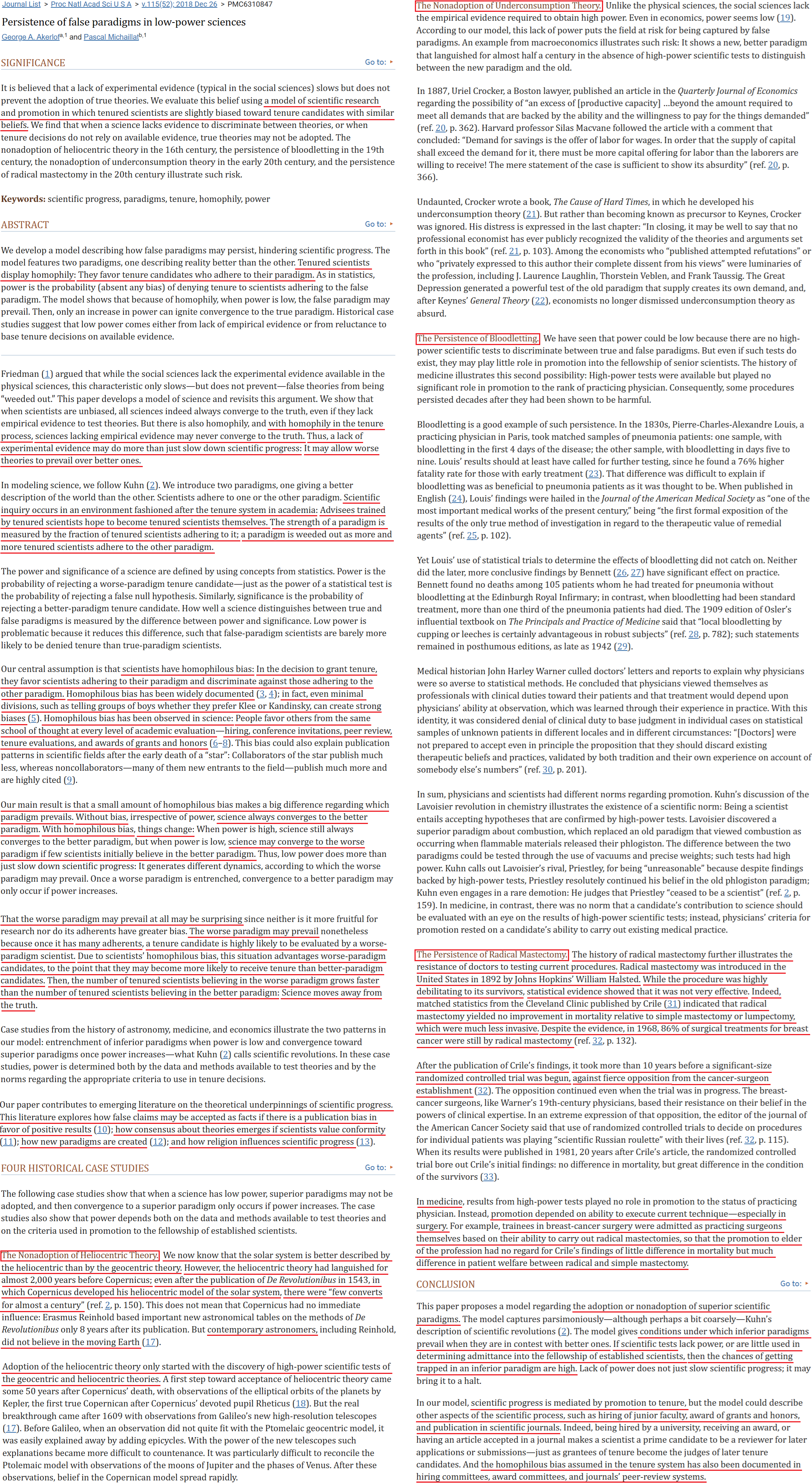
https://www.pnas.org/doi/10.1073/pnas.1816454115
"Holocaust deniers are very slick people. They justify everything they say with facts and figures."
-
Eye of Zyclone
- Posts: 551
- Joined: Fri Apr 04, 2025 3:12 pm
Re: Atrocity Propaganda, Then and Now
Wrong. So-called "facts of common knowledge," which are the basis of the judicial notice thing, exempt someone from having to provide evidence for something. That's even their raison d'être in the judicial system of those who won WW2.
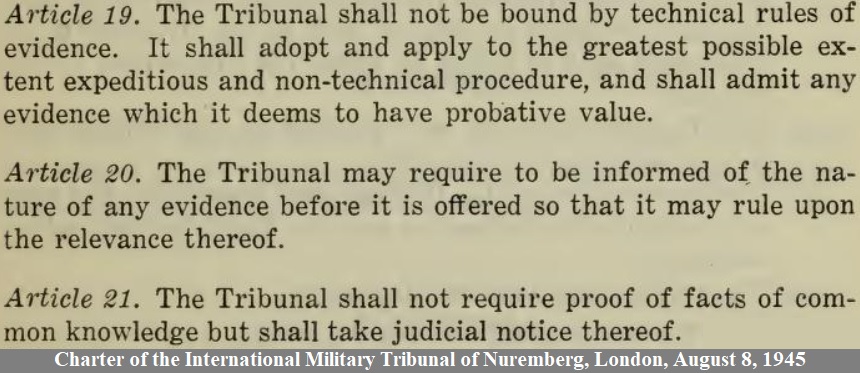
Judicial notice
Judicial notice is a rule in the law of evidence that allows a fact to be introduced into evidence if the truth of that fact is so notorious or well-known, or so authoritatively attested, that it cannot reasonably be doubted. This is done upon the request of the party seeking to rely on the fact at issue. Facts and materials admitted under judicial notice are accepted without being formally introduced by a witness or other rule of evidence, even if one party wishes to plead evidence to the contrary.
Judicial notice is frequently used for the simplest, most obvious common sense facts, such as which day of the week corresponded to a particular calendar date or the approximate time at sunset.
Historical examples
In the 1981 case of Mel Mermelstein v. Institute for Historical Review, the Superior Court of Los Angeles County took judicial notice of the fact that Jews were gassed to death at the Auschwitz Concentration Camp in 1944.
https://en.wikipedia.org/wiki/Judicial_notice
Mel Mermelstein
He is best known for his litigation with the Institute for Historical Review over evidence of gas chambers in German concentration camps during World War II. The legal dispute was resolved in Mermelstein's favor, without the court giving an opinion on the merits of the dispute, since it ruled that the existence of gas chambers at Auschwitz is a legally indisputable fact.
In 1980, the Institute for Historical Review (IHR) promised a $50,000 reward to anyone who could prove that Jews were gassed at Auschwitz.[5]
Mermelstein wrote a letter to the editors of the Los Angeles Times and others, including The Jerusalem Post. The Institute for Historical Review wrote back, offering him $50,000 for proof that Jews were, in fact, gassed in the gas chambers at Auschwitz. Mermelstein, in turn, submitted a notarized account of his internment at Auschwitz and how in 1944 he witnessed Nazi guards ushering his mother and two sisters and others towards (as he learned later) gas chamber number five.[5]
The IHR refused to pay the reward, stating that Mermelstein's notarized account was "not sufficient proof". Represented by public interest attorney William John Cox, Mermelstein subsequently sued the IHR in the Superior Court of Los Angeles County for breach of contract, anticipatory repudiation, libel, injurious denial of established fact, intentional infliction of emotional distress, and declaratory relief (see case no. C 356 542). On October 9, 1981, both parties in the Mermelstein case filed motions for summary judgment in consideration of which Judge Thomas T. Johnson of the Superior Court of Los Angeles County took "judicial notice of the fact that Jews were gassed to death at the Auschwitz Concentration Camp in Poland during the summer of 1944",[1][6] judicial notice meaning that the court treated the gas chambers as common knowledge, and therefore did not require evidence that the gas chambers existed. On August 5, 1985, Judge Robert A. Wenke entered a judgment based upon the Stipulation for Entry of Judgment agreed upon by the parties on July 22, 1985. The judgment required IHR and other defendants to pay $90,000 to Mermelstein and to issue a letter of apology to "Mr. Mel Mermelstein, a survivor of Auschwitz-Birkenau and Buchenwald, and all other survivors of Auschwitz" for "pain, anguish and suffering" caused to them.[6][5]
https://en.wikipedia.org/wiki/Mel_Mermelstein
The "evidence" being the divergent and now-admittedly-false testimonies of Ada Bimko and Zofia Litwinska in this instance.


"Holocaust deniers are very slick people. They justify everything they say with facts and figures."
-
Eye of Zyclone
- Posts: 551
- Joined: Fri Apr 04, 2025 3:12 pm
Re: Atrocity Propaganda, Then and Now
Oy vey. That's just deniers' hypercriticism.

"Holocaust deniers are very slick people. They justify everything they say with facts and figures."

Re: Atrocity Propaganda, Then and Now
Some reading;
https://codoh.com/library/document/brit ... r-factory/
—Cavendish-Bentinck—As regards putting Poles to death in gas chambers, I do not believe that there is any evidence that this has been done.
https://codoh.com/library/document/brit ... r-factory/
If I were to guess why no t4 personnel were chosen to perform gassing that had experience with gassing, it would be because THERE WERE NONE.
-
Eye of Zyclone
- Posts: 551
- Joined: Fri Apr 04, 2025 3:12 pm
Re: Atrocity Propaganda, Then and Now
Stubble wrote: ↑Thu Dec 04, 2025 1:07 am Some reading;
—Cavendish-Bentinck—As regards putting Poles to death in gas chambers, I do not believe that there is any evidence that this has been done.
https://codoh.com/library/document/brit ... r-factory/
Britain’s Rumor Factory
Origins of the Gas Chamber Story
By Andy Ritchie ∙ March 9, 2017
In August 1943 Poland’s government-in-exile lobbied the British and American governments to issue a public statement condemning “German terror in Poland”. Moray McLaren – head of the Polish section of Britain’s main propaganda body the Political Warfare Executive (PWE) – advised the Foreign Office “in confidence that, from his contacts with the Poles, he has recently gained the impression that they are becoming seriously worried lest the Germans might shortly succeed in persuading Polish quislings to come forward and even form some kind of puppet government. The present Polish request may possibly have some connection with such fears.”[3]
Moreover, Britain’s own Special Operations Executive (SOE), responsible for organizing and supplying Polish underground fighters, reported that German anti-partisan operations were increasingly successful in “affecting their work, in that the cells of the underground resistance movement in the affected areas are to a great extent liquidated, and materials delivered are liable to be discovered. SOE would accordingly welcome any form of deterrent that could be devised.”
Denis Allen of the Foreign Office’s Central Department (not to be confused with the unrelated Roger Allen who also figures in this story) suggested that a statement should be issued with “some indication that the actions being carried out by the German authorities in Poland will in some measure be held against Germany as a whole”. With the British Parliament in its summer recess and Prime Minister Winston Churchill on his way to Quebec for a secret summit with U.S. President Franklin Roosevelt, the most logical opportunity would be for a joint Anglo-American statement (issued to the press rather than to Parliament).
Allen’s department had prepared a draft statement which was discussed with the Poles. This condemned the “brutality” of German anti-partisan operations involving mass deportations in the Lublin area of southeastern Poland. The draft statement (which made no reference to Jews and seemed to relate to Polish civilians) alleged:
[...]“Some children are killed on the spot, others are separated from their parents and either sent to Germany to be brought up as Germans or sold to German settlers or despatched with the women and old men to concentration camps, where they are now being systematically put to death in gas chambers.
His Majesty’s Government re-affirm their resolve to punish the instigators and actual perpetrators of these crimes. They further declare that, so long as such atrocities continue to be committed by the representatives and in the name of Germany, they must be taken into account against the time of the final settlement with Germany. Meanwhile the war against Germany will be prosecuted with the utmost vigour until the barbarous Hitlerite tyranny has been finally overthrown.”
One of the most secret parts of SO1/PWE work involved the propagation of rumors, known as “sibs” from the Latin verb sibilare (to whisper), by an Underground Propaganda (UP) Committee. This dated back to the Electra House days in 1940 shortly before the creation of SOE, and continued through the various bureaucratic changes.
From August 1941, the UP Committee was chaired by David Bowes-Lyon, younger brother of the then Queen (and uncle of the present Queen Elizabeth II) – he was also a cousin of Victor Cavendish-Bentinck. He later summarized the purpose of sibs in a “Most Secret” paper for senior bureaucrats:
The UP Committee (which included representatives from PWE, SOE, MI6 and the Ministry of Economic Warfare), was responsible in the first instance for deciding on suitable rumors, which would then be cleared through the Foreign Office or JIC:[19]“The object of propaganda rumours is […] to induce alarm, despondency and bewilderment among the enemies, and hope and confidence among the friends, to whose ears it comes. If a rumour appears likely to cheer our enemies for the time, it is calculated to carry with it the germ of ultimate and grave disappointment for them.
Rumours vary immensely in their degree of credibility, the wideness of their diffusion and the type of audience for which they are designed; but they have these factors in common, that they are intended for verbal repetition through all sorts of channels, and that they are expected to induce a certain frame of mind in the general public, not necessarily to deceive the well-informed.”
[...]“Dissemination of those rumours finally approved is the function of SOE. For this purpose whispering organisations have been set up in neutral countries and in unoccupied France. Lines have also been established by which rumours can be passed to SOE’s collaborators in Germany, and directives on oral propaganda to an organisation in Northern Italy.
It should be emphasised that the method of dissemination is essentially oral, and this is the most difficult form of propaganda for enemy security services to deal with.
Rumours are not deliberately placed in the Press and Radio in Europe, though they have from time to time appeared in the newspapers or broadcasts, having been picked up by correspondents or commentators.
In the USA, however, a news agency controlled by SOE has been used to place them in the Press of the American continent; but here again the newspapers were quite unaware that the material was in any way inspired.
Rumours are therefore the most covert of all forms of propaganda. Although the enemy may suspect that a certain rumour has been started by the British Government, they can never prove it. Even if they succeed in capturing an agent engaged in spreading whispers, there will be no written evidence against him, and should they extort a confession from him, nothing is easier than for the British Government to deny the whole story.
In fact, although more than 2,000 rumours have been disseminated in the last year, we have no evidence that the enemy have ever traced any of them back to a British whispering organisation. Those that have been denied or otherwise referred to have, as far as we know, been attributed to other sources.”
On 3rd December 1940 a sib was launched via SOE[21]
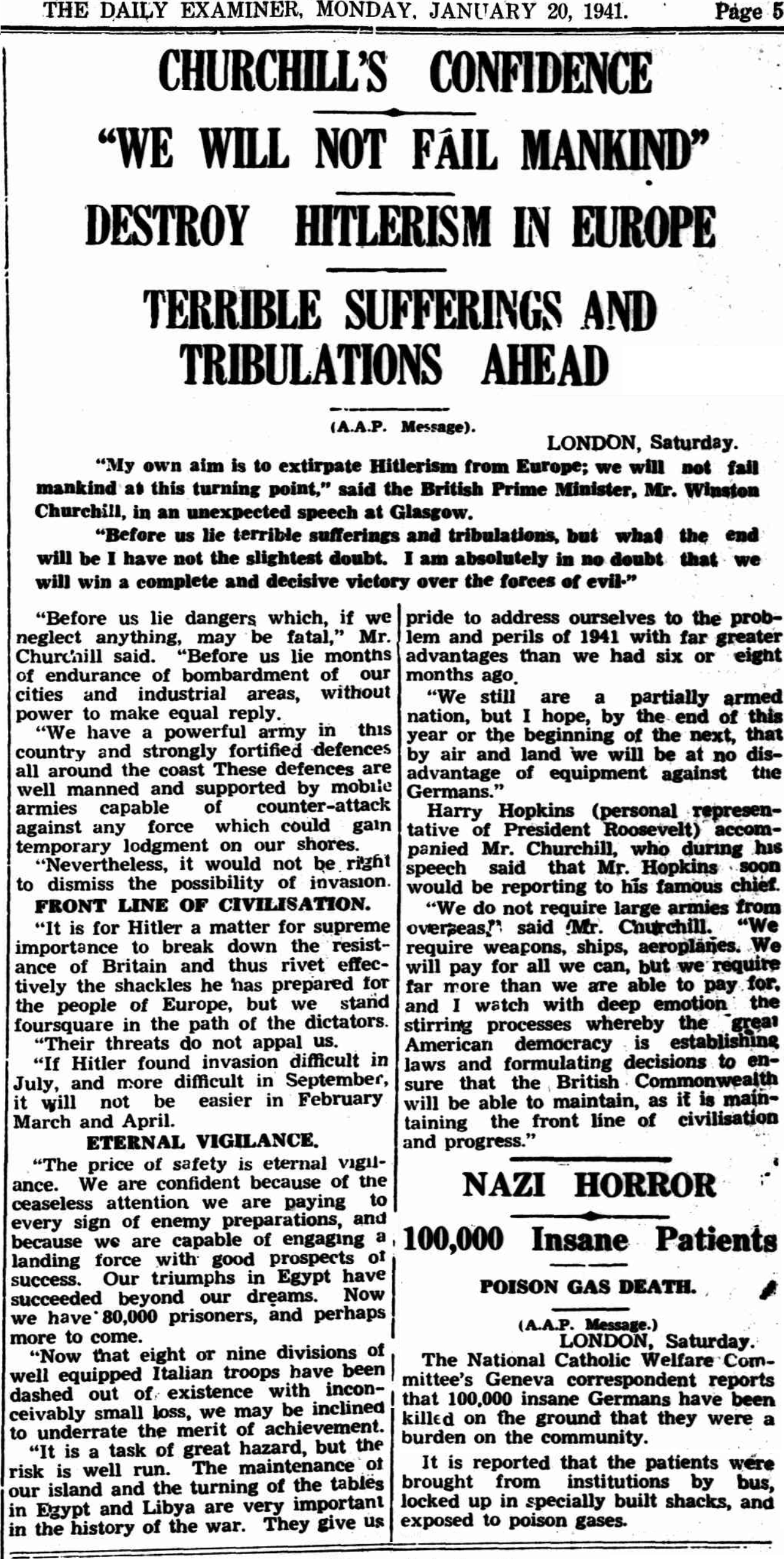
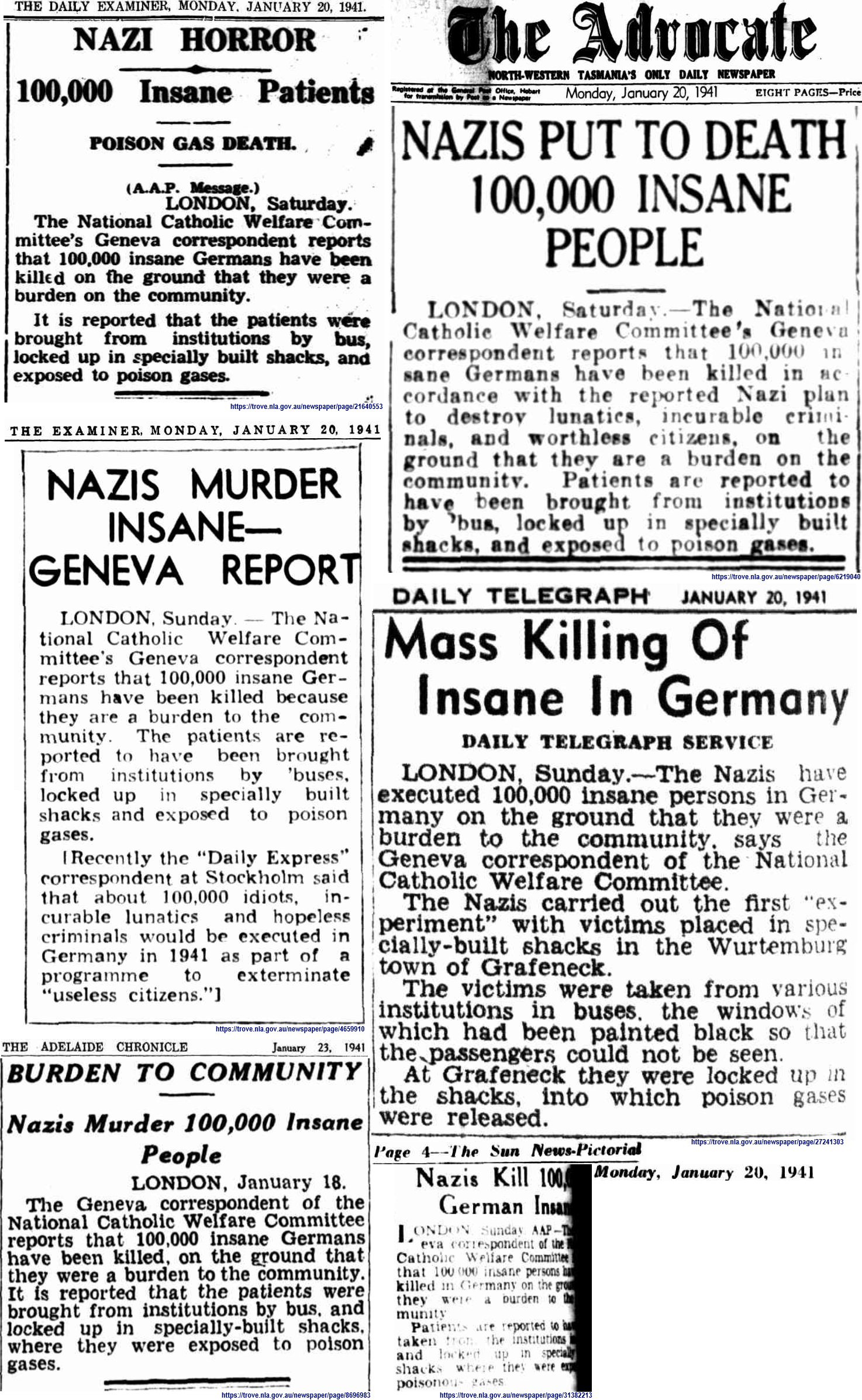
The Bethel Institution was a well-known Protestant charitable hospital for the mentally ill and epileptics. In fact its director – Protestant theologian Friedrich von Bodelschwingh – was not sent to Dachau or any other camp. He survived the war and died in 1946.[22]“that the Superintendent of the Bethel Institute for Incurables had been sent to Dachau for refusing to permit the inmates to be put in lethal chambers. Within two weeks it was reported that this rumour was circulating in Switzerland and, on the 19th December, that the Vatican had issued a decree condemning the killing of physical or mental deficients. The rumour has appeared in intercepted letters, and last Sunday the Sunday Express carried the story that 100,000 mental deficients had been executed.”
The main purpose of this sib was to stir up hostility between the Churches and the National Socialist Government over the issue of eugenics and euthanasia. SO1’s French specialist Prof. Denis Brogan (a Cambridge political scientist) was said to have “extremely fine Catholic contacts” in various countries,[23] and “Catholic channels for rumours” were also discussed with Douglas Woodruff, the influential editor of the Catholic journal The Tablet.[24] At this very early stage, the gassing rumor was restricted to “incurables” – it was a story about euthanasia rather than politically or racially motivated executions.
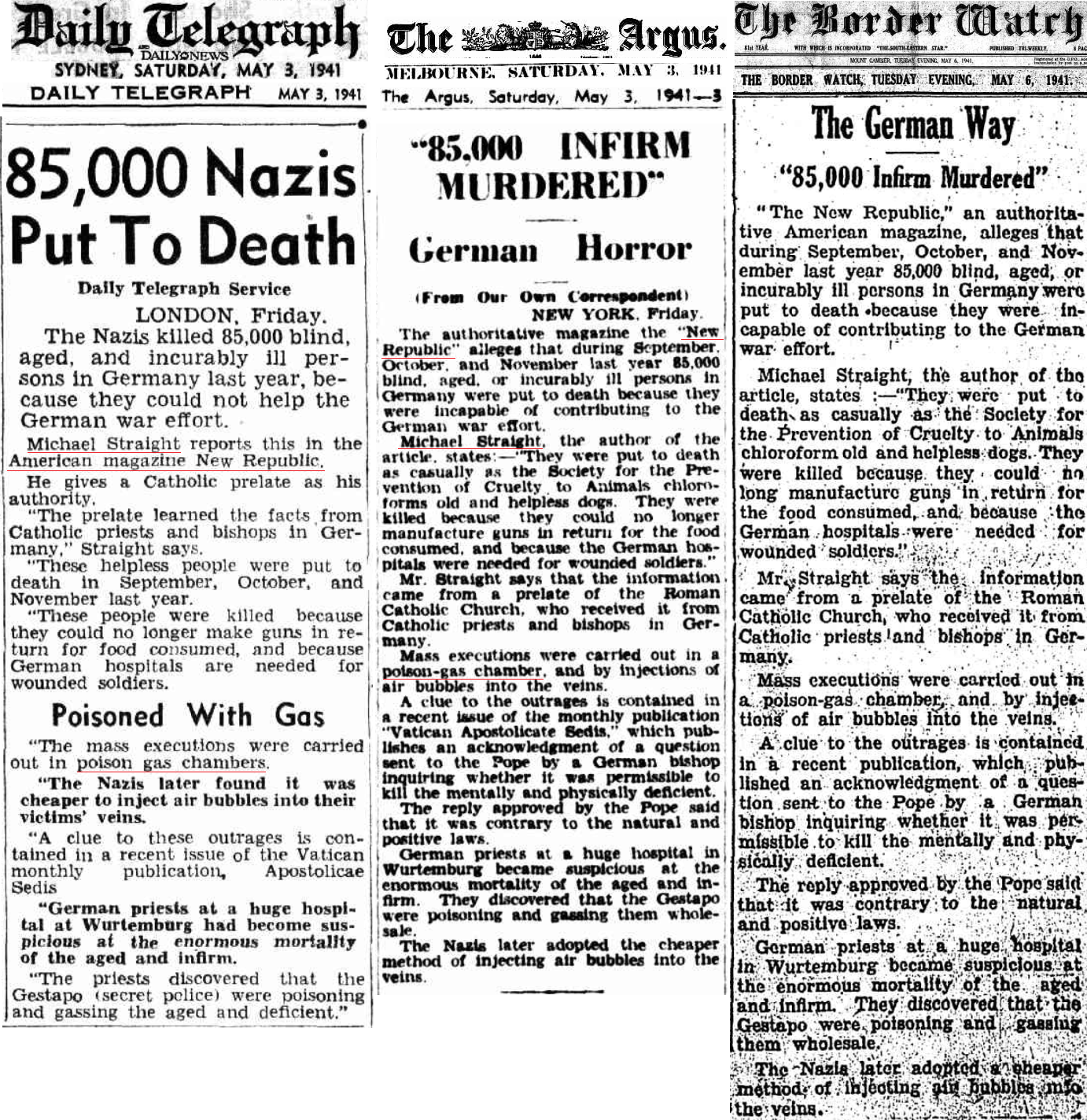
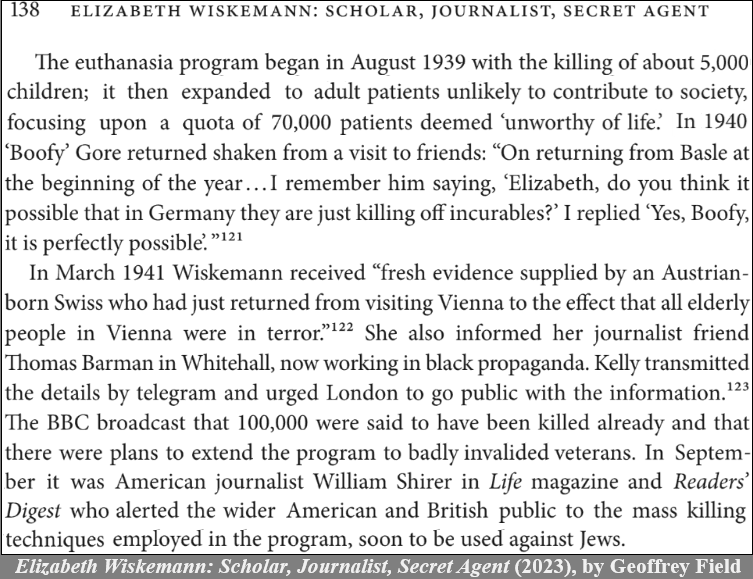
A few months later SOE reported with satisfaction that this sib had been picked up by Vatican Radio. Moreover, Elizabeth Wiskemann – a Swiss-based, Anglo-German journalist, historian and MI6 operative – had acquired “fresh evidence supplied by Austrian-born Swiss who had just returned from visiting Vienna to the effect that all elderly people in Vienna were in terror.”[25]
Among other euthanasia sibs (first circulated in November 1940) was a “rumour that doctors in military hospitals in France have been instructed to make death easy for incapacitated soldiers and airmen”. Extra bite was given to this sib by the suggestion (intended to promote inter-service resentment) that in the case of infantry the loss of one limb would amount to incapacity, leading to euthanasia, whereas this “was not to be considered incapacity in the case of Air Force or SS troops”.[26]
Intercepted letters from Swiss civilians during August 1941 showed that they were innocently passing on versions of the gas-chamber story. One wrote:
A separate letter gave another variant inspired by the same sib:[27]“Somebody from Bern who was in Germany said, the new bombs from England were awful, they break half a street to pieces, and somewhere in a shelter, people were all on the ceiling smashed like flies, it was terrible, and so very many were ill with their nerves as they had not room for them in the hospitals, and with some which were not get better, they just open the gas and kill them, like the heavy wounded too…”
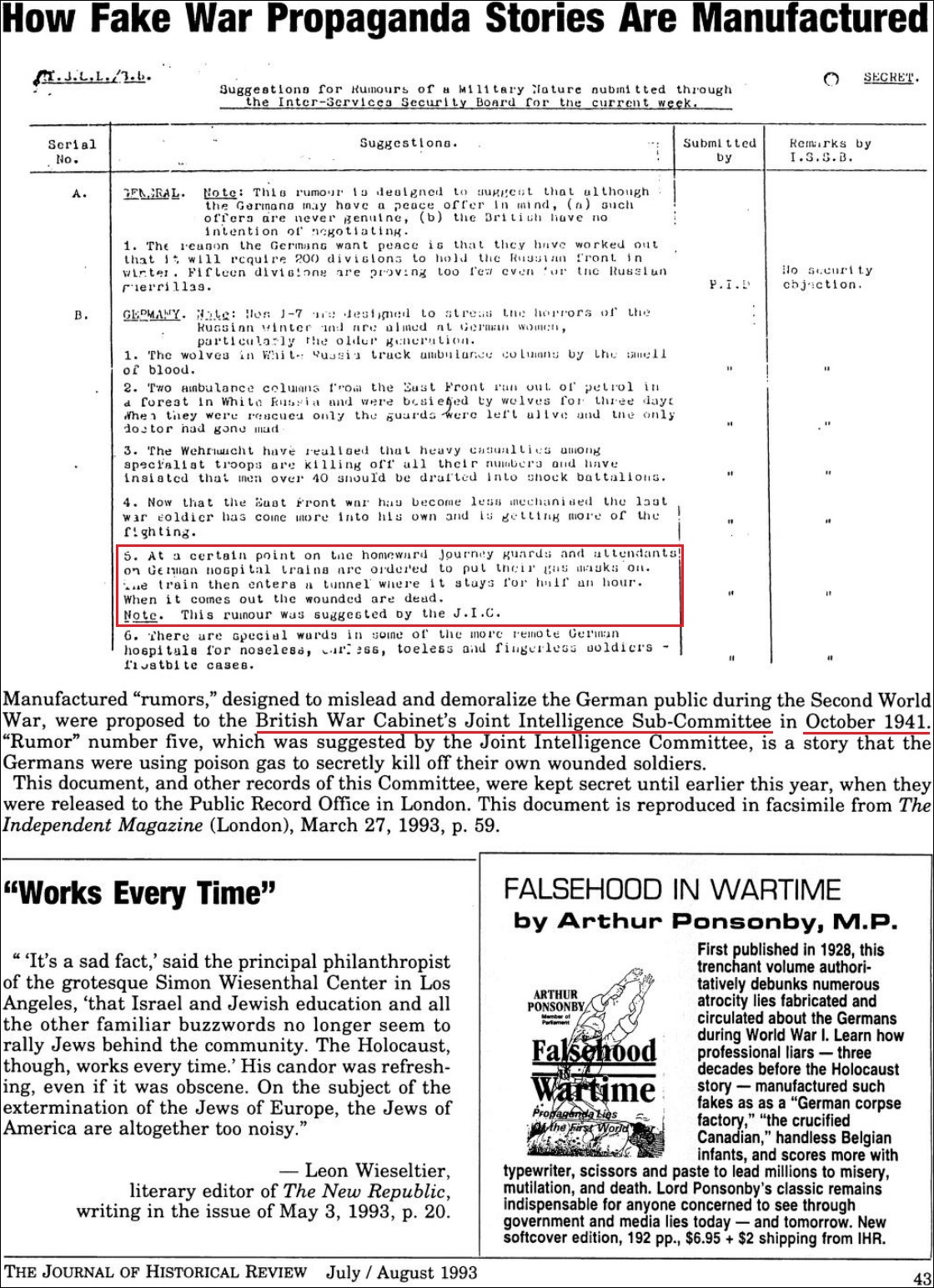
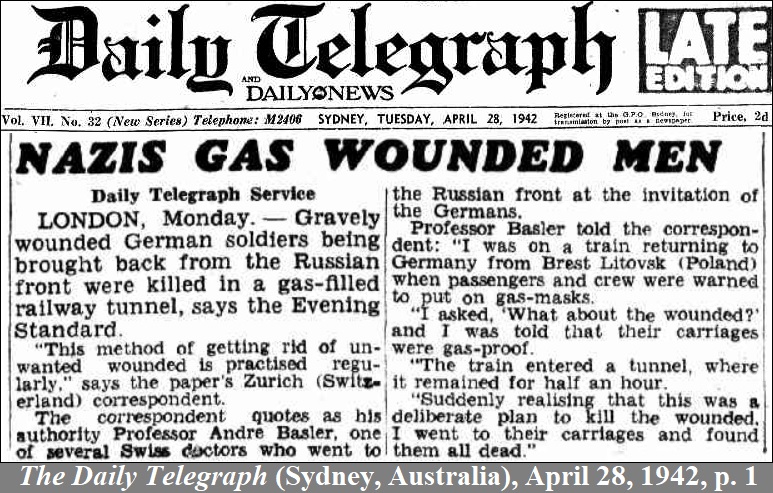
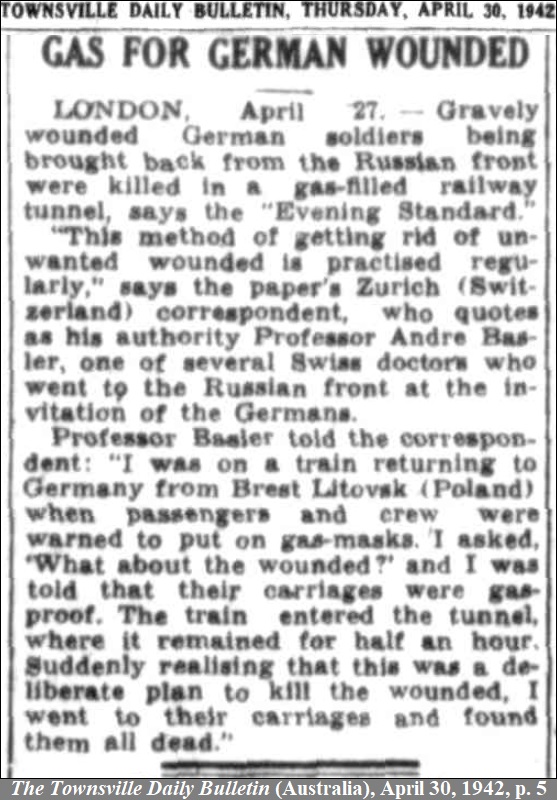
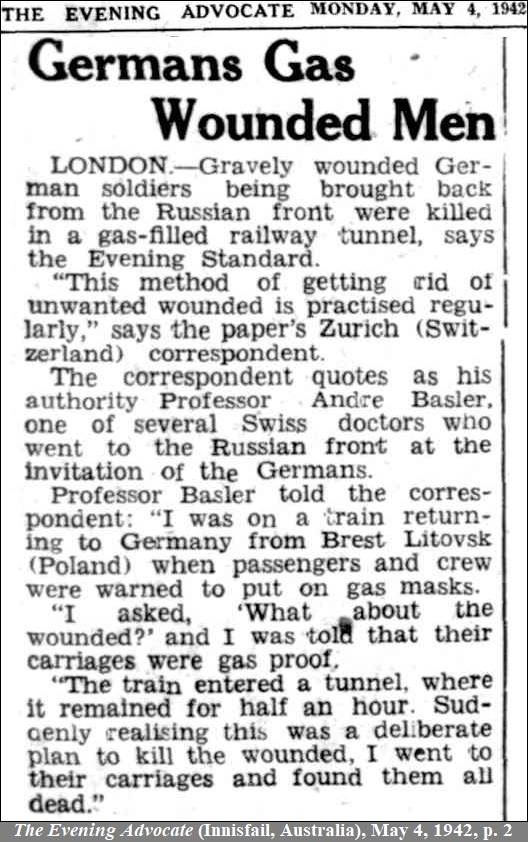
While most sibs originated from PWE, the success of this gas-chamber rumor led to a War Office suggestion passed to Cavendish-Bentinck’s JIC in November 1941. They had heard it from their military attaché in Berne, Col. H.A. Cartwright (who was in fact an MI6 officer) as “a story which, with some variations, has been circulating freely in Berne, and has come in from various quite independent informants always from apparently reliable sources.”[28]“The severely wounded Germans are apparently just gassed! We have heard several stories about this and from people coming back from the country.”
In this version of the rumor:
Cartwright had added:[29]“Guards and superintendents of trains containing wounded German soldiers from the Eastern Front are ordered at certain places to put on their gas masks. The trains then enter a tunnel where they remain for upwards of half an hour. On leaving the tunnel all the wounded soldiers are dead. Severely wounded soldiers are disposed of in the same manner in so-called emergency hospitals, of which there are many.”
The Inter-Services Security Board (through which PWE and others cleared their rumors in case they inadvertently clashed with other British secret operations) had raised no objection, and added:“The Guard who furnished this information is stated to have been on duty on one of the trains in which wounded soldiers were ‘gassed’. He was sworn to secrecy under penalty of death, but stated he could no longer withhold his secret from the outer world by reason of his conscience, and wanted the German public to learn the fate of their wounded soldiers.”
This recommendation might have proved significant in the longer term. The difference between a rumor/sib and propaganda is of course that the former (as with “black” propaganda) was intended to be untraceable to British sources.“We recommend this rumour also as useful propaganda.”
[...]
In November 1941, the Underground Propaganda Committee approved a sib which cunningly linked euthanasia by gassing to typhus and defeatism:[37]
[...]“These stories about gassing the wounded on the East Front are due to a misunderstanding. The Gas Vans and Trains are used only for plague cases and are really merciful since the poor fellows would have no chance anyhow.”
Later that month a note from the War Office Deputy Director of Operations, Col. John Sinclair (who became Chief of MI6 from 1953 to 1956) to David Bowes-Lyon approved the UP Committee’s new development of the gas-chamber story:[39]
This was later given a further twist:[40]“The Germans need every hospital they have got for their own wounded, so foreign workers who fall seriously sick are just sent to the gas-chamber.”
As the situation on the Eastern Front worsened, the SOE Executive Committee noted:[41]“Foreign workers should not go to Germany because they are transferred to occupied Poland or blitzed districts, gassed if unfit, sterilised, cheated of their wages, or liable to be treated as hostages.”
It is perhaps significant that SOE’s leaders here register the point that – in the case of typhus – propaganda rumors had become fact. Had he been aware of genuine use of homicidal gas chambers, Cavendish-Bentinck could have made a similar point in August 1943: but he didn’t.“We have now arrived at a situation where it is virtually impossible to distinguish between ‘come-backs’ on certain of our rumour campaigns and genuine reports from enemy and occupied territory. We have, for instance, for the last four months been keeping up a steady campaign on the subject of Fleck Typhus on the Eastern Front. This at first met with no noticeable reaction, but the number of reports has steadily grown, until the prevalence of this disease is now an accepted fact. It seems probable that the reports now refer to genuine outbreaks, but the rumour campaign can claim credit for putting into the minds of the German people an exaggerated idea of its seriousness.”
In fact, when the Daily Mirror on 23rd March 1942 reported euthanasia by gassing in a report filed by its Lisbon correspondent, it was highlighted by SOE as a “come-back” of one of their sibs, rather than a potentially true story. The Mirror report read:[42]
Conclusion“Through the widow of one of the men concerned, I learn that 300 Germans wounded in hospital at Dresden were quietly disposed of with gas as they were unlikely to be of further use to the Reichswehr. All had lost limbs or arms on the Eastern front, or had appalling body injuries.”
I have catalogued these very early references to homicidal gassings because they indicate that Victor Cavendish-Bentinck believed he had good reason, in August 1943, to disbelieve stories about mass murders of Poles and Jews in gas chambers.
Revisionists accept that a euthanasia program began in Germany at the start of the war (using lethal injections) but was abandoned in August 1941on Adolf Hitler’s orders due to the scale of religious opposition, especially from the Catholic Bishop von Galen of Münster. The alleged use of gas chambers in this euthanasia program has been seen by revisionists as an attempt to bolster Holocaust myths.[44] British propagandists’ invention of a “lethal chamber” aspect to euthanasia could in this context be seen as the basis for later accretions of myth.
With so many gaps in the documentary record, we might never know precisely how these stories were built up. What we can say is that existing SOE and PWE records fatally undermine one of Prof. Richard Evans’s arguments against David Irving. As noted above, Evans wrote:
In fact PWE/SOE certainly did invent stories about homicidal gassings – the inventions were circulated long before any such gassings are now alleged to have taken place.“There was no evidence here or anywhere else, indeed, that the British Political Warfare Executive had invented the story of the gas chambers.”
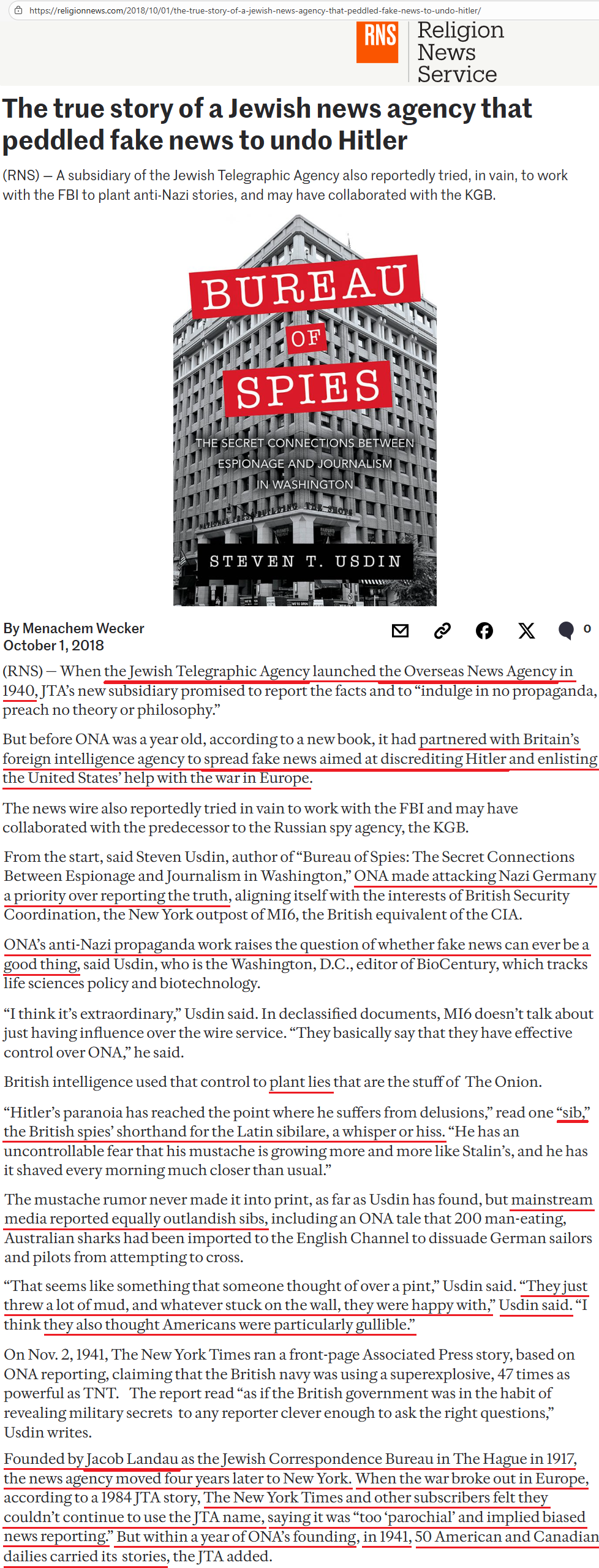
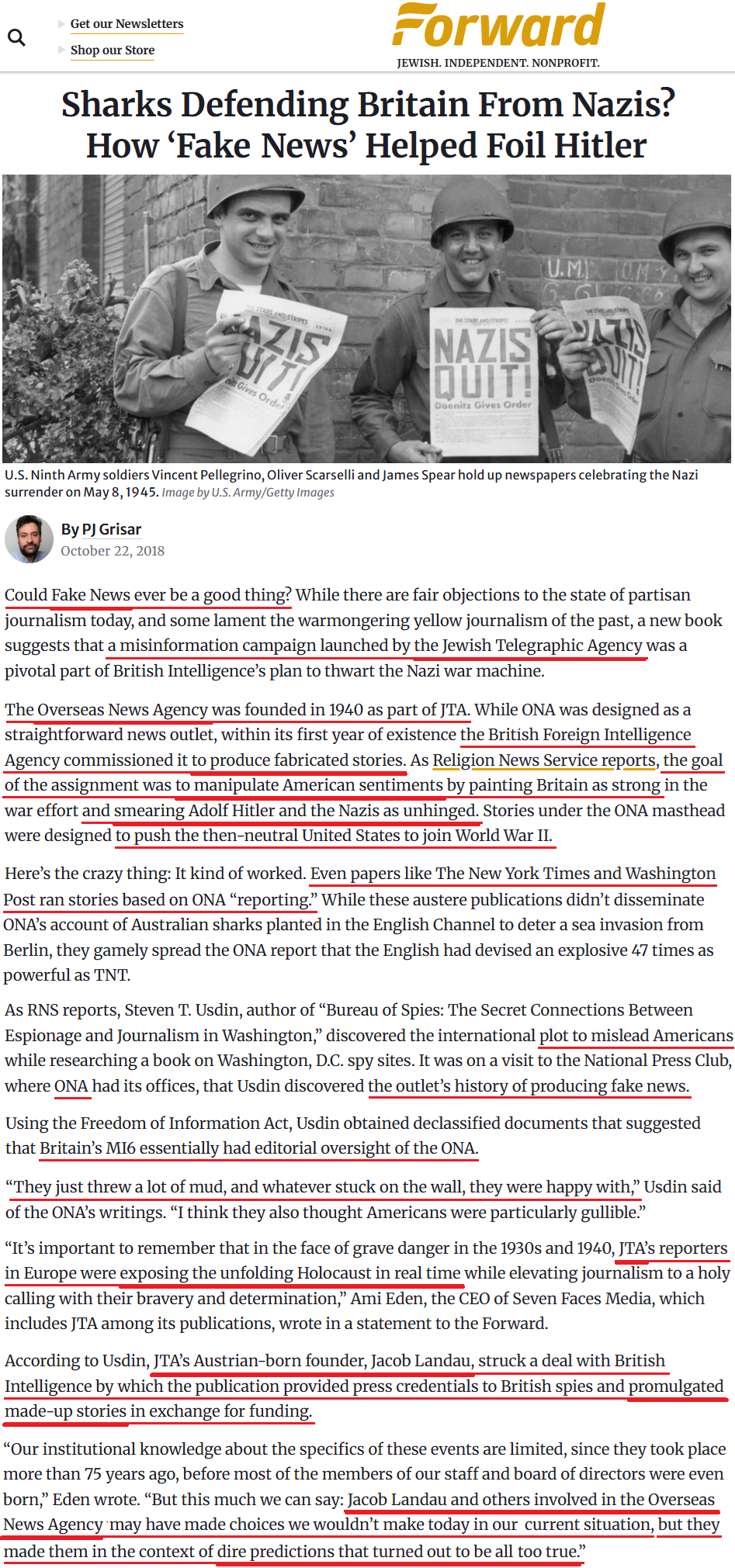

Last edited by Eye of Zyclone on Thu Dec 04, 2025 12:38 pm, edited 2 times in total.
"Holocaust deniers are very slick people. They justify everything they say with facts and figures."
Re: Atrocity Propaganda, Then and Now
That is evidence, it would be too difficult to orchestrate a hoax, the size of the Holocaust, as someone, would be bound to blow it.Stubble wrote: ↑Thu Dec 04, 2025 1:07 am Some reading;
—Cavendish-Bentinck—As regards putting Poles to death in gas chambers, I do not believe that there is any evidence that this has been done.
https://codoh.com/library/document/brit ... r-factory/
Sanity Check - "Thus, currently revisionists can console themselves by affirming their incredulity..."
Re: Atrocity Propaganda, Then and Now
EXCELLENT post EoZ! Kudos!
If I were to guess why no t4 personnel were chosen to perform gassing that had experience with gassing, it would be because THERE WERE NONE.
-
Eye of Zyclone
- Posts: 551
- Joined: Fri Apr 04, 2025 3:12 pm
Re: Atrocity Propaganda, Then and Now
Thank you, Stubble.

Here's a little more :
Eye of Zyclone wrote: ↑Thu Dec 04, 2025 12:23 pmBritain’s Rumor Factory
Origins of the Gas Chamber Story
By Andy Ritchie ∙ March 9, 2017
[...]
On 3rd December 1940 a sib was launched via SOE[21]
The Bethel Institution was a well-known Protestant charitable hospital for the mentally ill and epileptics. In fact its director – Protestant theologian Friedrich von Bodelschwingh – was not sent to Dachau or any other camp. He survived the war and died in 1946.[22]“that the Superintendent of the Bethel Institute for Incurables had been sent to Dachau for refusing to permit the inmates to be put in lethal chambers. Within two weeks it was reported that this rumour was circulating in Switzerland and, on the 19th December, that the Vatican had issued a decree condemning the killing of physical or mental deficients. The rumour has appeared in intercepted letters, and last Sunday the Sunday Express carried the story that 100,000 mental deficients had been executed.”
The main purpose of this sib was to stir up hostility between the Churches and the National Socialist Government over the issue of eugenics and euthanasia. SO1’s French specialist Prof. Denis Brogan (a Cambridge political scientist) was said to have “extremely fine Catholic contacts” in various countries,[23] and “Catholic channels for rumours” were also discussed with Douglas Woodruff, the influential editor of the Catholic journal The Tablet.[24] At this very early stage, the gassing rumor was restricted to “incurables” – it was a story about euthanasia rather than politically or racially motivated executions.
"Holocaust deniers are very slick people. They justify everything they say with facts and figures."