Page 2 of 2
Re: AI usecase - image generation
Posted: Mon Jul 27, 2026 5:44 pm
by Wetzelrad
I had Grok render a Zyklon-introduction column matching the description of Filip Müller. With this I had many difficulties (invisible guardrails, ignored directions, many iterations, it had to be manually touched up, and there are still visual errors), but I'm fairly satisfied with the result.
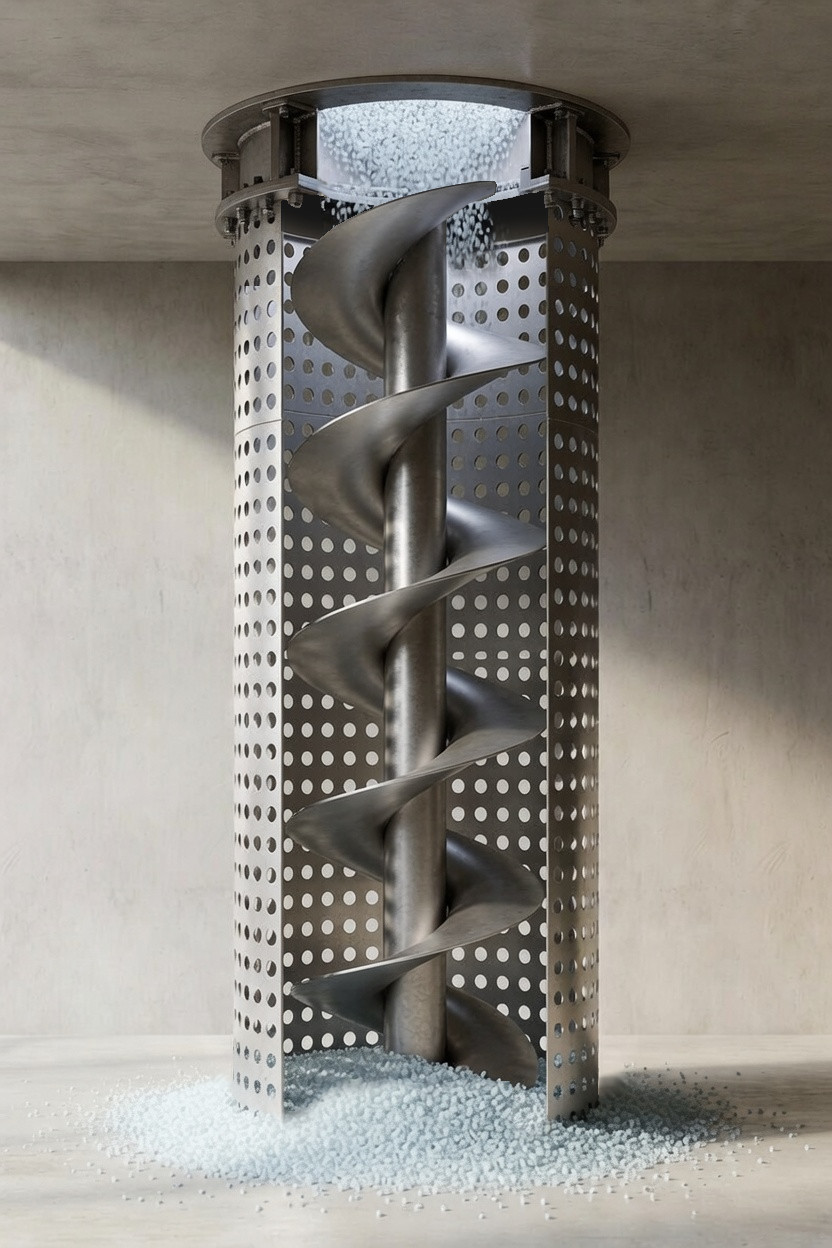
For comparison here is Müller's textual description, as reproduced in
Sonderkommando Auschwitz I.
The Zyclon B gas crystals were inserted through openings into hollow pillars made of sheet metal. They were perforated at regular intervals and inside them a spiral ran from top to bottom in order to ensure as even a distribution of the granular crystals as possible.
[...]
When some room had been made behind the door, the corpses were hosed down. This served to neutralize any gas crystals still lying about, but mainly it was intended to clean the dead bodies.
It's apparent Müller never understood that the Zyklon pellets had to be removed or cleaned up (see also his descriptions of Crema I) -- rather, for him it was a "crystal" which totally sublimated into gas. His two-sentence description of the column could be interpreted in multiple ways, but the most apparent plain reading of it is that the "crystals" were meant to be distributed
through the "perforations". Else there could be no purpose to the spiral design.
Re: AI usecase - image generation
Posted: Mon Jul 27, 2026 6:37 pm
by Stubble
Wetzelrad wrote: ↑Mon Jul 27, 2026 5:44 pm
I had Grok render a Zyklon-introduction column matching the description of Filip Müller. With this I had many difficulties (invisible guardrails, ignored directions, many iterations, it had to be manually touched up, and there are still visual errors), but I'm fairly satisfied with the result.
For comparison here is Müller's textual description, as reproduced in
Sonderkommando Auschwitz I.
The Zyclon B gas crystals were inserted through openings into hollow pillars made of sheet metal. They were perforated at regular intervals and inside them a spiral ran from top to bottom in order to ensure as even a distribution of the granular crystals as possible.
[...]
When some room had been made behind the door, the corpses were hosed down. This served to neutralize any gas crystals still lying about, but mainly it was intended to clean the dead bodies.
It's apparent Müller never understood that the Zyklon pellets had to be removed or cleaned up (see also his descriptions of Crema I) -- rather, for him it was a "crystal" which totally sublimated into gas. His two-sentence description of the column could be interpreted in multiple ways, but the most apparent plain reading of it is that the "crystals" were meant to be distributed
through the "perforations". Else there could be no purpose to the spiral design.
Muller described spent pellets in Krema I and working around them before they were swept up, so, I don't think he believed the sublimated. Perhaps part of the misunderstanding here is that he didn't write 'Eyewitness Auschwitz', but, used a ghost writer.
Re: AI usecase - image generation
Posted: Mon Jul 27, 2026 9:24 pm
by Wetzelrad
Reviewing
Eyewitness Auschwitz now, I don't see any passages that are inconsistent with my interpretation. I can't find a single instance where Müller mentioned handling the Zyklon pellets outside the "hosed down" remark I shared above. There is nothing at all about sweeping up or removing pellets. (As far as I know, Chasan/Chazan is the only one who had the idea of sweeping them up.)
On page 13, referring to Crema I, Müller did claim there were "gas crystals lying on the concrete floor", but these cannot be assumed to be "spent" pellets, like you say, because he doesn't use any word like that. His description better aligns with his equal description for Crema II: they are "gas crystals still lying about". As at Crema II, he may have imagined these were "neutralized" by water, or he may have believed the ventilation -- his imaginary "large fan" in the ceiling -- protected him as he worked. I maintain my interpretation.
This passage from page 122 is relevant:
[...] tins containing Zyclon B poison gas [...] After the "disinfecting operators" had poured the lethal gas crystals into the gas chambers one of them took the empty tins back to their Red Cross ambulance [...]
Müller claimed the Zyklon cans were emptied and left empty, whereas the
standard practice for Zyklon was to return the depleted pellets to the cans they came from. This supports that Müller was unfamiliar with Zyklon and, again, he probably thought the "crystals" sublimated and vanished into the air.
Re: AI usecase - image generation
Posted: Mon Jul 27, 2026 10:27 pm
by Stubble
That's your right Sir, of course.
Have you looked at his 1964 testimony?
https://www.auschwitz-prozess.de/zeugen ... ler-Filip/
Vorsitzender Richter:
Ja. Und was waren da, grüne Kristalle noch gelegen, sagten Sie?
Zeuge Filip Müller:
Das war das Gas.
Vorsitzender Richter:
Ja, haben die denn kein Gas mehr abgegeben, die grünen Kristalle?
Zeuge Filip Müller:
Nein, die grünen Kristalle, die haben nachher kein Gas [+ abgegeben]. Und es [war] nur so ein Geruch. So war es. — Jako když se pálí líh, ten pevný líh.
Re: AI usecase - image generation
Posted: Tue Jul 28, 2026 12:28 am
by Wetzelrad
No, I hadn't found that. Skimming, it looks very similar in content to his book. If it's true that his book was ghostwritten, then it might have been based on the interpreter (Jarolim)'s translation of his words into German, which appears to differ slightly from Müller's words in Czech. Example:
In the Czech transcript, Müller says:
Uvnitř se nacházela taková spirála. Když se ten plyn t am hodil, aby prostě to vypařování postupovalo pomalým způsobem.
There was a spiral inside. When the gas was put there, the evaporation would proceed slowly.
But the interpreter puts it differently in German:
Innen war eine Spirale. Wenn das Gas oben eingeworfen wurde, sollte die Spirale dazu dienen, die richtige Verteilung des Gases zu bewirken.
There was a spiral inside. When the gas was introduced at the top, the spiral was intended to ensure the proper distribution of the gas.
Evaporation and distribution are different concepts. "Distribution" is the word that made it into Müller's book.
As to the exchange you posted, you are right to point it out. It does read as if he was describing inert pellets (where he said: "No, the green crystals did not release any gas afterwards. It was just a smell"). I will continue to question that interpretation on the basis that he didn't understand how Zyklon worked, how long ventilation would be required, the safety procedures that would be necessary, the health effects i.e. headaches from being exposed to it, and he especially did not say anything about removing the pellets by sweeping or by removal of the column/s, and lastly because he claimed the cans were put back in the ambulance empty instead of their being immediately refilled.
But I don't want to get bogged down on Filip Müller. Back to AI images after this.
Re: AI usecase - image generation
Posted: Tue Jul 28, 2026 12:49 am
by Stubble
For sure man, of course.
Good work getting an AI to make an image. Again, I had some luck with Venice AI, but, it didn't understand scale at all. It also kept omitting the center column from Kula's description and when I asked it to do both columns from the different testimonies it would just do the same thing twice.
AI still has a ways to go me thinks.
Re: AI usecase - image generation
Posted: Tue Jul 28, 2026 10:15 am
by HansHill
I had been trying similar, with similar results to Wetzelrad, in hitting invisible guardrails and generating slop. I focused entirely on feeding Kula's first description (the better of the two).
I managed to change tactics slightly and was able to produce this:
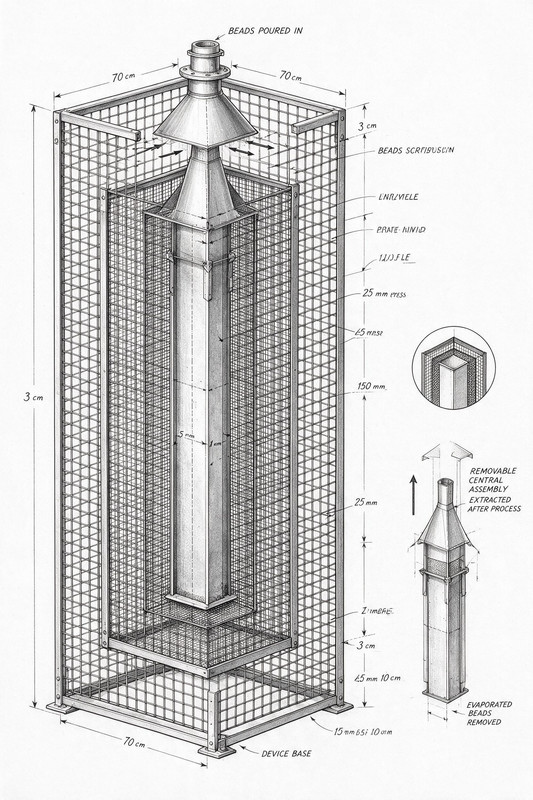
Now firstly, it's still slop (notice the jibberish words, and the measurements are not accurate or to scale). You'll note also that it took the novel step of reducing the inner column! I found this interesting because this was not mentioned anywhere in his first statement.
Secondly, and more interestingly, my change of tactics was simple: to replace any mention of "Zyklon" firstly with "grain", and removing any reference to evaporation. This managed to produce some interesting outputs, however given the word grain, it seemed biased towards producing a feeding device of sorts, seemingly in an agricultural context.
Eventually I replaced "grain" simply with "beads", and re-introduced "evaporation and much to my surprise this was still obscure enough to produce the above!
Re: AI usecase - image generation
Posted: Tue Jul 28, 2026 2:49 pm
by Fred Ziffel
what would 700 one person urns look like?
Re: AI usecase - image generation
Posted: Fri Sep 04, 2026 10:13 pm
by Archie
I'd like to see a simulation of the Babi Yar massacre. Holocaust Controversies has helpfully assembled a collection of testimonies describing the process. I was asking the AI to help me work it all out and it started sounding like a revisionist even without any encouragement from me aside from asking basic questions about the procedure and timeline.
https://holocaustcontroversies.blogspot ... 30_18.html
Number Shot: 33,771
Duration: Two Days
Total Time: around 20 hours total; Day 1: Morning to nightfall (let's be generous and say 12 hours); Day 2: Stopped at 2:30 or 3 (around 8 hours)
This works out to
28.1 people shot per minute.
The batch size of victims is not clear from the descriptions. One testimony says there were around 20 Jews for a given group. Another mentions 3 groups doing the shooting. Three groups of 20 would be 60 victims for a given "wave." If we assume something higher like 10 groups (or increase the batch size) that gets us up to 200 victims per wave. At that rate, each wave would have to be processed every 7.1 minutes and that would have to be maintained for 20 hours. I don't think there's any way to depict this without descending into pure fantasy.
How the larger group was held over the two days is not entirely clear but it seems they moved to the ravine on foot and were not sent in trucks. There are big logistical problems either way. On foot, the issue is that to stick to the 7 minutes per wave pace the next batch of victims would need to be waiting no more than a few hundred meters away which would be well within earshot.
If we want to try to save this with some Muehlenkamp math, we could assume a really large number per wave. But you have to disregard the testimonies to go that route. Fritz Höfer for example describes only two marksmen going down the line giving neck shots which does not seem compatible with a huge wave size.