The curious case of Dr James Roth
Posted: Fri Sep 11, 2026 11:12 am
Dr Roth is a central figure in the study of the chemistry of Auschwitz, due to his appearance in three primary capacities;
i) In performing the laboratory analysis for Fred Leuchter,
ii) In testifying to the lab results and adjacent topics such as Prussian Blue at the Zundel trial, and
iii) His subsequent public backtracking on statements in support of the revisionist position.
I will use this thread to prepare a primer and analysis of Roth’s involvement with the Leuchter / Zundel saga. We will deal briefly with the background of the Leuchter Report, including a few comments of sampling gathering and lab methodology.
The Leuchter Report
Sampling Methodology described under The Leuchter Report
Leuchter’s sampling has been scrutinized and criticized as being less than ideal. For example, while he denoted the locations where he took samples from crematoria in self-produced maps of these buildings drawn by himself and reproduced in his expert report, and while there is a film documenting Leuchter’s sampling, of which can be seen in the Errol Morris documentary, he neglected to clearly indicate the sample material in all cases, merely referring to them as “brick, mortar and sediment”. Additionally, Leuchter neglected to denote any depth profiling. It is only from analyzing the traces left by his sampling, can we deduce 3cm+ depth profiling. Finally, the provenance of certain samples has been critisized, with one brick fragment sample being seen taken out from a puddle of water. One cannot say with certainty where this brick originated.
Commissioning of Alpha Analytics:
What is interesting here is that whilst this was indeed a “blind” experiment on the part of Roth and Alpha Analytics with respect to sample origin, Leuchter does indicate which sample was the control. For this reason, we cannot truly call it blind, but rather unbiased toward origin or provenance. His indication to the lab that samples 1 – 31 should equal or exceed 32 is an interesting insight as to Leuchter’s midset during this interim period.
====
Methods Used
As per Germar Rudolf:
For the cyanide analysis, this laboratory used a procedure carried out analogously to the
German standard (DIN 38 405, Section D 13, and according to which would later be performed by Rudolf via the Fresenius Institute.). Control analyses were prepared for some test samples near the detection limit of 1 mg cyanide per kg test material. The results fluctuated up to 40%.
And as per Roth:
Testimony at the Zundel Trial
For his documentary movie “Mr. Death” on Fred A. Leuchter, Errol Morris interviewed Prof. Dr.
James Roth. During this interview, Prof. Roth did all he possibly could to distance himself from
the possible consequences of the analyses performed by his company.
Transcript
This backtracking incident is especially noteworthy due to the fact that the Dutch architectural historian Prof. Robert Jan van Pelt quoted Roth in his 1999 expert report prepared for the Irving trial (and Roth was quoted in International media in connection with it). In it, van Pelt wrote about Roth’s statements in Morris’s movie
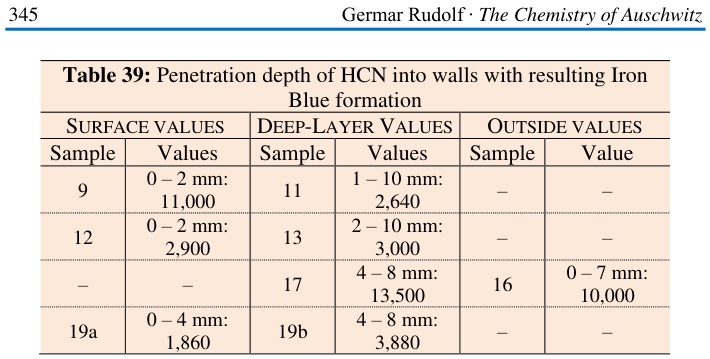
Rudolf’s analysis, complete with depth profiling demonstrates that HcN penetration is evident in masonry, far from being a surface level phenomenon.
And this corresponds with what we know about the diffusion properties of building materials:

Diffusion is defined as the process whereby atoms or molecules spontaneously move from an area of higher concentration to lower concentration. It governs how gas moves through a material.
Crucially, Roth in his backtracking is arguing against his own testimony and analytic results. Consider, his own lab was able to detect cyanide in sample 32 (the control) in the 1,000 ppm range using their chosen method. To later argue this method cannot detect cyanide is absurd and unscientific.
Key takeaways:
- When commissioned without bias to origin, both Roth (Alpha Analytics) and Fresenius Institute chose a comparable method of cyanide detection, lending credibility and corroboration to each set of results.
- Roth under oath testified Prussian Blue formation would be expected in samples 9 and 29 (alleged homicidal gas chambers), with no difference in expection of formation from sample 32 (delousing chamber).
- Roth under oath testified that porous material such as masonry would allow for deep penetration of hydrogen cyanide, allowing for Prussian Blue formation, further corroborated by Green.
- Roth’s subsequent backtracking focused primarily on sample size, obfuscation of source, and dilution of sample material.
- Unlike Markiewicz, Roth’s backtracking makes no reference to prejudice against Prussian Blue detection.
- In turn, Roth does not invoke Markiewicz’ free associated cyanides argument, even in his backtracking.
- Roth’s backtracking is further belied by his testimony in that sample 32 (delousing chamber), whilst diluted during the process, the cyanide was fully able to be detected under the chosen method.
- Judge Gray (Irving Trial) rejects Roth’s testimony as chemistry expert, in favour of Roth’s media quotes and that of Van Pelt who is not a Chemistry expert.
i) In performing the laboratory analysis for Fred Leuchter,
ii) In testifying to the lab results and adjacent topics such as Prussian Blue at the Zundel trial, and
iii) His subsequent public backtracking on statements in support of the revisionist position.
I will use this thread to prepare a primer and analysis of Roth’s involvement with the Leuchter / Zundel saga. We will deal briefly with the background of the Leuchter Report, including a few comments of sampling gathering and lab methodology.
The Leuchter Report
Sampling Methodology described under The Leuchter Report
Leuchter’s sampling has been scrutinized and criticized as being less than ideal. For example, while he denoted the locations where he took samples from crematoria in self-produced maps of these buildings drawn by himself and reproduced in his expert report, and while there is a film documenting Leuchter’s sampling, of which can be seen in the Errol Morris documentary, he neglected to clearly indicate the sample material in all cases, merely referring to them as “brick, mortar and sediment”. Additionally, Leuchter neglected to denote any depth profiling. It is only from analyzing the traces left by his sampling, can we deduce 3cm+ depth profiling. Finally, the provenance of certain samples has been critisized, with one brick fragment sample being seen taken out from a puddle of water. One cannot say with certainty where this brick originated.
Commissioning of Alpha Analytics:
====Spoiler
March 9, 1986
Alpha Analytical
200 Homer Road
Mansfield, MA 01721
Gentlemen:
Enclosed, please find 32 samples of materials for analysis. All are for determination of cyanide residue except # 12 which is for determination of material.
Sample # 32 is control sample. More blue color. Other sample should equal or exceed cyanide content.
Sample # 12 is Gasket material. Determine composition.
Sample # 7 is sediment material. Determine cyanide content.
Samples # 1 through # 11; Samples # 13 through 32. Brick, mortar and sediment. Cyanide content.
Test results for court litigation. Please certify.
All samples stored in cool, damp and sunlight free locations.
Please complete analysis as soon as possible.
Very truly yours,
Fred A. Leuchter (handwritten signature)
Fred A. Leuchter, Jr.,
Chief Engineer
What is interesting here is that whilst this was indeed a “blind” experiment on the part of Roth and Alpha Analytics with respect to sample origin, Leuchter does indicate which sample was the control. For this reason, we cannot truly call it blind, but rather unbiased toward origin or provenance. His indication to the lab that samples 1 – 31 should equal or exceed 32 is an interesting insight as to Leuchter’s midset during this interim period.
====
Methods Used
As per Germar Rudolf:
For the cyanide analysis, this laboratory used a procedure carried out analogously to the
German standard (DIN 38 405, Section D 13, and according to which would later be performed by Rudolf via the Fresenius Institute.). Control analyses were prepared for some test samples near the detection limit of 1 mg cyanide per kg test material. The results fluctuated up to 40%.
And as per Roth:
That Roth’s methodology is consistent with the Rudolf methodology, and both laboratories (Alpha Analytics and Fresenius) independently chose this method of cyanide detection in masonry when approached blind, with the same detection limits, lends credibility and legitimacy to both sets of analyses.Spoiler
The tests were performed by taking a representative sample of the material that was received by the laboratory, placing it in a flask that could be sealed, adding a low concentration of acidic solution, specifically sulphuric acid, then warming the sample in that solution while in the process passing gas through it.
Air passed through the solution and the acidic environment volatilized the cyanide and formed hydrogen cyanide gas. This gas was then passed through a solution of sodium hydroxide. Any hydrogen cyanide would react with the sodium hydroxide to form sodium cyanide. After a period of time required to assume complete removal of any cyanide in the sample, the solution was analysed colour metrically for the presence of cyanide. This process was repeated with each of the samples, with duplicates on certain selected samples and with spot samples in which known amounts of cyanide were added to check recovery. Cyanide spike recovery tests performed on several of the samples all indicated that the analyses and the techniques and methods by which the samples were analyzed were valid.
- Roth Testimony to describe the methodoloy, via Barbara Kulaszka
Testimony at the Zundel Trial
BacktrackingSpoiler
Roth testified that he received samples from Fred Leuchter in his capacity as an Analytical Chemist at Alpha Analytical Laboratories. Roth directly supervised the tests performed on the samples and the preparation of the test report. The purpose of the tests was to determine total iron content and total cyanide content in the samples. The identification numbers assigned to the samples were those designated by Leuchter.
Roth was shown Exhibit 144, a colour photograph of the blue staining on the wall of Delousing
Facility No. 1 at Birkenau from which sample 32 had been removed. He indicated that the blue
colour was what was commonly referred to as "Prussian blue."
The chemical definition of Prussian blue was ferro-ferri-cyanide. Prussian blue was an iron
cyanide produced by a reaction between iron and the hydrogen cyanide. It was a very stable
compound which stayed around a long time. If hydrogen cyanide came into contact with bricks
or mortar containing iron, it was fully conceivable that a reaction of the iron and hydrogen
cyanide would take place, leaving behind the Prussian blue. In porous materials such as brick
and mortar, the Prussian blue could go fairly deep as long as the surface stayed open, but as
the Prussian blue formed, it was possible that it would seal the porous material and stop the
penetration. If all surface iron was converted to Prussian blue, the reaction would effectively
stop for lack of exposed iron.
Roth testified that the iron / cyanide reaction capabilities of samples 9 and 29 (Homicidal gas chambers) were no different from that of sample 32 (delousing chamber). If samples 9 and 29 had been exposed continually everyday for two years to 300 parts per million of hydrogen cyanide, Roth testified that he would expect to see the formation of the iron cyanide compounds; the so-called "Prussian blue" material, in detectable amounts. The reaction of the two substances was an accumulative reaction; the reaction continued with each exposure. One way for this reaction not to occur would be a lack of water. These reactions, in many cases, required water or vapour in order to occur. However, in rooms of normal temperatures and normal humidity, there would be plenty of moisture present for this type of reaction to take place.
Prussian blue did not normally disappear unless it was physically removed. To be removed from
a porous material like a brick it would have to be removed by sandblasting or grinding down the
surface or by the application of a strong acid such as high levels of sulphuric, nitric or hydrochloric acid. It would be more difficult to remove from porous surfaces because of the tact that the formation would have taken on depth.
- Zundel Trial, via Barbara Kulaszka
For his documentary movie “Mr. Death” on Fred A. Leuchter, Errol Morris interviewed Prof. Dr.
James Roth. During this interview, Prof. Roth did all he possibly could to distance himself from
the possible consequences of the analyses performed by his company.
Transcript
===Spoiler
I went up to Toronto, on very short notice, not knowing any of the background, at all, of what
was going on. They wanted somebody from the laboratory to say, yes, we analyzed these
samples, yes, we produced this report on the analysis, and that's what I was there to do.
I don't think the Leuchter results have any meaning. There's nothing in any of our data that says
those surfaces were exposed or not.
Even after I got off the stand, I didn't know where the samples came from. I didn't know which
samples were which. And it was only at lunch that I found out, really, what the case involved.
Hindsight being 20/20, the test was not the correct one to have been used for the analysis.
He presented us with rock samples anywhere from the size of your thumb up to half the size of
your fist. We broke them up with a hammer so that we could get a sub-sample; we placed it in a
flask, add concentrated sulfuric acid. It undergoes a reaction that produces a red-colored
solution. It is the intensity of this red color that we can relate with cyanide concentration.
You have to look at what happens to cyanide when it reacts with a wall. Where does it go? How
far does it go? Cyanide is a surface reaction. It's probably not going to penetrate more than 10
microns. Human hair is 100 microns in diameter. Crush this sample up, I have just diluted that sample 10,000; 100,000 times. If you're going to go look for it, you're going to look on the
surface only. There's no reason to go deep, because it's not going to be there. Which was the
exposed surface? I didn't even have any idea.
That's like analyzing paint on a wall by analyzing the timber that's behind it. If they go in with blinders on, they will see what they want to see. What was he really trying to do? What was he trying to prove? Use at the Irving Trial.
This backtracking incident is especially noteworthy due to the fact that the Dutch architectural historian Prof. Robert Jan van Pelt quoted Roth in his 1999 expert report prepared for the Irving trial (and Roth was quoted in International media in connection with it). In it, van Pelt wrote about Roth’s statements in Morris’s movie
Additionally, the judges verdict from that trial contain numerous mentions of Roth in this exact context;“Roth explained that cyanide will react on the surface of brick or plaster, penetrating the material not more than 10 microns, or 0.01 mm, or one tenth the thickness of a human hair [...]. In other words, if one wants to analyze the cyanide concentration in a brick sample, one should take a representative sample of the surface, 10 microns thick, and no more.”
And the rebuttals from Germar Rudolf:Spoiler
"7.115 The Defendants relied on the content of an interview of Dr Roth, the scientist at the
Massachusetts laboratory which carried out the tests on Leuchter's samples. According to
Dr Roth, cyanide produces a surface reaction which will penetrate no further than one tenth of the breadth of human hair. The samples with which he was provided by Leuchter ranged in size between a human thumb and a fist, so they had to be broken down with a hammer before analysis. Roth asserts that the resulting dilution of any cyanide traces effectively invalidates the test results.
"13.79 The reason why Irving initially denied the existence of gas chambers at Auschwitz
was, as has been seen, the Leuchter report. I have summarised in some detail the findings
made by Leuchter at paragraphs 7.82 to 7.89 above. I will not repeat myself. I have also set
out at paragraphs 7.104 to 7.108 above the reasons why van Pelt on behalf of the Defendants dismissed the Leuchter report as flawed and unreliable. Those reasons were put to Irving in cross-examination. It is a fair summary of his evidence to say that he accepted the validity of most of them. He agreed that the Leuchter report was fundamentally flawed. In regard to the chemical analysis, Irving was unable to controvert the evidence of Dr Roth (summarised at paragraph 7.106 above) that, because the cyanide would have penetrated the brickwork and plaster to a depth of no more than one tenth of the breadth of a human hair, any cyanide present in the relatively large samples taken by Leuchter (which had to be pulverised before analysis) would have been so diluted that the results on which Leuchter relied had effectively no validity.
- Justice Gray in his Findings on Justification
Dr Richard Green in turn corroborates that HCN, vis-a-vis Prussian Blue penetrates deeply into the masonry:Prof. Dr. Roth did not give evidence in front of this court. Being totally ignorant in Chemistry, Prof. Van Pelt is not in the position to testify on this subject at all. Mr. Irving did indeed refute Prof. Roth's claim by showing how, in the case of the Auschwitz delousing facilities, the cyanide migrated through the entire wall, coloring its outer wall patchy blue. More could be said about it, but that alone "exterminates" Roth's "evidence". But apart from that: Everybody knows that plaster is a very rough, porous and course material. How can a dispassionate judge seriously assume that a gas like hydrogen cyanide cannot penetrate into such material deeper than just a few mikrometers? And if he doesn't feel competent on that: why does he not want to hear an expert in his court first before judging about it?
Apart from that: Leuchter was correct: The morgues of Krematoria II and III were not heated and damp, and a plaster is not a sealing that prevents hydrogen cyanide to penetrate walls, see my critique of van Pelt's claims.
He stated that cyanide was expected to only be detected on the surface of masonry, and that any present cyanide would be diluted - this however contradicts his very own results of the Delousing chamber where cyanides were found, and therefore not diluted.
- Germar Rudolf - Critique of the "Findings on Justification" by Judge Gray
This is corroborated by the actual findings:"splotchy and saturated deep within the building materials".
- Richard Green, Leuchter, Rudolf and the Iron Blues
Rudolf’s analysis, complete with depth profiling demonstrates that HcN penetration is evident in masonry, far from being a surface level phenomenon.
And this corresponds with what we know about the diffusion properties of building materials:
Diffusion is defined as the process whereby atoms or molecules spontaneously move from an area of higher concentration to lower concentration. It governs how gas moves through a material.
Crucially, Roth in his backtracking is arguing against his own testimony and analytic results. Consider, his own lab was able to detect cyanide in sample 32 (the control) in the 1,000 ppm range using their chosen method. To later argue this method cannot detect cyanide is absurd and unscientific.
Key takeaways:
- When commissioned without bias to origin, both Roth (Alpha Analytics) and Fresenius Institute chose a comparable method of cyanide detection, lending credibility and corroboration to each set of results.
- Roth under oath testified Prussian Blue formation would be expected in samples 9 and 29 (alleged homicidal gas chambers), with no difference in expection of formation from sample 32 (delousing chamber).
- Roth under oath testified that porous material such as masonry would allow for deep penetration of hydrogen cyanide, allowing for Prussian Blue formation, further corroborated by Green.
- Roth’s subsequent backtracking focused primarily on sample size, obfuscation of source, and dilution of sample material.
- Unlike Markiewicz, Roth’s backtracking makes no reference to prejudice against Prussian Blue detection.
- In turn, Roth does not invoke Markiewicz’ free associated cyanides argument, even in his backtracking.
- Roth’s backtracking is further belied by his testimony in that sample 32 (delousing chamber), whilst diluted during the process, the cyanide was fully able to be detected under the chosen method.
- Judge Gray (Irving Trial) rejects Roth’s testimony as chemistry expert, in favour of Roth’s media quotes and that of Van Pelt who is not a Chemistry expert.