Identifying the Buildings in Mid-field I at Majdanek (Crematorium, Laundry, "Gas Chambers")
Posted: Thu Jun 04, 2026 6:46 pm
It may surprise you to know that on the grounds of Majdanek today there is a building which has been variously identified as a crematorium, a laundry drying facility, "gas chambers", disinfection chambers, and an infirmary, but in spite of all that history it is never presented to the public.
I would like to get this building correctly identified along with the buildings that once stood as its neighbors in Middle Field I, also referred to as Inter-field I or Intermediate Compound I.
To begin with, let's look at some contemporary documents. The best technical drawing of the camp is one made in 1942 that can be found online here: part 1, part 2, and part 3. According to this drawing, the westernmost building in Mid-field I is the Krematorium (Building XV) and the parallel building to its east is the Prov. Wäschereibar (Building XIII). Both were 12.5 x 32.5 m. Between them, although faint, probably because it was erased, an additional building (Leichenkeller? Building XIV) can be seen.
A 1943 drawing has the same buildings in slightly different shapes and locations, with the addition of an unidentified thin perpendicular barrack behind Building XV. Both drawings conform reasonably well with a German aerial photo of the camp taken in September 1944. Here are all three side by side:
In Concentration Camp Majdanek, Mattogno shows that in other contemporary documents, Building XV was identified as the crematorium (p.101) and Building XIV as the mortuary, that measuring only 11.5 x 6.5m (p.146).
Based on all of the above, you would think that there is no question of what these buildings are, but instead there have been numerous competing theories, and they begin with the Soviet-Polish Investigatory Commission in 1944.
In a report, the Soviets claimed one of the buildings in this field contained two gas chambers (V and VI). According to Mattogno's translation, it was called "Barrack 28" (p.121). However, this is apparently not the original numbering of the building but the number that the Soviets themselves gave to it for the purpose of adding it to their map key. I'm not sure that Mattogno or Dalton understood this when writing about it. There is a real Barrack 28 in the Wachbataillon area, but clearly that is not what the Soviets were referring to in Mid-field I. Confusingly, within the same report the Soviets correctly referred to the original numbers of Barracks 41, 42, and 52.
With that established, let's refer to the Soviet map key for the four objects they drew in Mid-field I. Do we have anyone that can translate this spotty Russian text? I get:
26. Прачечная-[something], meaning "laundry-[something]"
27. Ср__й
28. Сушилка, meaning "dryer"
29. possibly [something]-огражденная, meaning "[something]-fenced"
Here is a link to the original image, if it's any help: https://web.archive.org/web/20210421232 ... mage58.gif
Because of the poor image quality, it's not clear if the order from west to east is 26-27-28-29 or 28-27-26-29. The latter seems more likely because it conforms with the location of the laundry in the 1942 plan I shared above.
Moving on, the Majdanek Museum has changed the identity of this westernmost building over time. In the late 1940s, they produced a map that labelled it "old gas chamber" (discussed here). A newer map photographed in 2007 labelled it "old crematorium". An even newer map doesn't label it at all.
I believe the Museum was continuing to push the myth of gassings in this building as recently as 1991, with the publication of Tadeusz Mencel's book. Approaching the present day, in 2019 the Museum published an article that clarifies much about gassings in Majdanek. It describes gassings at Inter-field I as "completely improbable". (However, this article was just recently deleted from their website.)
The same article identifies the westernmost building as the site of these alleged gassings, in what it says were actually "disinfection chambers". And identifies it as the same building as the old crematorium. It further identifies the "shed" just behind that as a morgue. I find this agreeable, although all the evidence presented is thin.
Now a few words about revisionist historians. In 1988, Jean-Claude Pressac wrote an article loaded with errors partially concerning Majdanek. His view was similar to what the Museum's has since become, only differing in that he claimed the gas chambers were later "converted into a drying room for clothing", and he thought the old crematorium was a separate building.
For reasons I can't divine, Carlo Mattogno has also put the old crematorium in a separate building, apparently that unidentified perpendicular building to the east (pp.138-139). Also, he seems to identify the westernmost building as the "drying facility" (p.294), which he otherwise identifies as "Barrack 28", but he contradicts this by saying that "Barrack 28 no longer exists." (p.137).
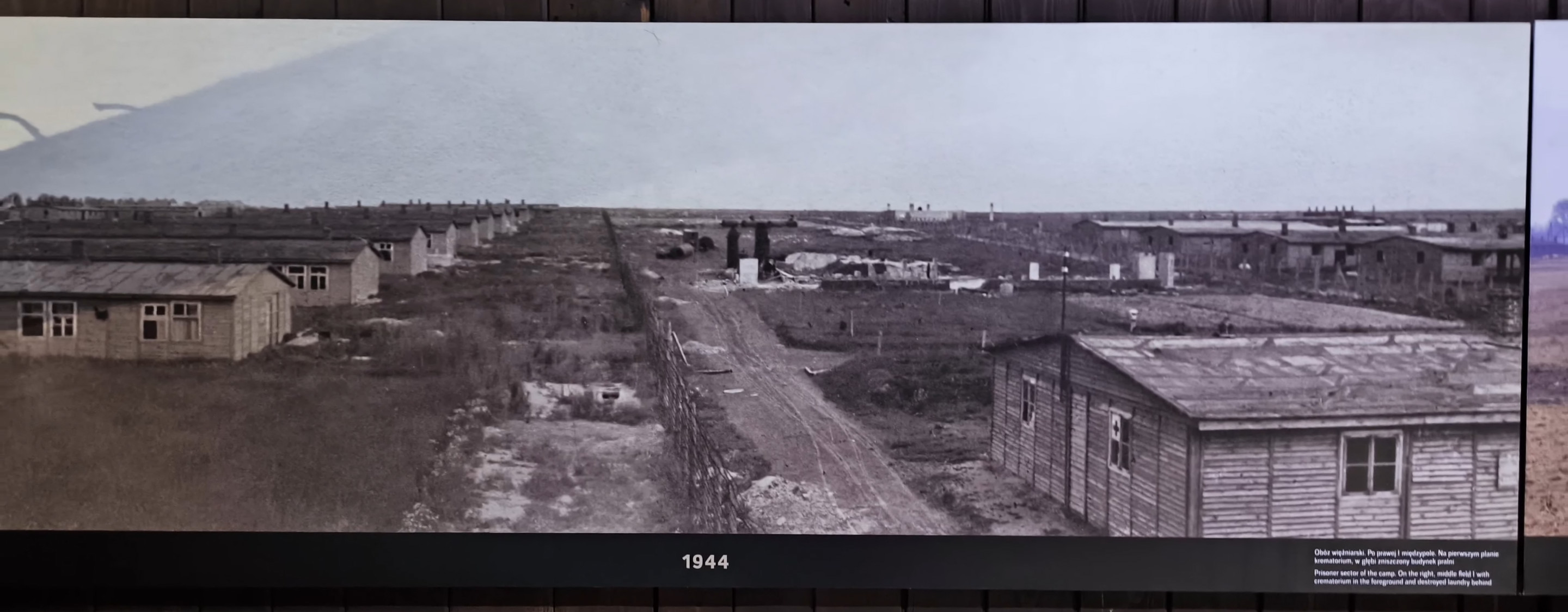
However, the westernmost building certainly still exists. It's the feature of (and only of) an exhibit comparing how it looked in 1944 compared to 2015. As Fred Ziffel has pointed out repeatedly, the 1944 photo shows it had a red cross sign in the window, which allows one to conclude that it may have been an infirmary at that time. Here is my best copy of that photo, which incidentally gives an excellent view of Mid-field I.
So I suspect Mattogno is wrong, which if true would mean several passages in his book need to be revised, but not on any matters of great consequence. More could be said here, especially on the absurdity of effectively shutting off from the public a building that was once claimed to be a "gas chamber" and the site of 80,000 cremations (p.79). But it would be better to first have all these buildings positively identified. Can anyone shed further light on this? Or at least confirm the sense of what I've written?
I would like to get this building correctly identified along with the buildings that once stood as its neighbors in Middle Field I, also referred to as Inter-field I or Intermediate Compound I.
To begin with, let's look at some contemporary documents. The best technical drawing of the camp is one made in 1942 that can be found online here: part 1, part 2, and part 3. According to this drawing, the westernmost building in Mid-field I is the Krematorium (Building XV) and the parallel building to its east is the Prov. Wäschereibar (Building XIII). Both were 12.5 x 32.5 m. Between them, although faint, probably because it was erased, an additional building (Leichenkeller? Building XIV) can be seen.


A 1943 drawing has the same buildings in slightly different shapes and locations, with the addition of an unidentified thin perpendicular barrack behind Building XV. Both drawings conform reasonably well with a German aerial photo of the camp taken in September 1944. Here are all three side by side:
- 1942 1943 1944.jpg (205.72 KiB) Viewed 2912 times
In Concentration Camp Majdanek, Mattogno shows that in other contemporary documents, Building XV was identified as the crematorium (p.101) and Building XIV as the mortuary, that measuring only 11.5 x 6.5m (p.146).
Based on all of the above, you would think that there is no question of what these buildings are, but instead there have been numerous competing theories, and they begin with the Soviet-Polish Investigatory Commission in 1944.
In a report, the Soviets claimed one of the buildings in this field contained two gas chambers (V and VI). According to Mattogno's translation, it was called "Barrack 28" (p.121). However, this is apparently not the original numbering of the building but the number that the Soviets themselves gave to it for the purpose of adding it to their map key. I'm not sure that Mattogno or Dalton understood this when writing about it. There is a real Barrack 28 in the Wachbataillon area, but clearly that is not what the Soviets were referring to in Mid-field I. Confusingly, within the same report the Soviets correctly referred to the original numbers of Barracks 41, 42, and 52.
With that established, let's refer to the Soviet map key for the four objects they drew in Mid-field I. Do we have anyone that can translate this spotty Russian text? I get:
26. Прачечная-[something], meaning "laundry-[something]"
27. Ср__й
28. Сушилка, meaning "dryer"
29. possibly [something]-огражденная, meaning "[something]-fenced"
- Polish-Soviet plan and key.jpg (71 KiB) Viewed 2912 times
Here is a link to the original image, if it's any help: https://web.archive.org/web/20210421232 ... mage58.gif

Because of the poor image quality, it's not clear if the order from west to east is 26-27-28-29 or 28-27-26-29. The latter seems more likely because it conforms with the location of the laundry in the 1942 plan I shared above.
Moving on, the Majdanek Museum has changed the identity of this westernmost building over time. In the late 1940s, they produced a map that labelled it "old gas chamber" (discussed here). A newer map photographed in 2007 labelled it "old crematorium". An even newer map doesn't label it at all.


I believe the Museum was continuing to push the myth of gassings in this building as recently as 1991, with the publication of Tadeusz Mencel's book. Approaching the present day, in 2019 the Museum published an article that clarifies much about gassings in Majdanek. It describes gassings at Inter-field I as "completely improbable". (However, this article was just recently deleted from their website.)
The same article identifies the westernmost building as the site of these alleged gassings, in what it says were actually "disinfection chambers". And identifies it as the same building as the old crematorium. It further identifies the "shed" just behind that as a morgue. I find this agreeable, although all the evidence presented is thin.
Now a few words about revisionist historians. In 1988, Jean-Claude Pressac wrote an article loaded with errors partially concerning Majdanek. His view was similar to what the Museum's has since become, only differing in that he claimed the gas chambers were later "converted into a drying room for clothing", and he thought the old crematorium was a separate building.
For reasons I can't divine, Carlo Mattogno has also put the old crematorium in a separate building, apparently that unidentified perpendicular building to the east (pp.138-139). Also, he seems to identify the westernmost building as the "drying facility" (p.294), which he otherwise identifies as "Barrack 28", but he contradicts this by saying that "Barrack 28 no longer exists." (p.137).
However, the westernmost building certainly still exists. It's the feature of (and only of) an exhibit comparing how it looked in 1944 compared to 2015. As Fred Ziffel has pointed out repeatedly, the 1944 photo shows it had a red cross sign in the window, which allows one to conclude that it may have been an infirmary at that time. Here is my best copy of that photo, which incidentally gives an excellent view of Mid-field I.
So I suspect Mattogno is wrong, which if true would mean several passages in his book need to be revised, but not on any matters of great consequence. More could be said here, especially on the absurdity of effectively shutting off from the public a building that was once claimed to be a "gas chamber" and the site of 80,000 cremations (p.79). But it would be better to first have all these buildings positively identified. Can anyone shed further light on this? Or at least confirm the sense of what I've written?

