On challenges to produce contrary ("revisionist") witnesses
Posted: Sat Mar 07, 2026 8:44 pm
Replying to BA's challenge here. My comments here are a sequel to what I said in this prior thread: viewtopic.php?t=315
I assume the answer will be to say that the people who shoveled coke and so forth in the Kremas are especially valuable sources as they were nearest to the action and are (supposedly) recounting direct personal experience rather than mere hearsay.
That is wrong for several reasons. For one thing, there are more considerations in source criticism than just hearsay vs not-hearsay. If we are talking about the crematoria at Auschwitz, limiting the pool to people who "worked in the kremas" (like Nessie does) or limiting to "extremination areas" (unclear how broad or narrow BA is interpreting this) in effect selects predominately for Jewish sonderkommandos.
Realistically, if there was a Holocaust going on, all of the staff at Auschwitz would have known about it. Pretty much all high-level Nazis would have known. Frankly, the Allies would have known about it. All of this must be considered, not just an arbitrary subset of testimonies.
Elementary Source Criticism
Certainly, someone who worked in a Kremas should, in theory, know whether thousands of Jews were being gassed and incinerated per day. So I would agree that these people would be in a position to say what happened. However, it does not follow that their accounts of events are accurate or honest.
Consider this important principle of source criticism: "The reliability of a given source is relative to the questions put to it."
https://en.wikipedia.org/wiki/Source_criticism
People doing low-level work should in theory be especially reliable in describing the interior layout of the Kremas, the details of the cremations, etc. They would be less qualified to comment on the planning for the construction of the Kremas, the overall extermination plan, and so forth.
A comment like this (from Nessie) is supremely silly.
To dismiss Himmler as not relevant is blazingly stupid. I would rank Himmler as second only to Hoess as the most relevant of the Auschwitz witnesses.
In theory, Jewish SK testimony should be especially valuable on interior details. But they aren't! They are demonstrably UNRELIABLE on these points! For example, they give wildly inflated figures about the cremations.
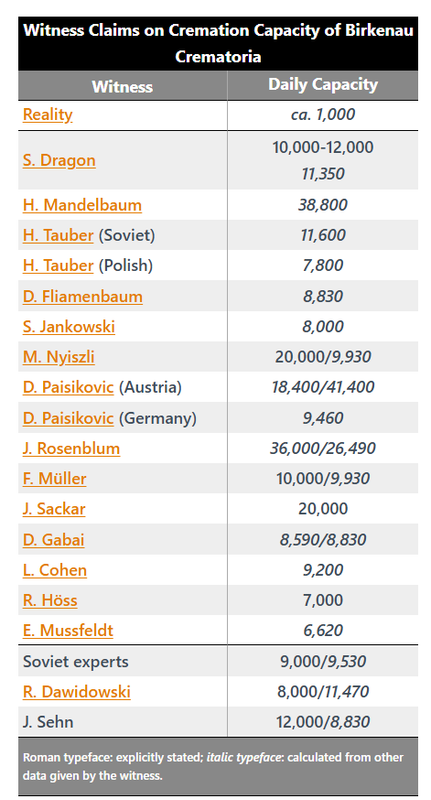 Is there really anything else to say here? If they say they were burning 10,000 bodies a day, 4 bodies per retort at a time and nonsense like that, this demolishes the ONLY reason we would have to give these testimonies any special weight which would be their particular competence on questions related to the interior of the Kremas.
And if we return to our principles of source criticism, it is really no surprise that these SK testimonies are rubbish because that is in fact exactly what you would expect.
German Statements
Another point that is made is that many SS men made statements going along with gassing, with some giving highly elaborate descriptions of gassings. Oh, so both Nazis and Jews agree! So it must be true! No. This is egregious context denial.
Statements by Germans made during the war would be convincing. Statement made after the war while under occupation and while being interrogated by enemy investigators (often Jewish) is not necessarily convincing.
Let me return to this point: "If it can be demonstrated that the witness (or source) has no direct interest in creating bias, the credibility of the message is increased." The implicit argument here is that statements by Germans at the IMT/NMT etc admitting to knowledge of gassings were against their interests. But that isn't really the case. Butz explains this very well in his book. Quite a few of them did dispute the charges (more on that later) and the ones that went along did have an incentive to "cooperate" with the Allies. Speer did not dispute gassings but he offered the court a carefully crafted story that allowed the court to excuse him personally to a degree. And it actually worked as he got a relatively light sentence. That sort of defense was the best that was possible given the circumstances.
The Demand for Contrary Statements
There are actually many statements from Germans disputing what we now call "the Holocaust." Often these deny knowledge, but since it is not possible for them not to have known it amounts to a denial that it happened at all.
Would they have had a bias to say that? Sure. We can't just take their word for it on these things. But like I argued here, the statements by people like Himmler (who is on record as endorsing the revisionist interpretation of the Kremas) is confirmed by a lot of other evidence, like the Krema construction timelines, the typhus outbreaks, the orders to reduce deaths, etc.
https://www.codohforum.com/viewtopic.php?t=315
In addition to Himmler (and the commonly quoted statements by Goering and Josef Kramer), there were numerous denials by the Nazis. Here are a few non-exhaustive examples.
It is common for Holocaust promoters to say that "no Nazi ever denied it," but this is obviously untrue. So bombsaway modifies it by phrasing his demand so as to exclude many statements he doesn't want to address.
We can of course dismiss these statements as lies, which I'm sure is what bombsaway's explanation would be. But as with Himmler, the claimed lack of knowledge is well supported by the documentary evidence and it mirrors the lack of knowledge by the Allies during the war.
Low-Level Contrary Statements
Okay, then. Now let's get on with bombsaway's "challenge" even though it is somewhat rigged.
Are there "low-level" statements supporting the revisionist thesis? Or are there zero as BA (and Nessie) have implied?
This is in no way a trivial request. The witness statements we have available are overwhelmingly from war-crimes trials and other published sources which are of course biased toward orthodox accounts. Even worse, the accounts of those who "worked in the Kremas" are tilted toward Soviet and Polish "investigations." Do you really think the Extraordinary State Commission was looking for statements contradicting their narrative? Do you think any witnesses would have been foolish enough to give such testimony to the ESC? If such testimony had been given, do you think these statements would have been given any publicity or would have been featured in published sources? Please be serious.
Once we start talking about obscure sources, you can't just assume that X, Y, Z doesn't exist, especially on the revisionist side. On the orthodox side, an army of Jews have gone over pretty much everything, many times over. The same is not the case for revisionists as we have very limited resources. "Mattogno would have mentioned it." That's foolish. Mattogno is one man and his efforts, though laudable, are meager compared to the collective efforts of scores of paid professional researchers. Mattogno has not been through everything. Not even close. The Nuremberg prosecution alone was an extraordinary effort that revisionists will never be able to match (pending major technological breakthroughs).
If such testimonies do exist, they are likely to be unpublished and/or extremely obscure.
That said, there are a number of low-level statements that I think do support the revisionist thesis (usually accidentally). Here are a few and these are just ones I happened to be aware of. I have never actually looked for them since I think this whole exercise is misguided to begin with for reasons already explained.
-Dr. Nyiszli accidentally admits that the LKs were in fact used as air raid shelters. Nyiszli is rubbish but this particular detail is an admission against interest and he would not have had any reason to make it up. Nor can it be well explained as a false rumor. If there was a "rumor" it would like be true. To say it other words, Nyizsli's statemnts about the gassings are not credible. His accidental reference to air raids is credible. No, that isn't inconsistent.
-Walter Schreiber was an engineer at Huta.
-Anonymous 1944 Account
Bombsaway will of course say this doesn't count because it is anonymous. However, it's also from Feb 1944 which is very early (and therefore preferred) and it says the source is someone directly involved in the construction. Imo, this is a far better source than ESC witnesses or Jewish memoirists.
What is interesting about it is that the source has apparently heard rumors about "gas chambers" yet he has no idea where these were located. Which is funny since he was building them! The people building the gas chambers didn't know they were building gas chambers. Interesting. And I think it's because it wasn't one. And then the point about it being similar in design to an air-raid shelter, though not conclusive by any means, gives some support to the arguments of Butz and Crowell.
Conclusion
-There is no justifiable reason to focus exclusively on low-level people
-We should expect recorded witness statements to skew heavily in favor of orthodoxy since the trials were rigged to produce that result and all incentives were in that direction
-Germans and others who had contrary accounts undeniably had a strong disincentive not to come forward. Staeglich was forced into early retirement and had his pension docked for making revisionist statements, and that was relatively light retaliation. If you were at Auschwitz, the smart move was to keep your head down after the war. To do otherwise would in many cases have been to invite prosecutorial attention.
-If such statements are produced, guys like Nessie and bombsaway will dismiss them as worthless using arbitrary, post hoc criteria, just as they do with all the denials by high-level people.
Let me raise an initial objection to the challenge, as stated. Why do we need to focus on people who "worked in so called extermination areas"? BA appears to have picked this up from Nessie ("people who worked in the Kremas"), but artificially limiting the pool of evidence to a subset of witnesses is arbitrary and without justification.
I assume the answer will be to say that the people who shoveled coke and so forth in the Kremas are especially valuable sources as they were nearest to the action and are (supposedly) recounting direct personal experience rather than mere hearsay.
That is wrong for several reasons. For one thing, there are more considerations in source criticism than just hearsay vs not-hearsay. If we are talking about the crematoria at Auschwitz, limiting the pool to people who "worked in the kremas" (like Nessie does) or limiting to "extremination areas" (unclear how broad or narrow BA is interpreting this) in effect selects predominately for Jewish sonderkommandos.
Realistically, if there was a Holocaust going on, all of the staff at Auschwitz would have known about it. Pretty much all high-level Nazis would have known. Frankly, the Allies would have known about it. All of this must be considered, not just an arbitrary subset of testimonies.
Elementary Source Criticism
Certainly, someone who worked in a Kremas should, in theory, know whether thousands of Jews were being gassed and incinerated per day. So I would agree that these people would be in a position to say what happened. However, it does not follow that their accounts of events are accurate or honest.
Consider this important principle of source criticism: "The reliability of a given source is relative to the questions put to it."
https://en.wikipedia.org/wiki/Source_criticism
People doing low-level work should in theory be especially reliable in describing the interior layout of the Kremas, the details of the cremations, etc. They would be less qualified to comment on the planning for the construction of the Kremas, the overall extermination plan, and so forth.
A comment like this (from Nessie) is supremely silly.
viewtopic.php?p=7906#p7906Himmler did not work at the Kremas, he was not an eyewitness and the senior Nazis, as seen at the Nuremberg trials, relied on plausible deniability. Hence, as a witness, he is of little relevance.
So-called revisionists, when they try to revise the history of the usage of the Kremas, fail to produce a single witness who worked there, to help prove their competing, contradicting claims.
To dismiss Himmler as not relevant is blazingly stupid. I would rank Himmler as second only to Hoess as the most relevant of the Auschwitz witnesses.
In theory, Jewish SK testimony should be especially valuable on interior details. But they aren't! They are demonstrably UNRELIABLE on these points! For example, they give wildly inflated figures about the cremations.
Spoiler
And if we return to our principles of source criticism, it is really no surprise that these SK testimonies are rubbish because that is in fact exactly what you would expect.
The tendency of a source is its motivation for providing some kind of bias. Tendencies should be minimized or supplemented with opposite motivations.
These are highly biased sources. Many of them are recorded quite late. The earlier ones were invariably collected as part of the Communist investigations. They are also very obviously not independent.If it can be demonstrated that the witness (or source) has no direct interest in creating bias, the credibility of the message is increased.
German Statements
Another point that is made is that many SS men made statements going along with gassing, with some giving highly elaborate descriptions of gassings. Oh, so both Nazis and Jews agree! So it must be true! No. This is egregious context denial.
Statements by Germans made during the war would be convincing. Statement made after the war while under occupation and while being interrogated by enemy investigators (often Jewish) is not necessarily convincing.
Let me return to this point: "If it can be demonstrated that the witness (or source) has no direct interest in creating bias, the credibility of the message is increased." The implicit argument here is that statements by Germans at the IMT/NMT etc admitting to knowledge of gassings were against their interests. But that isn't really the case. Butz explains this very well in his book. Quite a few of them did dispute the charges (more on that later) and the ones that went along did have an incentive to "cooperate" with the Allies. Speer did not dispute gassings but he offered the court a carefully crafted story that allowed the court to excuse him personally to a degree. And it actually worked as he got a relatively light sentence. That sort of defense was the best that was possible given the circumstances.
The Demand for Contrary Statements
There are actually many statements from Germans disputing what we now call "the Holocaust." Often these deny knowledge, but since it is not possible for them not to have known it amounts to a denial that it happened at all.
Would they have had a bias to say that? Sure. We can't just take their word for it on these things. But like I argued here, the statements by people like Himmler (who is on record as endorsing the revisionist interpretation of the Kremas) is confirmed by a lot of other evidence, like the Krema construction timelines, the typhus outbreaks, the orders to reduce deaths, etc.
https://www.codohforum.com/viewtopic.php?t=315
In addition to Himmler (and the commonly quoted statements by Goering and Josef Kramer), there were numerous denials by the Nazis. Here are a few non-exhaustive examples.
Spoiler
Lammers (IMT Vol 11)
Doenitz (IMT Vol 13)But, Witness, please be quite brief. I am now putting this question to you: Did Himmler ever tell you that the final solution of the Jewish problem would take place through the extermination of the Jews?
LAMMERS: That was never mentioned. He talked only about evacuation.
DR. THOMA: He talked only about evacuation?
LAMMERS: Yes, only about evacuation.
DR. THOMA: When did you hear that these 5 million Jews had been exterminated?
LAMMERS: I heard of that here a while ago.
DR. THOMA: In other words the matter was completely secret and only very few persons knew of it?
LAMMERS: I assume that Hirnmler arranged it so that no one learned anything about it and that he formed his Kommandos in such a way that nobody knew anything about them. Of course, there must be a large number of people who must have known something about it.
Puhl (IMT Vol 13)SIR DAVID MAXWELL-FYFE: Well, I won't argue with you but I suppose, Defendant, that you say-as we have heard from so many other defendants-that you knew nothing about the slave labor program, you knew nothing about the extermination of the Jews, and you knew nothing about any of the bad conditions in concentration camps. I suppose you are going to tell us you knew nothing about them at all, are you?
DOENITZ: That is self-evident, since we have heard here how all these things were kept secret; and if one bears in mind the fact that everyone in this war was pursuing his own tasks with the maximum of energy, then it is no wonder at all. To give an example I learned of the conditions in concentration camps... [gets cut off by the prosecutor]
SIR DAVID MAXWELL-FYFE: I just want your answer for the moment, and you have given it to me. I want you to come to a point...
Raeder (IMT Vol 14)DR. SAUTER: Now, Witness, in your affidavit under Figure 5, you say that among the articles deposited by the SS were jewelry, watches, spectacle frames, gold fillings-apparently these dental fillings-and other articles in large quantities which the SS had taken away from Jews and concentration camp victims and other persons. How do you know that?
PUHL: I know that from my interrogations at Frankfurt.
DR. SAUTER: You were told about these things during your interrogations in Frankfurt after your arrest?
PUHL: And they were shown to me.
DR. SAUTER: You had no knowledge of them while you were free and administered the Reichsbank as Vice President?
PUHL: No, because, I repeat it again, we never discussed this in the Directorate, since it was of no basic significance for currency or banking policy or in any other respect.
Severing (IMT Vol 14)SIR DAVID MAXWELL FYFE: Now, I want you to come to quite a different point. Do you say that you did not know anything about the extermination of Jews in the Eastern Territories?
[There was no response.]
Do you say that you did not know about the extermination of Jews in the Eastern Territories?
RAEDER: I say clearly under oath that I had not the slightest inkling about it. I might add in explanation that on no account would Hitler have spoken about such things to a man like myself, whose opinion he knew, especially because he was afraid that on my part there would be very serious objections. I explained the other day why I used the word "Jews" in my memorial speech. In my opinion, I was obliged to do so. But that had nothing at al, to do with an extermination of Jews. About the Jewish matter I have only learned...
SIR DAVID MAXWELL-FYFE: Well...
RAEDER: Excuse me, please, one moment. I only learned something about the Jewish matter when Jews who were known to me, mostly friends of my old parents, approached me and told me that they were about to be evacuated from Berlin. And then I intervened for them. That was the only thing I knew. On occasions I was told in answer to my questions that they were to be evacuated to cities where ghettos had been established. I always understood that a ghetto was a district in a city where all the Jews lived together, so that they would not have to mingle with the rest of the population.
Sauckel (IMT Vol 15)DR. SIEMERS: Minister Severing, as far as I have been able to ascertain, you have inadvertently not yet answered one of my questions clearly.
With reference to the concentration camps you said that you had heard of certain individual cases, and you named the individual cases. In order to avoid any misunderstanding, I just want to ask you in conclusion: did you hear of the mass murders which have been mentioned in this Trial, whereby at Auschwitz, for instance, an average of about 2,000 persons a day were exterminated in the gas chambers? Were you in possession of this knowledge before the collapse, or did you not know anything about that either?
SEVERING: I knew nothing whatsoever about these mass murders, which only became known in Germany after the collapse of the Hitler regime, partly through announcements in the press and partly through trials.
Jodl (IMT Vol 15)DR. SERVATIUS: Did you have any knowledge as to what would happen to the Jews?
SAUCKEL: Do you mean...?
DR. SERVATIUS: The final solution.
SAUCKEL: No, I had no knowledge of that. It would have made my task much easier and I would have had much less difficulty if all these people, as far as they were capable of working, had been brought into the labor plan in a more reasonable manner. I knew absolutely nothing about this final solution, and it was entirely contrary to my interest.
DR. EXNER: As we are just talking of the Jews, will you tell the Court what you knew about the extermination of Jews? I remind you that you are under oath.
JODL: I know just how improbable these explanations sound, but very often the improbable is true and the probable untrue. I can only say, fully conscious of my responsibility, that I never heard, either by hint or by written or spoken word, of an extermination of Jews. On one single occasion I had doubts, and that was when Himmler spoke about the revolt in the Jewish Ghetto. I did not quite believe in this heroic fight; but Himmler immediately supplied photographs showing the concrete dugouts which had been built there, and he said, "Not only the Jews but also Polish Nationalists have taken refuge there and they are offering bitter resistance." And with that he removed my suspicions.
DR. EXNER: Did you know anything about concentration camps, or what did you know about them? Please be brief.
JODL: I can briefly say that I knew there were concentration camps at Dachau and Oranienburg. Some divisional officers visited Oranienburg once in 1937 and gave me very enthusiastic accounts of it. I heard the name of Buchenwald for the first time in the spring of 1945. When the name was mentioned, I thought it was a new troop training camp; and I made inquiries. The inmates were always described as German habitual criminals and certain inveterate political opponents, who however, like Schuschnigg or Niemoller, were held there in a kind of honorable detention. I never heard a single word about tortures, deported persons, or prisoners of war, crematoriums or gas vans, torments reminiscent of the Inquisition, and medical experiments. I can only say that, even if I had heard of these things, I would not have believed them until I had seen them with my own eyes.
We can of course dismiss these statements as lies, which I'm sure is what bombsaway's explanation would be. But as with Himmler, the claimed lack of knowledge is well supported by the documentary evidence and it mirrors the lack of knowledge by the Allies during the war.
Low-Level Contrary Statements
Okay, then. Now let's get on with bombsaway's "challenge" even though it is somewhat rigged.
Are there "low-level" statements supporting the revisionist thesis? Or are there zero as BA (and Nessie) have implied?
This is in no way a trivial request. The witness statements we have available are overwhelmingly from war-crimes trials and other published sources which are of course biased toward orthodox accounts. Even worse, the accounts of those who "worked in the Kremas" are tilted toward Soviet and Polish "investigations." Do you really think the Extraordinary State Commission was looking for statements contradicting their narrative? Do you think any witnesses would have been foolish enough to give such testimony to the ESC? If such testimony had been given, do you think these statements would have been given any publicity or would have been featured in published sources? Please be serious.
Once we start talking about obscure sources, you can't just assume that X, Y, Z doesn't exist, especially on the revisionist side. On the orthodox side, an army of Jews have gone over pretty much everything, many times over. The same is not the case for revisionists as we have very limited resources. "Mattogno would have mentioned it." That's foolish. Mattogno is one man and his efforts, though laudable, are meager compared to the collective efforts of scores of paid professional researchers. Mattogno has not been through everything. Not even close. The Nuremberg prosecution alone was an extraordinary effort that revisionists will never be able to match (pending major technological breakthroughs).
If such testimonies do exist, they are likely to be unpublished and/or extremely obscure.
That said, there are a number of low-level statements that I think do support the revisionist thesis (usually accidentally). Here are a few and these are just ones I happened to be aware of. I have never actually looked for them since I think this whole exercise is misguided to begin with for reasons already explained.
-Dr. Nyiszli accidentally admits that the LKs were in fact used as air raid shelters. Nyiszli is rubbish but this particular detail is an admission against interest and he would not have had any reason to make it up. Nor can it be well explained as a false rumor. If there was a "rumor" it would like be true. To say it other words, Nyizsli's statemnts about the gassings are not credible. His accidental reference to air raids is credible. No, that isn't inconsistent.
-Walter Schreiber was an engineer at Huta.
This statement was recorded late (1999) and it can be critiqued on various grounds. But I share just to point out that it is false to say there are "zero" contrary witnesses.L.: What did the Huta Corporation build?
S.: Among other things, crematoria II and III with the large morgues.
L.: The prevalent opinion (considered to be self-evident) is that these large morgues were allegedly gas chambers for mass killings.
S.: Nothing of that sort could be deduced from the plans made available to us. The detailed plans and provisional invoices drawn up by us refer to these rooms as ordinary cellars.
L.: Do you know anything about introduction hatches in the reinforced concrete ceilings?
S.: No, not from memory. But since these cellars were also intended to serve as air raid shelters as a secondary purpose, introduction holes would have been counterproductive. I would certainly have objected to such an arrangement. (HH #42, pg. 77-78)
-Anonymous 1944 Account
The only reason I know about this is because Graf cites it for other reasons. He seems to have missed the significance of the air raid shelter.Unpublished. Polish Underground Movement (1939-1945) Study Trust; a reference number was not given
February 2, 1944
“The concentration camp in Auschwitz.”
The crematorium is underground; it is built following the pattern of an air raid shelter. Only the chimney protrudes above ground, in whose construction the informant was also involved. The informant does not know where the gas chambers are located; he merely heard that they are underground, built on the pattern of the crematorium.
Krematorium miesci sie pod ziemia zbudowane na wzòr scronu przeciwlotniczego. Nad powierzchnia ziemi unosi sie jedynie komin, przy budowie ktòrego byl zatrudniony ròwniez informator. Gdzie mieszcza sie komory gazowe, informator nie wie, slyszal jedynie, ze sa pod ziemia, zbudowane na zwòr krematorium. (HH#36, pg 92)
Bombsaway will of course say this doesn't count because it is anonymous. However, it's also from Feb 1944 which is very early (and therefore preferred) and it says the source is someone directly involved in the construction. Imo, this is a far better source than ESC witnesses or Jewish memoirists.
What is interesting about it is that the source has apparently heard rumors about "gas chambers" yet he has no idea where these were located. Which is funny since he was building them! The people building the gas chambers didn't know they were building gas chambers. Interesting. And I think it's because it wasn't one. And then the point about it being similar in design to an air-raid shelter, though not conclusive by any means, gives some support to the arguments of Butz and Crowell.
Conclusion
-There is no justifiable reason to focus exclusively on low-level people
-We should expect recorded witness statements to skew heavily in favor of orthodoxy since the trials were rigged to produce that result and all incentives were in that direction
-Germans and others who had contrary accounts undeniably had a strong disincentive not to come forward. Staeglich was forced into early retirement and had his pension docked for making revisionist statements, and that was relatively light retaliation. If you were at Auschwitz, the smart move was to keep your head down after the war. To do otherwise would in many cases have been to invite prosecutorial attention.
-If such statements are produced, guys like Nessie and bombsaway will dismiss them as worthless using arbitrary, post hoc criteria, just as they do with all the denials by high-level people.