Page 1 of 2

Abraham Krzepicki

Posted: Sun Nov 23, 2025 6:35 pm
by Stubble
I know there is a thread open in 'debate', but, I'd like to explore things here as well.

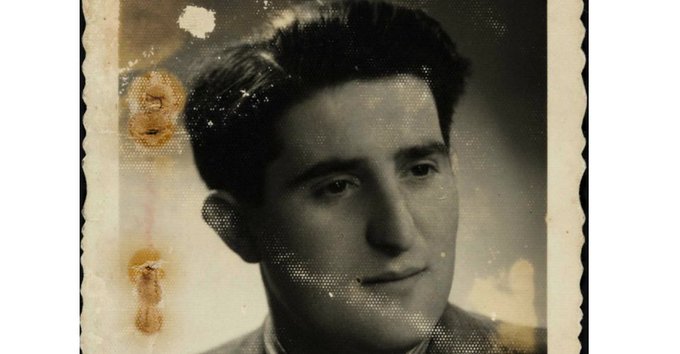
An example of something I want to look at in this thread is a supposed photograph of Krzepicki.

It can be found in a couple of places. It is in Germar's encyclopedia, but that image appears 'touched'.

This copy appears to be more 'raw'.

Image

I am sharing it from this website;

https://www.techpedia.pl/index.php?str=tp&no=34750

Title appears to be;
Abraham Krzepicki after escaping from Treblinka
How does this image come to us? Who is this person?

Re: Abraham Krzepicki

Posted: Sun Nov 23, 2025 6:50 pm
by pilgrimofdark
Stubble wrote: Sun Nov 23, 2025 6:35 pm Title appears to be;
Abraham Krzepicki after escaping from Treblinka
How does this image come to us? Who is this person?
It's included in the Yiddish notebooks from Auerbach.

Page 574 of the full document. Have fun waiting for it to download that far.

The back of the photo says "Jakób Krzepicki" and the Ringelblum Archive refers to him as "Jakub Abram Krzepicki."

Then there's another document with some Polish. It mentions a Jakób Krzepicki at the top, and Abram Krzepicki at the bottom. The middle mentions "Roza Krzepicka Palestyna Tel-Aviv."

Re: Abraham Krzepicki

Posted: Sun Nov 23, 2025 7:17 pm
by pilgrimofdark
I'll post an annotated bibliography of what we've found on Krzepicki so far.

---

Krzepicki, Abraham. “Account of a Treblinka escapee.” Warsaw Ghetto, December 1942. Originally published as Relacja uciekiniera z Treblinki. ARG II 378. Center for Jewish History. https://cbj.jhi.pl/documents/727956/0/.

This is a 16-page handwritten document written in Polish by multiple people. It contains a map and map key. The "December 1942" date is approximate, as the archive only says "after December 1942."

-

Krzepicki, Abraham. “Report entitled ‘A Man Escaped from Treblinka... Conversations with a Returnee.’” Interview by Rachel Auerbach. December 26, 1942. Originally published as Relacja pt. „Człowiek uciekł z Treblinek... rozmowy z powracającym". Print. Center for Jewish History (ARG II 382). https://cbj.jhi.pl/documents/729025/519/.

This is the interview/record/account written in Yiddish by Rachel Auerbach in her notebooks. It is 35 pages long. It includes a map with no map key, as well as a photograph of "Jakob Krzepicki" and an address card of three Krzepicki family members (Jakob, Roza, Abram). The date is also approximate: "after December 26, 1942."

-

Krzepicki, Abraham. “Treblinka.” Bleter Far Geszichte, 1956. Center for Jewish History (PJ.230). https://cbj.jhi.pl/documents/1298664/72/.

The is the first Yiddish publication. It is around 70 pages and includes numerous [passages in square brackets] that are editorial insertions from Rachel Auerbach. It is much longer than any of the 1942 handwritten documents, indicating Auerbach may have drastically expanded it.

-

Krzepicki, Abraham. “Treblinka.” Newsletter of the Jewish Historical Institute, 1962. PL.382. https://cbj.jhi.pl/documents/721824/84/.

This is the first Polish translation of the first four chapters. It also contains editorial additions by Auerbach in the text, and some explanatory footnotes by the editors of the newspaper.

-

Krzepicki, Abraham. “Eighteen Days in Treblinka.” In The Death Camp Treblinka: A Documentary, translated by Alexander Donat. Holocaust Library, 1979.

This is the English translation by Donat. It is mostly based on the 1956 Yiddish publication, and has chapter and section headings like the Yiddish version. Donat removes Auerbach's inappropriate editorializations.

---

I think the publications from 1956-1979 can be safely disregarded as corrupted by Auerbach's editing.

The early documents are much shorter. Knowing what, if anything, Krzepicki actually said would require going back to those.
Re: Abraham Krzepicki

Posted: Sun Nov 23, 2025 7:21 pm
by Stubble
Does the bit in question say to notify his relatives if he dies?

Krzepicki’s relatives to notify his fate in case of his death (Roza Krzepicka in Tel Aviv, Eretz Israel, and Abram Krzepicki in Port Louis, Mauritius).

I got this from a pdf and can link it if you'd like.

I also got a full name and DOB.

Abram Jakub Krzepicki (Praszka, 1915–Warsaw, 1943)

(Edit: I was responding to your first post when you made the second post, and I missed this information in the second post because I simply grazed it. After gleaning the second post, I see this is redundant. My apologies. Hopefully the below in the spoiler is useful).

Lookie what I got here;
Spoiler
  The Roll Call.  Thus,
at 7 p.m., the work ended on my second day in Treblinka.  At 7 o’clock, a roll call was held and an
inmate count made.  Altogether, there
were about 500 of us, and a Jewish commander (kapo) was appointed to take
charge of us.  He was G. 7 an
engineer from Lodz, who was a convert to Christianity.  The roll call that day (just as on all the
Galewski...

We have confirmation it was the actor through the picture. This puts him squarely in the Wiernick Book Club. He is also in the Auerbach Dungeons & Dragons Guild.
https://www.tapatalk.com/groups/holocau ... GQG9Ge6XXQ

Re: Abraham Krzepicki

Posted: Thu Nov 27, 2025 8:10 pm
by pilgrimofdark
Stubble wrote: Sun Nov 23, 2025 7:21 pm We have confirmation it was the actor through the picture. This puts him squarely in the Wiernick Book Club. He is also in the Auerbach Dungeons & Dragons Guild.
Everyone remembers Engineer Galewski. None of them remember each other. Wiernik remembers none of them. Makes sense to me.

From Krzepicki's "abridged" version in Polish written by numerous people:
From 800 to 1,000 people are let into the bathhouse at one time. None of us laborers knew exactly how death was dealt out. But we thought we could smell a barely perceptible trace of chlorine near the bathhouse.

- page 8 (page 9 of the archive document)
Well, there you have it.

Re: Abraham Krzepicki

Posted: Thu Nov 27, 2025 8:22 pm
by Stubble
pilgrimofdark wrote: Thu Nov 27, 2025 8:10 pm Everyone remembers Engineer Galewski. None of them remember each other. Wiernik remembers none of them. Makes sense to me.

From Krzepicki's "abridged" version in Polish written by numerous people:
From 800 to 1,000 people are let into the bathhouse at one time. None of us laborers knew exactly how death was dealt out. But we thought we could smell a barely perceptible trace of chlorine near the bathhouse.

- page 8 (page 9 of the archive document)
Well, there you have it.
1) This is the best summary I've ever seen and with so few words. You have completely encapsulated the Treblinka II fable in less than 15 words! :clap:

2) That seals the deal. The cross contamination of the propaganda is complete.

Re: Abraham Krzepicki

Posted: Fri Nov 28, 2025 3:51 pm
by pilgrimofdark
This is probably the sequence of events.

The 1942 Polish group writing project doesn't mention Galewski. Neither does the Wiernik collaborative writing group.

Someone (Krzywoszewski?) adds him in while expanding and typesetting Rok w Treblince.

In 1956, Auerbach expands the original 1942 documents, backwards-corroborating it with the 1944 A Year in Treblinka canonical version of the story. Rachel Auerbach was able to recover the memories of a dead person, maybe at a seance in 1956 before writing Krzepicki's first-person account.

The official Ringelblum Archive edition in English is Donat's 1979 translation of the 1956 Yiddish expanded version, which causes me to question what's in the 1942 Yiddish notebook even more.

I suppose the only way to confirm would be to have someone transcribe the 1942 Yiddish handwriting.

Re: Abraham Krzepicki

Posted: Fri Nov 28, 2025 5:13 pm
by Stubble
The Dec '42 one is Polish, ain't it?

Never mind, I see it. Link 2 post 3.

Re: Abraham Krzepicki

Posted: Fri Nov 28, 2025 5:51 pm
by pilgrimofdark
I missed it earlier, but the official English translation is here: https://cbj.jhi.pl/documents/1283768/271/

They refer to it as "abridged and slightly altered, unfinished testimony." In a footnote they disclose it's handwritten by two people.

Re: Abraham Krzepicki

Posted: Wed Dec 03, 2025 3:12 pm
by pilgrimofdark
The Ringelblum Archive has an official English translation that matches more accurately the 577-page Yiddish notebook.

It includes page numbers corresponding to the Yiddish notebook, which Donat's translation doesn't have, even though it's basically just Donat's translation.

A few more observations.

The first notebook is Auerbach's introduction, with a lot of heavy editing in the margins.

The second notebook starts with a Table of Contents.

There are a number of interpolated pages in the first two notebooks: 17c, 17d, 206a, etc.

There are also many passages crossed out in the notebook. Some of these are referred to in footnotes, but definitely not all.

Then the last 35-page document is called "Treblinka - Supplement," and that matches the page numbers of the final Yiddish notebook.

Re: Abraham Krzepicki

Posted: Mon Dec 08, 2025 6:16 pm
by pilgrimofdark
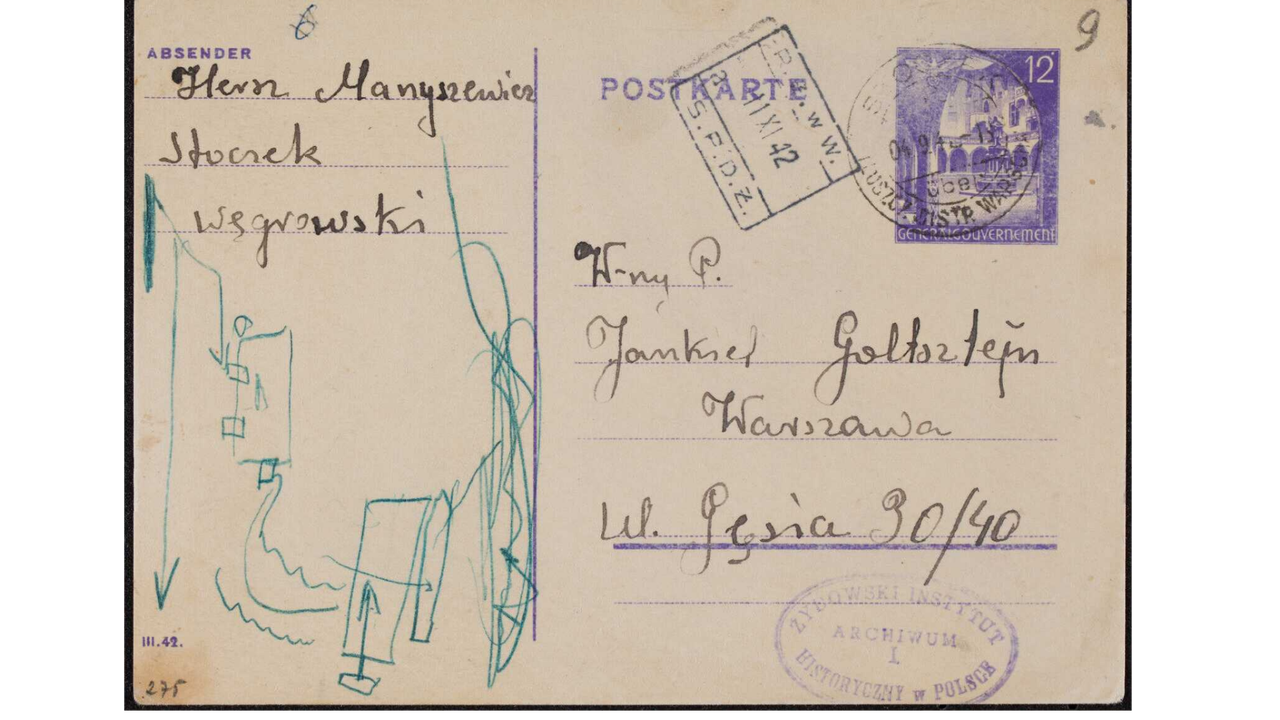
The Central Jewish Library believes it is likely the sketch of Treblinka on this postcard was drawn by Krzepicki.

Image

ARG II 369
Absender:
Hersz Manyszewicz
Stoczek Wegrowski

To:
Mr Jankiel Goltsztejn
Warsaw
Gesia Street 30, flat 40

My dearest,
I have not heard from you for so many weeks. I beg of you to write back and tell me how you are doing as soon as you get this postcard.
I can't make sense of the chronology.

They say Krzepicki spent a month in Węgrów after his escape, which was on September 13.

How does this postcard get stamped on September 9 from a person with an address in Węgrów? It's too early for Krzepicki to be there, if he was indeed at Treblinka.

Maybe the postcard was sent from Treblinka by a person at Treblinka who used to live in Węgrów, and Krzepicki sketched the map on this other person's postcard?

Or Krzepicki isn't the one who drew the map.

I'm missing something else entirely.

Re: Abraham Krzepicki

Posted: Mon Dec 08, 2025 6:38 pm
by Stubble
Wait, mail went to Treblinka II?

Re: Abraham Krzepicki

Posted: Thu Dec 11, 2025 3:53 am
by Archie
Stubble wrote: Mon Dec 08, 2025 6:38 pm Wait, mail went to Treblinka II?
That's actually a classic Holocaust meme. The orthodox spin on it is that the Nazis sent fake postcards to Warsaw from "resettled" Jews. This was supposedly a trick to convince the remaining Jews to get on the train. To keep everything secret.

Oif der Vach (underground Jewish newspaper), 20 Sep 1942 (quoted in Arad, 292-294)
During the first week of the “deportation Aktion” Warsaw was flooded with greetings from the deported Jews. The greetings arrived from Białystok, Brest Litovsk, Kosov, Malkinia, Pinsk, Smolensk. All this was a lie. All the trains with the Warsaw Jews went to Treblinka, where the Jews were murdered in the most cruel way. The letters and greetings came from people who succeeded in escaping from the trains or from the camp. It is possible that in the beginning, from the first transports, some of the Warsaw Jews were sent to Brest-Litovsk or Pinsk, in order that their greetings would mislead, deceive, and provoke false illusions among the Jews in Warsaw. Actually, what was the fate of the deported Jews? We know it from the stories of the Poles and of those Jews who succeeded in escaping from the trains or from Treblinka…
The article goes on to describe a gas chamber with a trap door. Note that technically this mail was not sent from Treblinka but rather from people who were in Treblinka.

NO-1247 (Eichmann letter, 5 Jun 1943) (quoted in Butz)
[…] to counteract the fantastic rumors circulating in Slovakia about the fate of the evacuated Jews, attention should be drawn to the postal communications of these Jews with Slovakia […], which for instance amounted to more than 1,000 letters and postcards for February/March this year. Concerning the information apparently desired by Prime Minister Dr. Tuka about the conditions in Jewish camps, no objections would be raised by this office against any possible scrutinizing of the correspondence before it is forwarded to the addressees.
You even see references to this in popular culture (hence why I said "meme"). Take this example from C. M. Kornbluth's 1951 sci-fi novelette The Marching Morons. Kornbluth was Jewish.
A team at the Pole worked at Barlow's direction on a mail setup. There would have to be letters to and from Venus to keep the slightest taint of suspicion from arising. Luckily Barlow remembered that the problem had been solved once before—by Hitler. Relatives of persons incinerated in the furnaces of Lublin or Majdanek continued to get cheery postal cards.
https://www.gutenberg.org/files/51233/5 ... 1233-h.htm

Re: Abraham Krzepicki

Posted: Thu Dec 11, 2025 4:08 am
by Stubble
Holy shit, we have mail from resettled jews? Have these letters been collated some place for review? This would be EXTREMELY helpful for my missing jew hunting endeavor!

I'd have approximate dates with rough locations!

(I apologize for taking this thread for a walk here, but, I'd really, really like to see this mail!)

Re: Abraham Krzepicki

Posted: Thu Dec 11, 2025 4:52 am
by Archie
Stubble wrote: Thu Dec 11, 2025 4:08 am Holy shit, we have mail from resettled jews? Have these letters been collated some place for review? This would be EXTREMELY helpful for my missing jew hunting endeavor!

I'd have approximate dates with rough locations!
I wasn't aware any of these had survived, although the Krzepicki one posted above sure seems like one.

Actually forging mail for dead Jews seems like it would be totally impractical. Even figuring out who to address it to would be a pain. Plus you have to imitate the handwriting, etc. And you're doing that for thousands of people. No way. So I think they'd have to argue here that they forced the Jews to write postcards on the way to Treblinka. But I don't think that scenario quite adds up because if you only sent one letter and then nada that would be almost more suspicious than sending no letters at all.

I remember discussing the Oif der Vach article with bombsaway before. Bombs was arguing that it was irrational to believe in resettlement since there was zero evidence for it. I asked him if he had reviewed all the potentially relevant documents and if he would consider e.g. something like that article to be evidence of resettlement (something more than "zero"). He said it wasn't because we don't have the actual postcards, just a contemporaneous Jewish newspaper referencing the postcards. And he said they were fraudulent (without explaining how they did this).