Replying here to a comment by "Denying-History."
D-H's (rather audacious) summary of the document is something like the following: The ICRC's reply is confirming that there were exterminations in Auschwitz I but that these had ceased several months prior. Nothing in the letter applies at all to Auschwitz II because the delegate did not visit Auschwitz II.
Two things are crucial to this fanciful interpretation. 1) the narrow interpretation of "Auschwitz" as referring to Auschwitz I only, 2) the phrase "no
further exterminations."
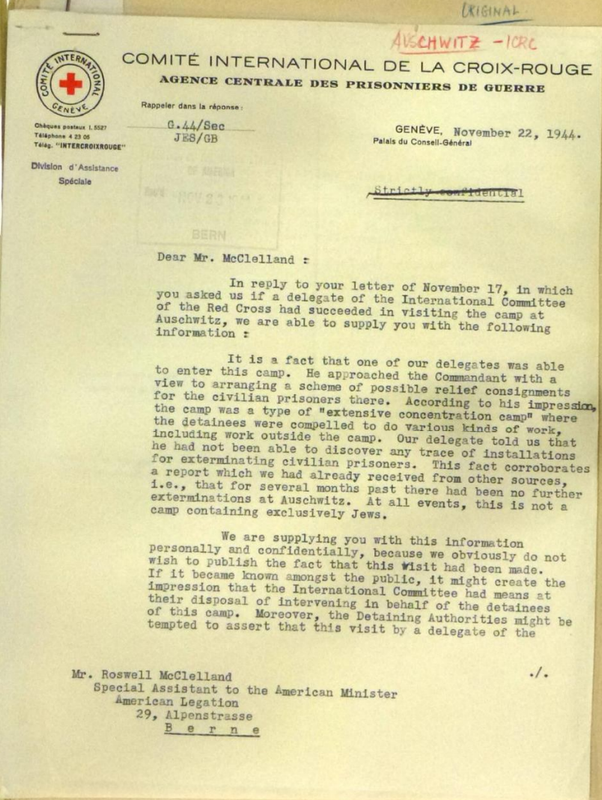
Transcription:
In reply to your letter of November 17, in which you asked us if a delegate of the International Committee of the Red Cross had succeeded in visiting the camp at Auschwitz, we are able to supply you with the following information:
It is a fact that one of our delegates was able to enter this camp. He approached the Commandant with a view to arranging a scheme of possible relief consignments for the civilian prisoners there. According to his impression, the camp was a type of “extensive concentration camp” where the detainees were compelled to do various kinds of work, including work outside the camp. Our delegate told us that he had not been able to discover any trace of installations for exterminating civilian prisoners. This fact corroborates a report which we had already received from other sources, i.e., that for several months past there had been no further exterminations at Auschwitz. At all events, this is not a camp containing exclusively Jews.
We are supplying you with this information personally and confidentially, because we obviously do not wish to publish the fact that this visit had been made. If it became known amongst the public, it might create the impression that the International Committee had means at their disposal of intervening in behalf of the detainees of this camp. Moreover, the Detaining Authorities might be tempted to assert that this visit by a delegate of the International Committee is sufficient proof that the detainees of the camp were receiving good treatment. The means available to us are unfortunately far from being adequate enough to secure improvement in the treatment of civilian prisoners at Auschwitz, or in other concentration camps.
We feel sure that you will understand our motives and that you will consider this information as confidential, except in respect of the United States Legation, to whom you may communicate the above, if you consider it necessary.
Before looking at individual phrases, let's look at the big picture. What prompted this letter and what, fundamentally, was communicated in reply?
Context: McClelland was the WRB rep. He had been working with the materials now known as the WRB report which were released at the end of November and which claimed 1,765,000 Jews had been gassed at Auschwitz (mostly Auschwitz II). McClelland evidently asked if the ICRC had visited "the camp at Auschwitz." And it's safe to assume he asked about "exterminations" since that's what he'd been looking into and the reply takes up that theme. Although D-H insists upon narrowing the scope to only Auschwitz I, there can be no question that McClelland's scope was wider.
If we were to characterize the ICRC reply at a high level, the only reasonable reading of it is to say that the ICRC is declining to endorse the idea of mass exterminations at Auschwitz (which McClelland was hoping/expecting they would confirm). It's worth noting here as well that the author could have easily said they didn't know or weren't sure or that they strongly suspected something but weren't able to confirm. The author doesn't say any of that. He pushes against the idea of Auschwitz as an extermination camp. You can discount what he's saying on various grounds, but that is plainly what he's saying.
We can now walk through specific phrases.
"Our delegate told us that he had not been able to discover any trace of installations for exterminating civilian prisoners."
This phrase is the one they don't like. As noted, D-H attempts to deal with this by limiting the scope to Auschwitz I only even though nothing in the text of the letter suggests this and McClelland (to whom the letter is addressed) would have no way to know this. Just because Rossel visited Auschwitz I is not grounds for assuming that therefore
the entire exchange narrowly refers only to Auschwitz I. McClelland most certainly did not have such narrow focus in his inquiry. Most of the material in the WRB report related to Auschwitz II and that is the whole reason he was inquiring.
Auschwitz II is often included in general mentions of "Auschwitz" and was only 3km from Auschwitz I. If the ICRC had any suspicions at all that thousands were being killed per day in Auschwitz II they would not have responded the way that they did.
McClelland: Say, have you all heard anything about mass exterminations at Auschwitz?
ICRC: Auschwitz? No, nothing like that.
...
ICRC: Oh, you meant Auschwitz II? Ah, yes, they're being killed by the millions in Auschwitz II. I thought you were asking strictly about Auschwitz I.
Humans don't communicate this way. People are good at picking up on context. If someone is asking if there are mass exterminations "at Auschwitz" you would reply with the most relevant information and mass exterminations at Auschwitz II would obviously be relevant. In linguistics, this is called pragmatics. D-H's entire interpretation relies on pretending not to understand pragmatics (which everyone understands intuitively).
https://en.wikipedia.org/wiki/Pragmatics
Note also the language used here. He could not find "any trace" of installations for exterminations. Again, the author does not need to say it like this, but he's going out of his way to use language that undercuts the proposition. He could have easily softened this had he wanted to.
"This fact corroborates a report which we had already received from other sources"
So he just told us there was "no trace" of any installations for exterminations and then in the next sentence he says that
other sources have
corroborated Rossel's conclusion of no exterminations.
"i.e., that for several months past there had been no further exterminations at Auschwitz."
Looking at this sentence in isolation, "no further exterminations" could imply that there were "exterminations" several months ago. And this is what D-H and the rest of them cling to. But I think reading this as a robust endorsement of earlier mass gassings is an enormous and unjustified leap. There's no detail about the nature or scale of possible earlier exterminations or what the basis would be for claiming this. Given the rest of this letter, I do not see how we can read this as any sort of authoritative comment on what might have happened several months earlier before they had made any visit at all. We cannot say with certainly what he meant by this, but I read it as leaving the door open for possible earlier atrocities but I don't read it as an assertion of any
strong positive claim about what happened months earlier (which they would have been in a less informed position to make).
For sake of argument, if we were to interpret this as referring to earlier mass gassings, the obvious reply would be to point out that this plainly contradicts the standard history which says mass gassings continued at Auschwitz
through Nov 1944. "Several months" doesn't fit. D-H tries to save this by saying the ICRC rep is referring to Auschwitz I (because of the Rossel visit). But this sentence does not even refer to Rossel but rather the "other sources." In the context of the overall exchange with McClelland, the broader understanding of "Auschwitz" is much more reasonable.
For info on the timeline of the gassings, see HH47 on Danuta Czech's Auschwitz Chronicles. Gassings are claimed in August, September, October.
"At all events, this is not a camp containing exclusively Jews."
Once again author is undercutting the idea that Jews are being exterminated en masse at Auschwitz. It seems this is being including as a corrective to the idea that Auschwitz was a "Jewish" camp.
Overall, does this letter sound like it's written by someone who believes Auschwitz is a murder camp? No, it plainly does not.
Could Auschwitz II have been kept secret?
Our pal Patrick jumped in with a reply where he seemed to be trying to say that everyone knew about Auschwitz.
He's essentially arguing against himself here. The argument he and D-H were making
crucially depends on the premise that Rossel would not have been able to notice anything with Auschwitz II because he only went to Auschwitz I and the two were separated by 3km. Then he turns around and says that it was no secret to anyone anywhere in the area. Just think of the flames and smoke spewing from the chimneys.
If you follow what they say closely you will find that they constantly contradict themselves on this question of secrecy.
A More Defensible Anti-Revisionist Argument
Sometimes I wonder who these guys are hoping to persuade with these tortured and unnecessary arguments. I really think they lose people by doubling-down on ridiculous things way too often. If I were on the other side, this is how I would try to deal with this document. I would say the ICRC did not have access to Auschwitz II and were therefore were unable to confirm the gassings there. I'd say that this letter reflects the opinion of an author who was apparently not convinced of the large scale gassings of Jews but that this person was mistaken and working with incomplete information. I would mention the "no further exterminations" point but I would not oversell it.

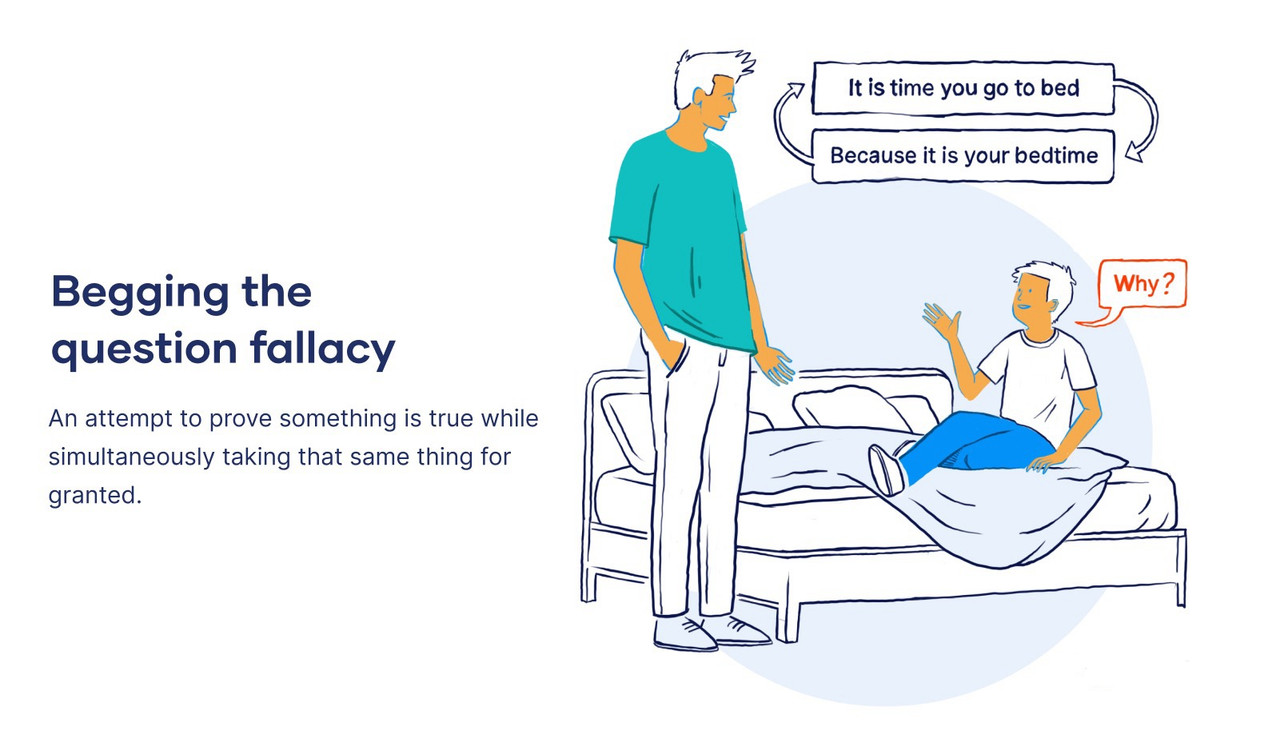
 That is merely a true-believer explanation based upon a stubbornly steadfast and intransigent insistence upon cherished, quasi-religious, core beliefs regarded as sacrosanct. Or in other words the logical fallacy of ‘begging-the-question’. That is, S-C starts every discussion from a position that refuses to question certain steadfast and rigid beliefs. He then either accepts or rejects information based on whether it supports or undermines his a priori belief.