Auschwitz inmate Benjamin Jacobs saw the inside of a gas van

A revisionist safe space
Post Reply
W
Wetzelrad
Posts: 756
Joined: Wed Feb 26, 2025 6:35 am

Auschwitz inmate Benjamin Jacobs saw the inside of a gas van

Post by Wetzelrad »

In Holocaust literature, gas vans are not usually said to have been ambulances. They're usually described as being a "Coffee Wagon", or like a furniture van, or a generic truck or van. The word "ambulance" or descriptions matching one do not appear at all in the Wikipedia pages for gas vans. Nor does it appear in Cameron Munro's lectures, and as the foremost expert on this topic he would know if anyone would.

Furthermore, gas vans are not usually associated with Auschwitz. Usually a killing location is said to have used either gas vans or gas chambers, not both, and Auschwitz is very much in the second category.

Therefore it is a remarkably rare and fortuitous event that Benjamin Jacobs (PKA Bronek Jakubowicz) was deliberately shown the driver's compartment of an ambulance gas van in Auschwitz. According to his memoir, this was an ambulance like those driven by other SS doctors, but it had been equipped with a lever in among the other controls with the label "Gas: use only when in motion". In a confession made directly to Jacobs, Auschwitz's 2nd camp dentist Willi Schatz revealed that this lever redirected the vehicle's exhaust into the rear of the vehicle to kill Jews by carbon monoxide poisoning. He himself had operated the vehicle in this way.

Also incredible is that Jacobs remembered Schatz in the context of 1943*, because historians have established that he was assigned to Auschwitz on January 20 or 30, 1944. A strange anachronism.

* Jacobs's memoir does not directly state the date of his meeting Schatz, however, the events of 1943 are described from page 88 until page 152, which was Christmas. 1944 begins on the following page. That is three pages after the Schatz introduction and confession.

Here is the passage from his memoir:
A few weeks after Dr. [Hans Wilhelm] Konig left, another dentist came to oversee the dental station. Dr. [Willi] Schatz was in his midforties, mild-mannered, friendly, and slightly hunched over. When I recited the camp's required litany, he said that I need not say it for him. Nor did he object to my continuing to treat the guards. But one time he came in very upset. He threw his hat on the chair disgustedly and walked through the dental station, his hand clutched behind his back. "Do you know what they made me do?" he said, looking straight at me, disturbed.

My place was not to reply, but since he looked at me and waited, I said, more out of politeness than curiosity, "What, Herr Hauptscharfuhrer?"

He held out the keys to his ambulance and said, "Go and look at the instrument panel. Then you will see what I mean." His vehicle was parked just a couple of steps from the door. I took his keys and went outside. I opened the driver's door and looked at the instrument panel, which had the usual levers: choke, lights, wipers, heater, and so on. Then I noticed a white lever below with the word Gas on it. Just below that was an inscription: "Achtung, nur im Betrieb gebrauchen" (Caution, use only when in motion). I knew then what it meant.

A shock went through me. I closed my eyes and stepped back. The souls of my mother and my sister were there. Though I knew that these outrageous vehicles existed, seeing one that looked so innocent evoked a new and intolerable pain. It was evidence of the most inhuman and unusual of crimes. It inflicted new and deep wounds. I stood transfixed a while until I regained my composure. The shock of this incident may be at the heart of this book.

I tried to conceal my outrage when I returned. I thought it would be best not to say that I understood what he meant. Although I thought his disgust was real, I could not allow myself to agree with him openly. "Herr Hauptscharfuhrer, I don't know what you meant," I said.

"Did you notice the sign under a handle that says 'Gas: Use only when in motion'?"

I said that I had but claimed I did not understand. I wanted him to tell me. "I saw that lever, Herr Hauptscharfuhrer, but I thought it was a hand accelerator."

"Don't you know what they are doing to you people?" And without waiting for an answer, he became specific. "By pulling this lever, we kill you people! With this lever the driver can divert the exhaust flow to the passenger section of the vehicle. The carbon monoxide then kills everyone in it. That is what we doctors are ordered to do." I looked at his disturbed face. It showed anger and disgust as he poured out his pent-up emotions. He then proceeded to tell me that a lot of our people had already been victims in that very vehicle.

The Dentist of Auschwitz: A Memoir (1995) by Benjamin Jacobs, pp.148-149
Though described as being "in his midforties", Schatz would actually have been 38 or 39 years old. Though called by "Hauptscharführer", a noncom rank, he was actually an Untersturmführer. Hans Wilhelm Konig was likewise called "Hauptscharführer" despite being an Obersturmführer. The memoir has a lot of these minor mistakes.

The function of the lever was left mysterious. How does a lever in the cab control where exhaust goes? Why would it be labelled, especially in the way that it was? What purpose would the caution warning serve?

And why of all people was a dentist assigned to this task? Surely there were better candidates available, heartless murderous types who wouldn't go and blab to a prisoner. Schatz's confession could have sent him to the gallows. Instead he was tried for selecting incoming prisoners to be gassed and ultimately acquitted. It's not explained in the memoir why Jacobs let Schatz get away with this, when he could have testified against him.

Hopefully some historian will resolve all these questions. When Cameron Munro finds out about this, he can add it to his list of known gas vans.

And just as a matter of clarity, Jacobs at this time was in Fürstengrube, a small subcamp of Auschwitz some 30 km NW. Despite Fürstengrube's seeming insignificance, Jacobs claimed it had regular visits not just by the dentists but also by doctors like Mengele.
User avatar
Eye of Zyclone
Posts: 566
Joined: Fri Apr 04, 2025 3:12 pm

Re: Auschwitz inmate Benjamin Jacobs saw the inside of a gas van

Post by Eye of Zyclone »

Wetzelrad wrote: Sun Apr 12, 2026 4:22 am The word "ambulance" or descriptions matching one do not appear at all in the Wikipedia pages for gas vans. Nor does it appear in Cameron Munro's lectures, and as the foremost expert on this topic he would know if anyone would.
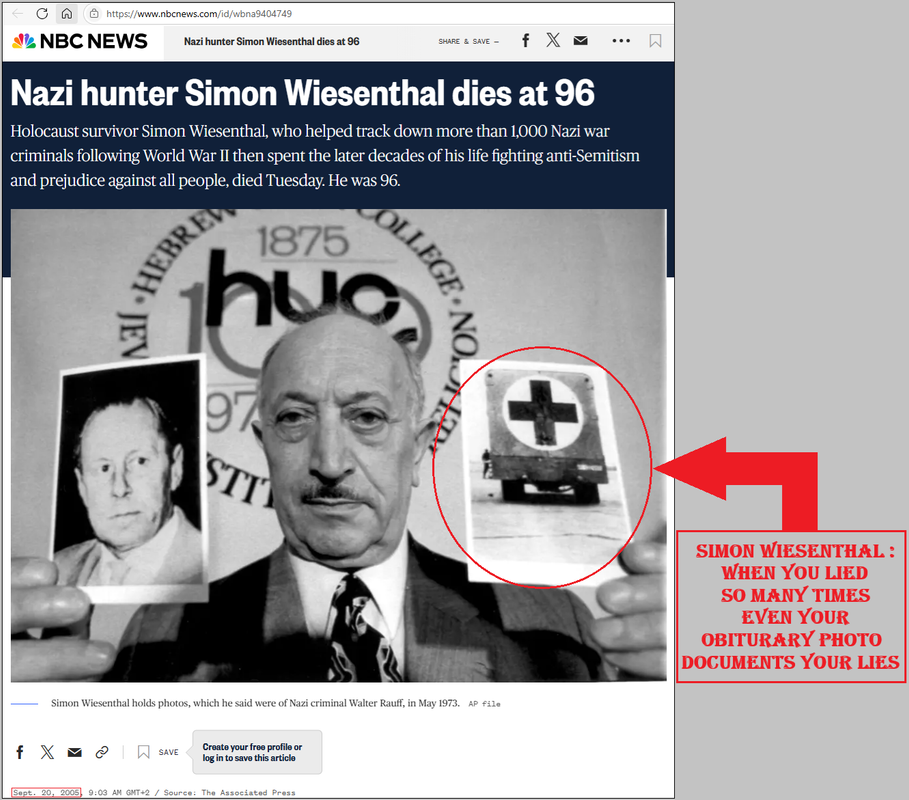
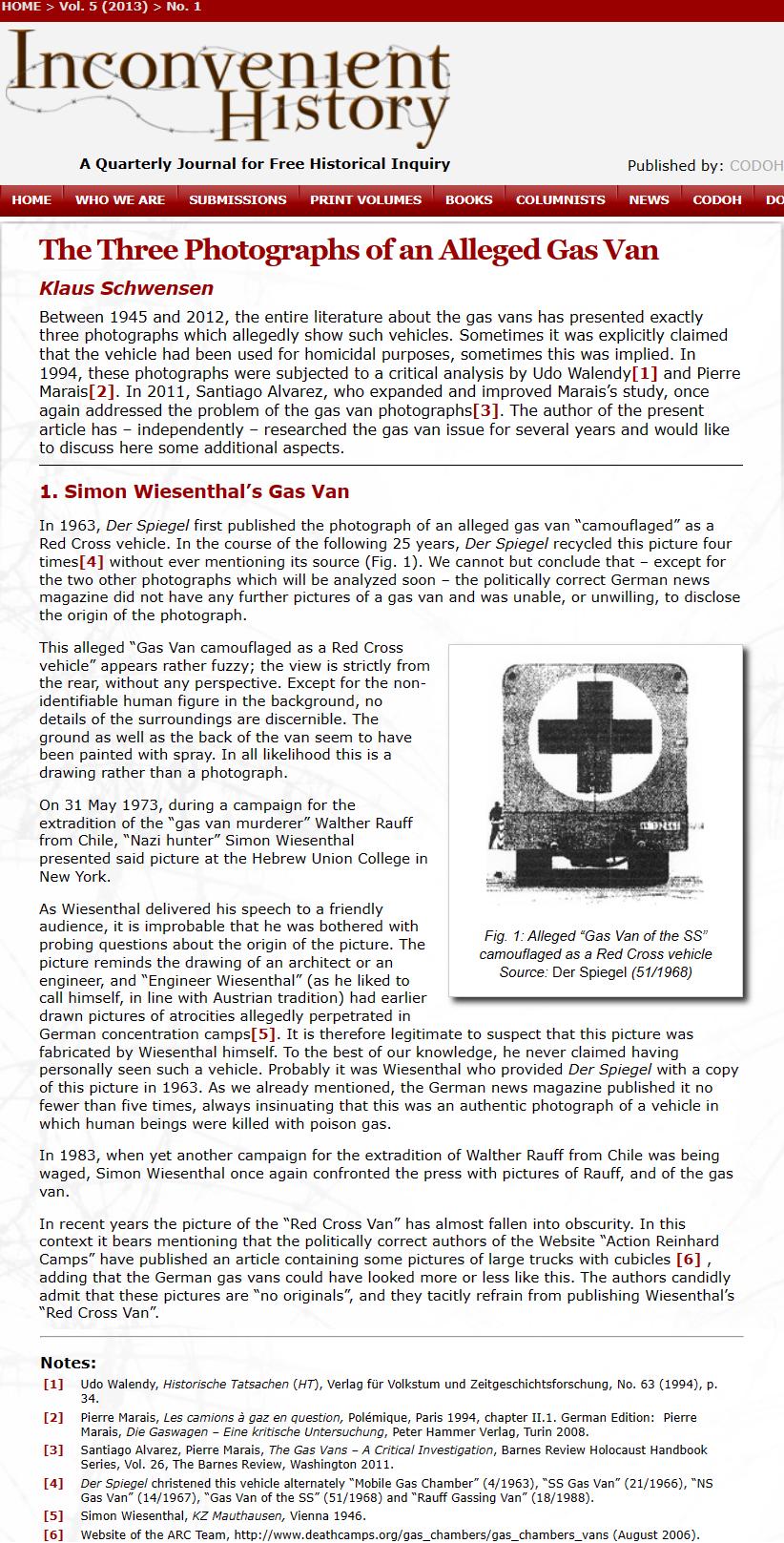
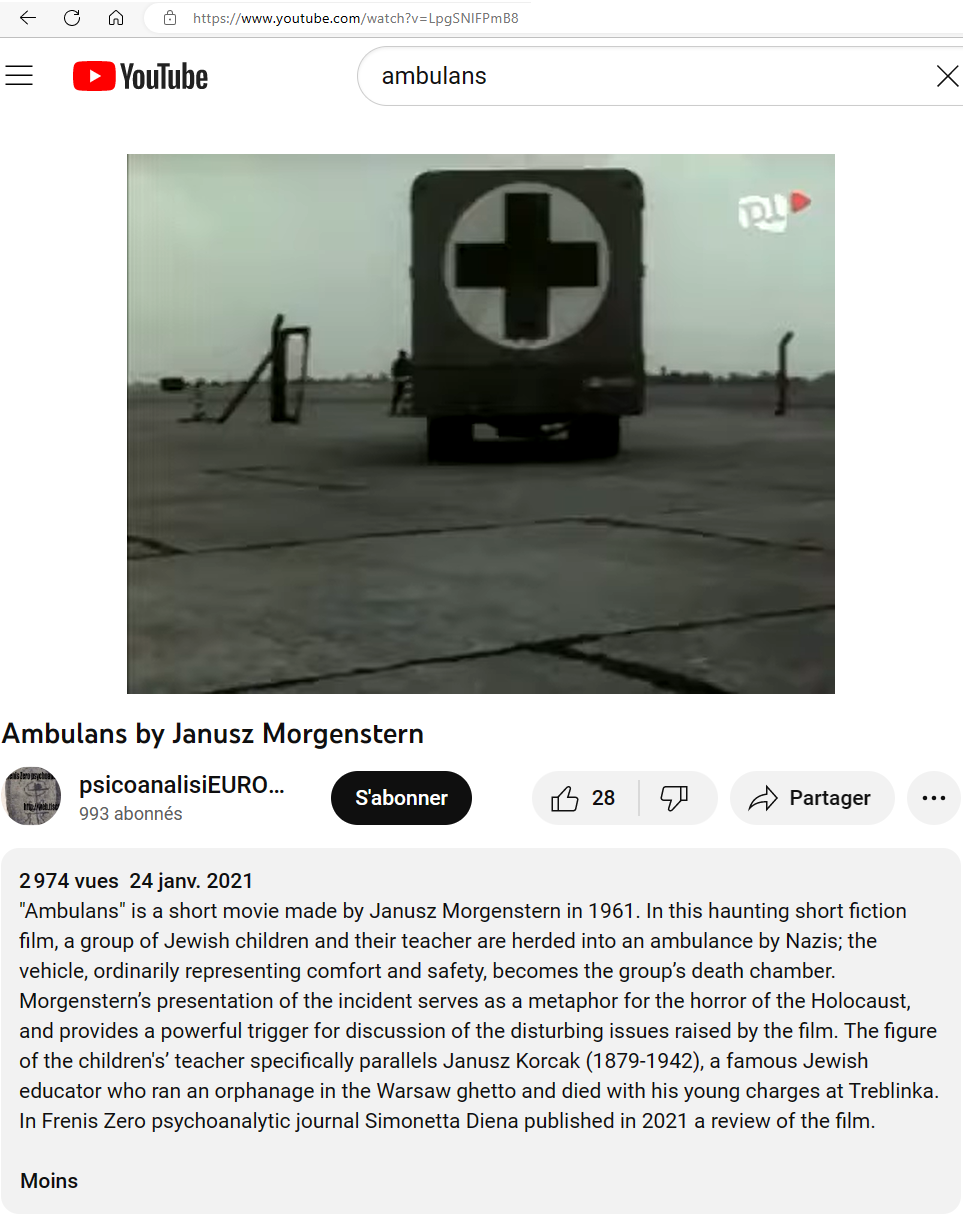
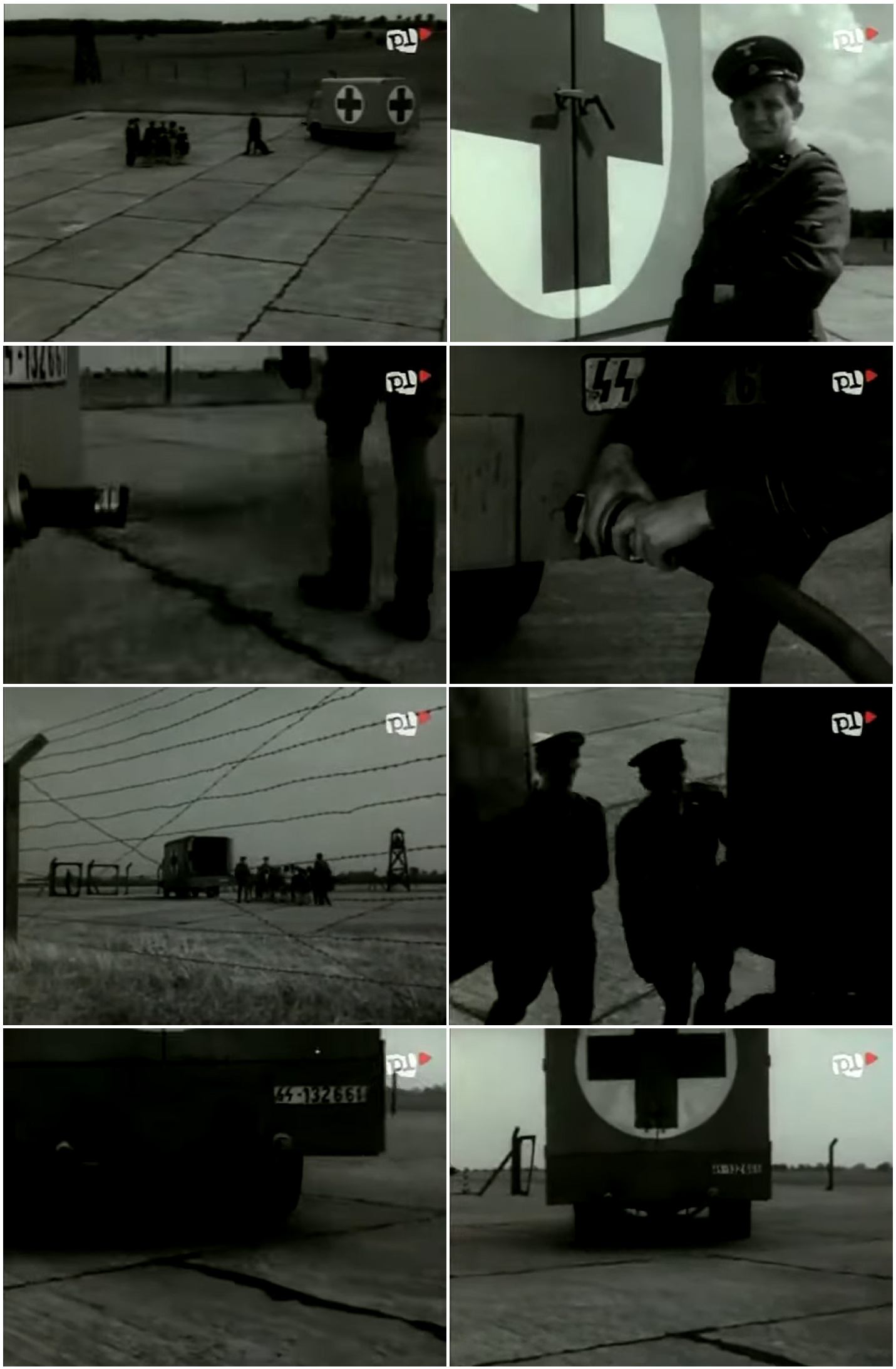
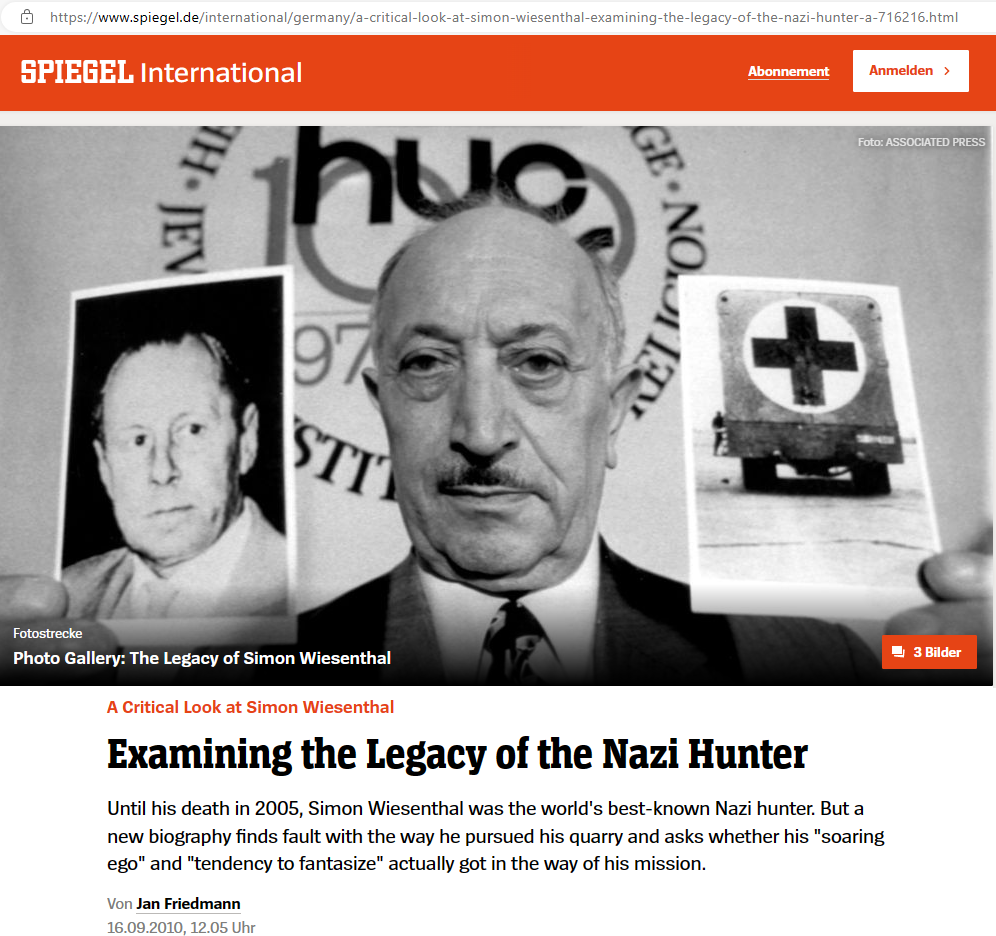
Wikipedia and Holohoaxers like Cameron Munro also know that they'd better hide that the gas-van atrocity story has gone through several variations, like most propaganda lies. In reality, the notorious Israeli spy Simon Wiesenthal 'documented' the Holocaust with the photo of an alleged gas van which was an ambulance and turned out to be taken from a post-WW2 Polish movie called Ambulans.

Image

Image
Gas Van Film and Photo Fraud
German News Magazine and Simon Wiesenthal Center's Museum
Caught Faking Photo and Film Captions

by Santiago Alvarez
Published: 2014-04-25

Image

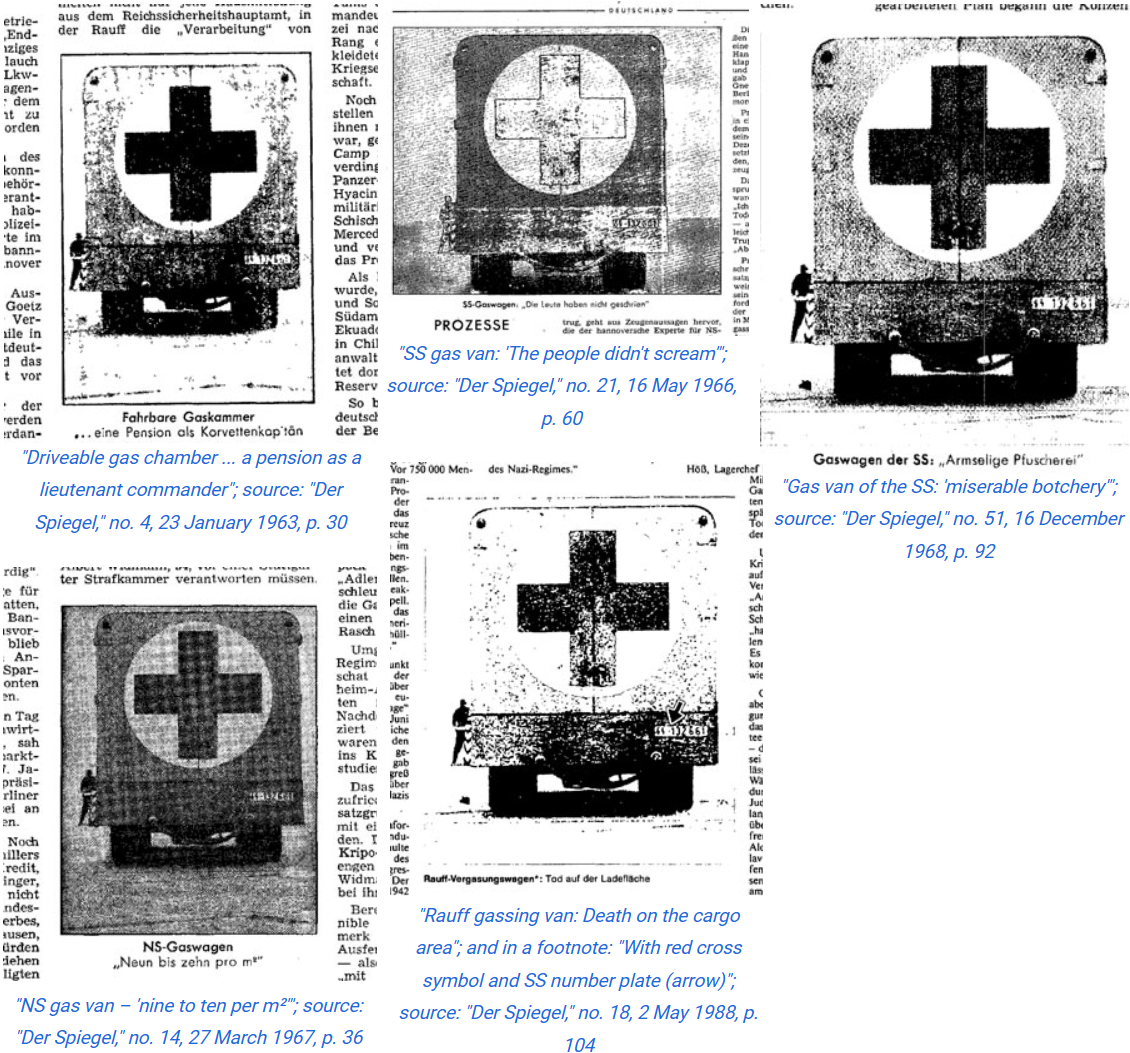
In at least five issues of the German news magazine Der Spiegel a photo was reproduced alongside articles which dealt with trials involving alleged murders in so-called "gas vans," which were supposedly committed during the Second World War by German units in Serbia, Poland and in German-occupied parts of the Soviet Union. The photos depict the rear view of a truck with a huge red cross sign painted on the rear door. See the reproductions in the illustrations to the right. No source has been given for this photo, which caused revisionist authors in the past to doubt the authenticity of this image.[1]

Image

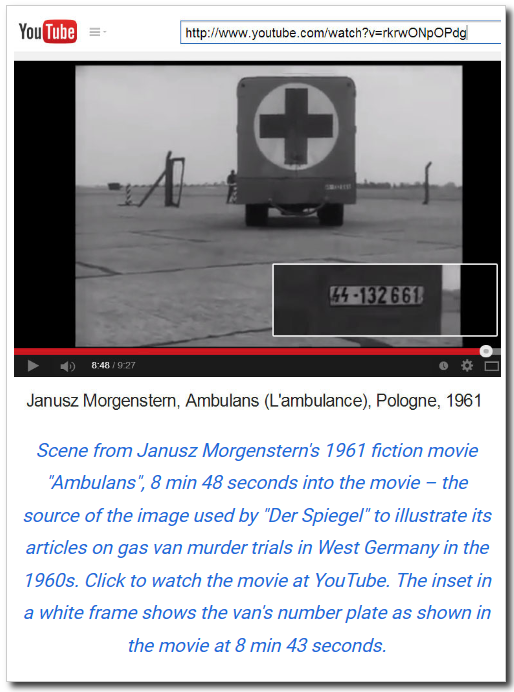
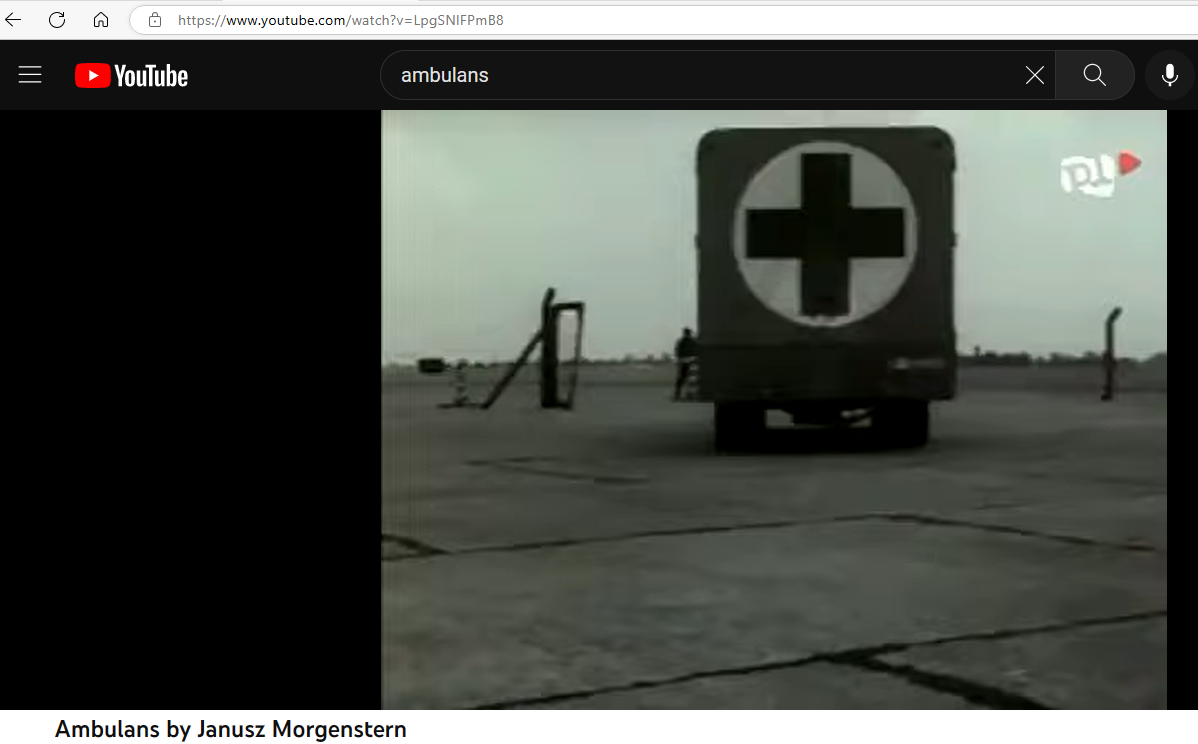
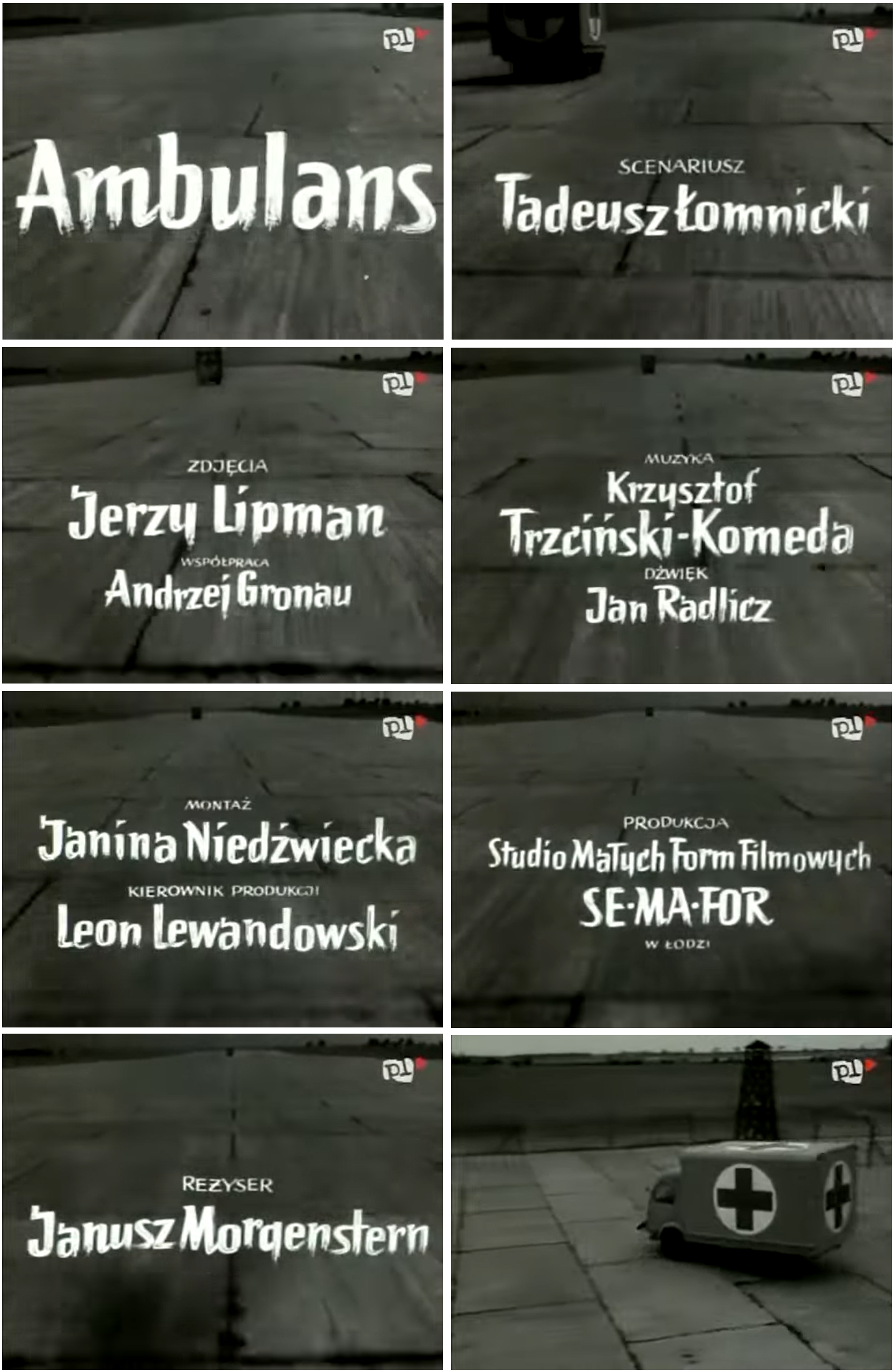
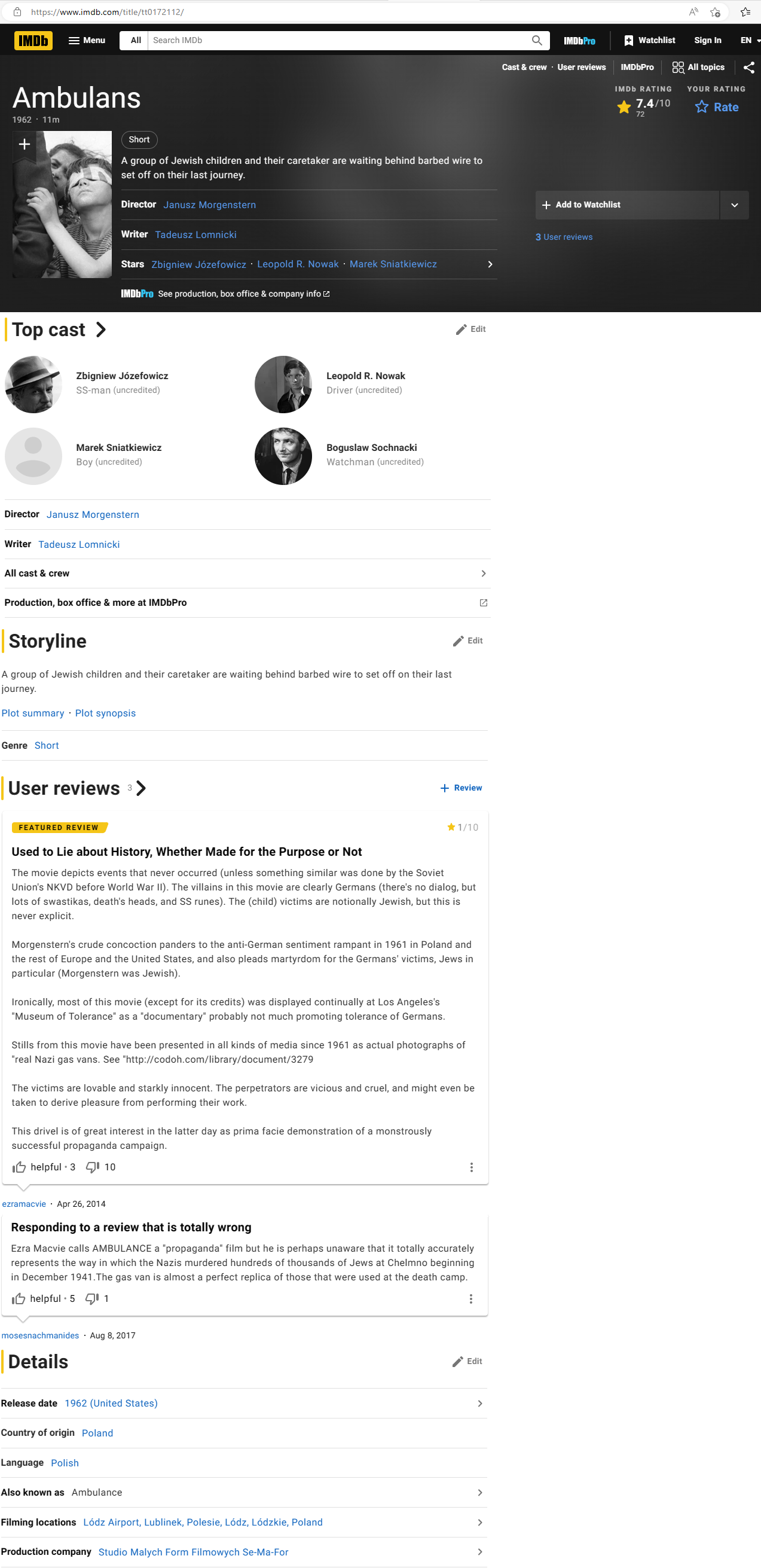
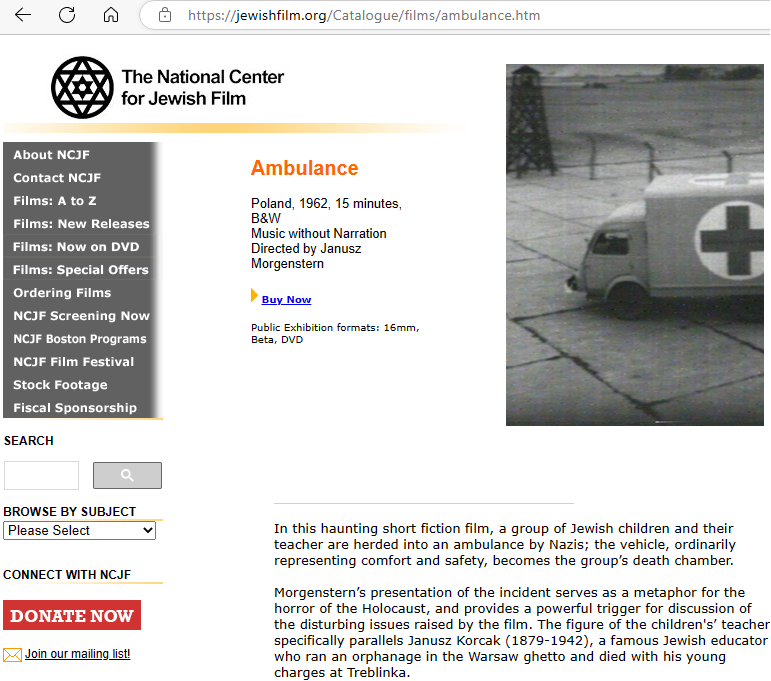
In a recent video, Jewish-American revisionist David Cole revealed that the Simon Wiesenthal Center's "Museum of Tolerance" in Los Angeles used to show an allegedly authentic documentary film depicting the gassing of several children in a "Nazi gas van." David Cole found out that the scene shown by the museum had been taken from the 1961 Polish fiction movie "Ambulans" directed by Polish-Jewish filmmaker Janusz Morgenstern.[2] David Cole managed to have the Simon Wiesenthal Center remove this fake "documentary" by instigating Janusz Morgenstern to confront the Center for this obvious copyright violation.

Watch Cole's video where he explains how he managed to stop this fraud, and then watch his juxtaposition of the Wiesenthal fraud with the Polish movie.

Cole's version of the Polish movie is rather mediocre. A better version can be watched here on YouTube. If you move the video to 8 min 48 seconds, you'll see exactly the picture used by Der Spiegel to illustrate its various articles, see below. The van's number plate can be seen at 8 min 43 seconds: "SS 132661," just like in the Spiegel illustrations.

Image

Case closed.

http://magazin.spiegel.de/EpubDelivery/ ... f/45142046
http://magazin.spiegel.de/EpubDelivery/ ... f/46407284
http://magazin.spiegel.de/EpubDelivery/ ... f/46450716
https://magazin.spiegel.de/EpubDelivery ... f/45865139
http://magazin.spiegel.de/EpubDelivery/ ... f/13527264

[1] Pierre Marais, Les camions à gas en question, Polémique, Paris 1994; Santiago Alvarez, The Gas Vans, The Barnes Review, Washington DC, 2011, pp. 35, 279; Klaus Schwensen, "The Three Photographs of an Alleged Gas Van," Inconvenient History, 5(1) (2013)
[2] https://pl.wikipedia.org/wiki/Ambulans_(film_1961); https://www.imdb.com/title/tt0172112/

https://codoh.com/library/document/gas- ... -fraud/en/
Ambulans by Janusz Morgenstern


Image

Image

Image

Image

Image

Image

Image
https://www.spiegel.de/international/ge ... 16216.html

https://www.stormfront.org/forum/t1328816/

Wetzelrad wrote: Sun Apr 12, 2026 4:22 am In Holocaust literature, gas vans are not usually said to have been ambulances. They're usually described as being a "Coffee Wagon", or like a furniture van, or a generic truck or van. The word "ambulance" or descriptions matching one do not appear at all in the Wikipedia pages for gas vans. Nor does it appear in Cameron Munro's lectures, and as the foremost expert on this topic he would know if anyone would.
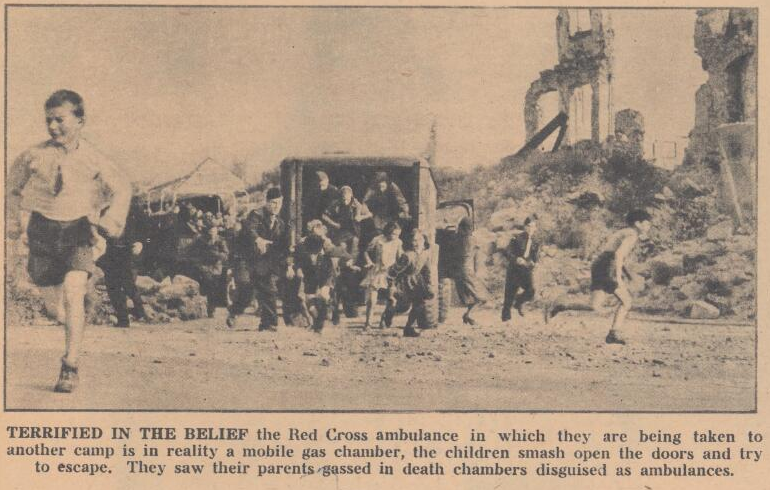
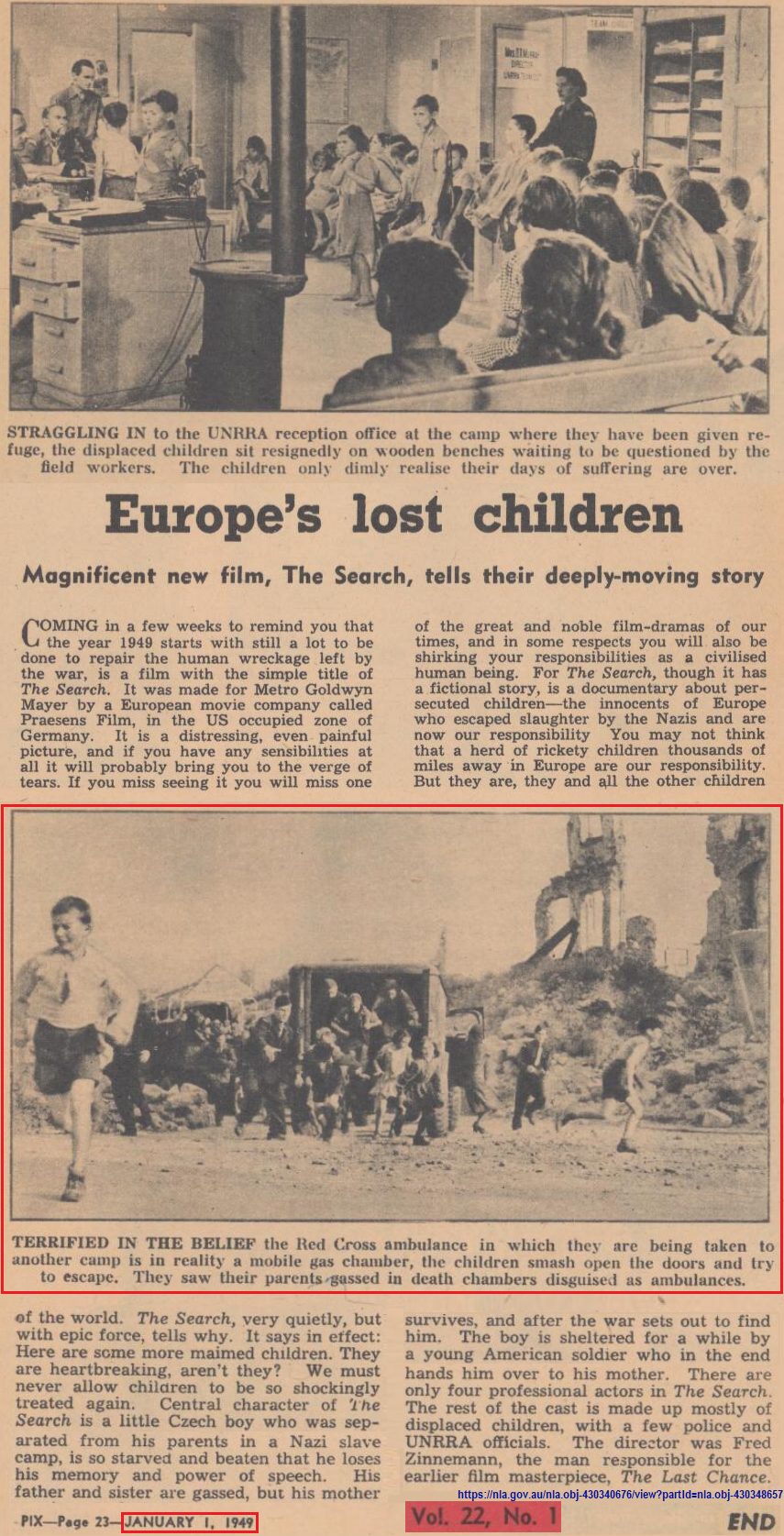
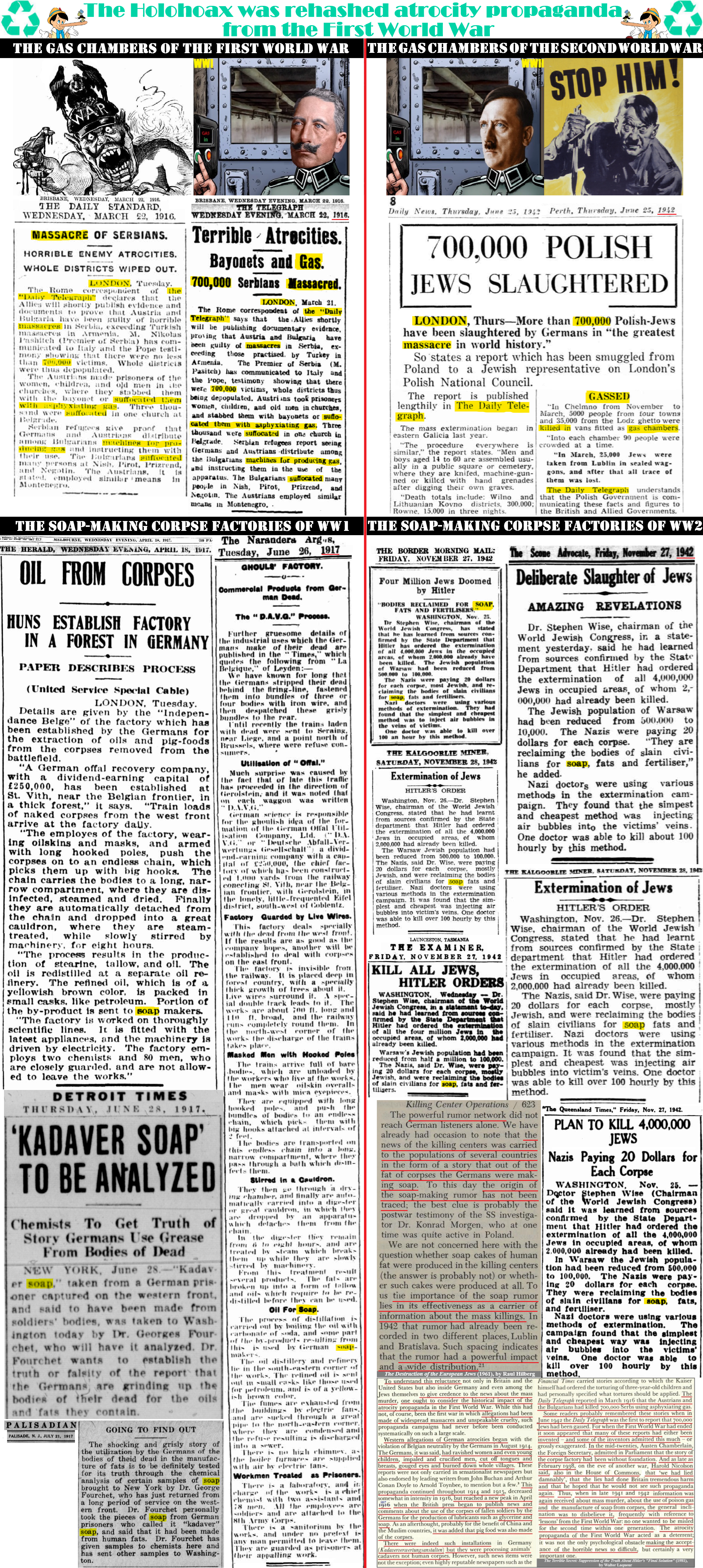
The Holohoax in its infancy :

Image

Image
https://nla.gov.au/nla.obj-430340676/vi ... 2/mode/1up
"Holocaust deniers are very slick people. They justify everything they say with facts and figures."
W
Wetzelrad
Posts: 756
Joined: Wed Feb 26, 2025 6:35 am

Re: Auschwitz inmate Benjamin Jacobs saw the inside of a gas van

Post by Wetzelrad »

Indeed, it's easy to imagine that Jacobs was influenced by one or the other of those films or derivative materials. If so, he may be the only one. I can't find any historian or witness who corroborates him.
User avatar
Eye of Zyclone
Posts: 566
Joined: Fri Apr 04, 2025 3:12 pm

Re: Auschwitz inmate Benjamin Jacobs saw the inside of a gas van

Post by Eye of Zyclone »

Wetzelrad wrote: Sun Apr 12, 2026 7:25 am Indeed, it's easy to imagine that Jacobs was influenced by one or the other of those films or derivative materials. If so, he may be the only one. I can't find any historian or witness who corroborates him.
Some "witnesses" also claimed that Red Cross ambulances were used to transport cans of Zyklon B to the alleged gas chambers.

Dr. Charles Sigismund Bendel (Lüneburg trial, October 1, 1945):
About twelve o’clock the new transport arrived, consisting of some 800 to 1000 people. These people had to undress themselves in the court of the crematorium and were promised a bath and hot coffee afterwards. They were given orders to put their things on one side and all the valuables on the other. Then they entered a big hall and were told to wait until the gas arrived. Five or ten minutes later the gas arrived, and the strongest insult to a doctor and to the idea of the Red Cross was that it came in a Red Cross ambulance.
Trenches Of Death

"The capacity of the crematorium was insufficient, so the Nazis dug three big trenches and fitted tubes to drain off the fat from the burning bodies," he said. "The trenches could dispose of a thousand bodies an hour." The daily timetable, he said, was: First, the trenches were cleaned out with petrol, which was set alight. Next 1000 people arrived at noon and were told to strip for a bath. Ambulances carrying gas arrived soon after, and the people were herded into gas chambers by guards wielding sticks. Shouting and hammering on the doors from the inside went on for two minutes, after which there was silence.

https://trove.nla.gov.au/newspaper/article/272470248

Marcel Nadjari:
Auschwitz inmate's notes from hell finally revealed
1 December 2017

Chilling testimony from an Auschwitz inmate forced to help the Nazi murder squads has finally been deciphered, thanks to painstaking detective work and digital imaging.

On scraps of notepaper Marcel Nadjari, a Greek Jew, described how thousands of Jews were herded into the gas chambers daily.

He was among about 2,200 members of the Sonderkommando - Jewish slaves of the SS who had to escort fellow Jews to the gas chambers. Then they had to burn the bodies, collect gold fillings and women's hair, and throw the ashes into a nearby river.

Having witnessed Nazi Germany's killing machine close up they knew it was only a matter of time before the SS exterminated them too.

So in November 1944 Nadjari stuffed his 13-page manuscript into a thermos flask, which he sealed with a plastic top. He then placed the thermos in a leather pouch and buried it near Crematorium III.

"The gas canisters were always delivered in a German Red Cross vehicle with two SS men. They then dropped the gas through openings - and half an hour later our work began. We dragged the bodies of those innocent women and children to the lift, which took them to the ovens."

https://www.bbc.com/news/world-europe-42144186

Google's AI:
Eyewitness testimony and accounts from Auschwitz prisoners indicate that Nazi SS men transported Zyklon B gas in vehicles marked with the Red Cross emblem to the gas chambers at Birkenau. These trucks, sometimes part of the German Red Cross (DRK), were used to deliver poisonous gas pellets to the camp while disguised as medical vehicles.

Key details regarding this subject include:
  • Method of Deception: The German Red Cross was a Nazi-affiliated organization that, under SS General Dr. Ernst Robert Grawitz, was involved in the "Euthanasia" Action T4 program, using vehicles disguised as medical transportation for lethal purposes.
  • Deliveries: According to accounts, such as those detailing deliveries from the I.G. Buna-Works (Monowitz) to Birkenau, delivery vans marked with the Red Cross would deliver canisters of "Gas Zyklon B" to the extermination sites.
  • Historical Context: The use of the emblem was part of the broader Nazi deception techniques and the exploitation of the "Lazarett" (infirmary) at sites like Treblinka to hide extermination activities.

These accounts highlight the complicity of various Nazi-aligned agencies in the systematic murder of prisoners.
"Holocaust deniers are very slick people. They justify everything they say with facts and figures."
User avatar
Callafangers
Administrator
Posts: 1290
Joined: Tue Sep 24, 2024 6:25 am

Re: Auschwitz inmate Benjamin Jacobs saw the inside of a gas van

Post by Callafangers »

I regret not coming across this thread sooner. From deathcamps.org (an orthodox Holocaust history website):
Resistance report from Auschwitz, sent by Stanislaw Klodzinski ("Staklo") to Teresa Lasocka-Estreicher ("K. Tell") and Edward Halon ("Boruta") in September of 1944 (Camp Resistance Files, vol. 2. p. 161):
"Police wagon no. 71462 - in other words a mobile gas chamber in Auschwitz. A unit of the so-called "Polizei-Sonderkommando", which previously worked in Lithuania, is stationed in the vicinity of the camp. This criminal commando used a car that was sealed, with a grate and hermetically closed doors, which served as mobile gas chambers (sic) to transport prisoners. To the end of the exhaust pipe there is attached the end of a metal hose, which when "needed" leads the wagon's exhaust gases into the wagon's interior through an appropriate opening. The inside of the wagon is a cabin made airtight by a tin lining, 4 metres long and 2.5 metres wide. The heavy doors lack any openings and have no latch on the inside. To the right of the doors is an opening covered by a heavy grating which can be opened from the outside and serves to air the wagon out after an execution. Description of the wagon: model Saurex (sic), in the shape of a long box, painted greenish-yellow. Registration no. Pol 71462, driver: Arndt, Oberwachtmeister of the Polizei-Sonderkommando. He should by the way be sentenced to death*. This wagon was used among other things to execute civilians convicted by the so-called Polizei-Sondergericht. The driver on that occasion left the van standing with the throttle open and, while walking around, joked: 'meanwhile, the little birds are choking in there.' Send to. (sic)
Cordial greetings - Staklo."
* At this time the camp resistance was composing a list of criminals from Auschwitz to be broadcasted by the BBC.

Testimony of Stanislaw Dubiel (Höß Trial, vol. 25, p. 82):
"It was Sturmbannführer Henschel who at first seemed to us to have a very good character. And in a few days, he found another method – gassing in a car. The car goes to Birkenau, by the time it gets there everyone is dead. The driver explained how it works, that the exhaust pipe goes straight into the car. By the time the driver gets to where he’s going, they’re already dead. That was the behaviour of this supposedly good man."

Testimony of Jan Dziopek (Höß Trial, vol. 8, p. 109):
"They were carried out at Block 11 until October 1944, after that the condemned were killed only at Birkenau, where they were taken from our place* in a prison van. That type of van was very tightly sealed and had apparatus for gassing the people inside. The gassing apparatus was built in the automobile workshops of the Fahrbereitschafts–Kommando."
* I.e. Auschwitz main camp.

Testimony of Edward Wrona (Höß Trial, vol. 26, p. 8.):
"I think none of the witnesses has emphasized that gas vans were used at Auschwitz. I assume that the accused Höß knew about it, because he went every day to look at his beautiful limousine in the automobile workshops and saw the three vans in which people were murdered standing there. Working at the water pumping station in Block 18, I leaned my head out and observed how girls and men were packed into these vans and the executions were carried out. I witnessed how one night a German general was executed, supposedly just for refusing to carry out an order in wartime. That time around 50 limousines drove up with a huge retinue of generals and the camp command, and the execution* was carried out ceremoniously, lighting up the wall of death and the square behind Block 11 with a searchlight."
* Possibly this refers to different, "regular" execution.

Testimony of Kazimierz Grabowski (Höß Trial, vol. 26, p. 32, 33):
"Presiding judge: Was there* a truck there designated in advance for gassing people?
Witness: Once one van that was especially encased in wood came in for repairs, I didn’t know what kind of van it was. German vehicles ran on methanol. There it was fitted with an exhaust pipe, round with small holes, when the prisoners were inside the van, the gas got in that way. After 15 minutes a person was ready. Before it even reached the crematorium, there were only corpses in the van. I ran across only one vehicle like that, on which I worked.
Pres: Was the van constantly in use?
Witness: Constantly, unless it was damaged, then it went in to be fixed.
Pres: Was this van used inside the camp, or outside?
Witness: That I don’t know.
* I.e. in the camp automobile repair workshops.

Testimony of Jozef Sliwa (APMAB, Collection "Statements", vol. 3, p. 336, 337):
"When a larger number of sick people had accumulated*, they were taken in vans to Auschwitz. I saw the vans – gas chambers, into which transports of Muselmans were loaded. I went inside and saw the gassing apparatus, i.e. pipes to let the exhaust gases in."
* In the Golleschau sub-camp.

Testimony of Zbigniew Kazmierczyk (APMAB, Collection "Statements", vol. 45, p. 4):
"Commissions often came from Auschwitz, which carried out selections among sick prisoners in the hospital. The selected prisoners were taken away to Auschwitz by vehicles, already gassing them on the way. I know from what friends told me that they were dark green, reinforced, sealed when closed, into which exhaust gas was let in."

Testimony of Wladyslaw de Rosenberg Grohs, police prisoner from Block 11 (APMAB. Collection "Statements", vol. 73, p. 38):
"Yes, well out of my hall sometimes only two persons out of 100 were transferred as prisoners to one of the blocks in the camp, the rest were loaded into trucks. In any case, at that time executions were not carried out in the courtyard of Block 11. We were convinced that the prisoners sentenced to death by the police Special Court were suffocated with exhaust products in the boxes of vans – before they got as far as the crematoria."

Testimony of Artur Meyer (APMAB, Collection "Statements", vol. 93, p. 23, 23a):
"Moreover, in Auschwitz there was a special apparatus. It was a car - gas chamber. In this van up to 14 people were loaded, it was hermetically sealed and until the van arrived at Birkenau, its passengers were gassed to death."

Testimony of George Goiny-Grabowski (APMAB, Collection "Statements", vol. 61, p. 167):
"As the Russian front approached to Auschwitz, a police Einsatzkommando arrived, whose members had green cuffs on the uniform. Among their vehicles were two gas vans, at which I had an opportunity to have a detailed look. The exhaust gases could be led into the car box filled with doomed persons... The gas vans had an image showing a human head which kept its nose closed with one hand."

Testimony of Kazimierz Czyzewski (Höß Trial, vol. 35, p. 163):
"Hitlerite civilian special courts which arrived every 14 days and tried hundreds of civilians in this Block 11. After the verdict, these people were driven into a hermetically proofed yellow van. Up to 50 people fit into it - the SS driver drove them to the crematorium (the prisoners did not know where they were brought), and in this van the people were gassed, the corpses were thrown out and cremated."


The statements were kindly supplied by Dr. Piotr Setkiewicz, Head of the Archives at the Auschwitz-Birkenau State Museum.
Polish statements were translated by Dr. Steve Paulsson.
http://www.deathcamps.org/gas_chambers/ ... testi.html
The sheer absurdity of this 'convergence of witnesses' which establishment historians must concede as false is a harsh blow to the 'gas van' narrative, and the Holocaust as a whole.
Forensics lack both graves and chambers—the liar's ink stains history's page.
User avatar
Eye of Zyclone
Posts: 566
Joined: Fri Apr 04, 2025 3:12 pm

Re: Auschwitz inmate Benjamin Jacobs saw the inside of a gas van

Post by Eye of Zyclone »

Callafangers wrote: Sun Sep 06, 2026 9:17 am The sheer absurdity of this 'convergence of witnesses' which establishment historians must concede as false is a harsh blow to the 'gas van' narrative, and the Holocaust as a whole.
The gas-van atrocity story was just a mixture of the gas-chamber atrocity story from the First World War (rehashed propaganda) and the delousing "special purpose vehicles" used by the Germans to combat typhus on the Eastern Front during the Second World War (epidemic decimation & sanitary countermeasures). These German "mobile delousing squads with special vans" clearly inspired the atrocity story of Nazi mobile killing squads with gas vans.

More info here: https://www.codohforum.com/viewtopic.php?p=18790#p18790

Image
larger view

Callafangers wrote: Sun Sep 06, 2026 9:17 am this 'convergence of witnesses'
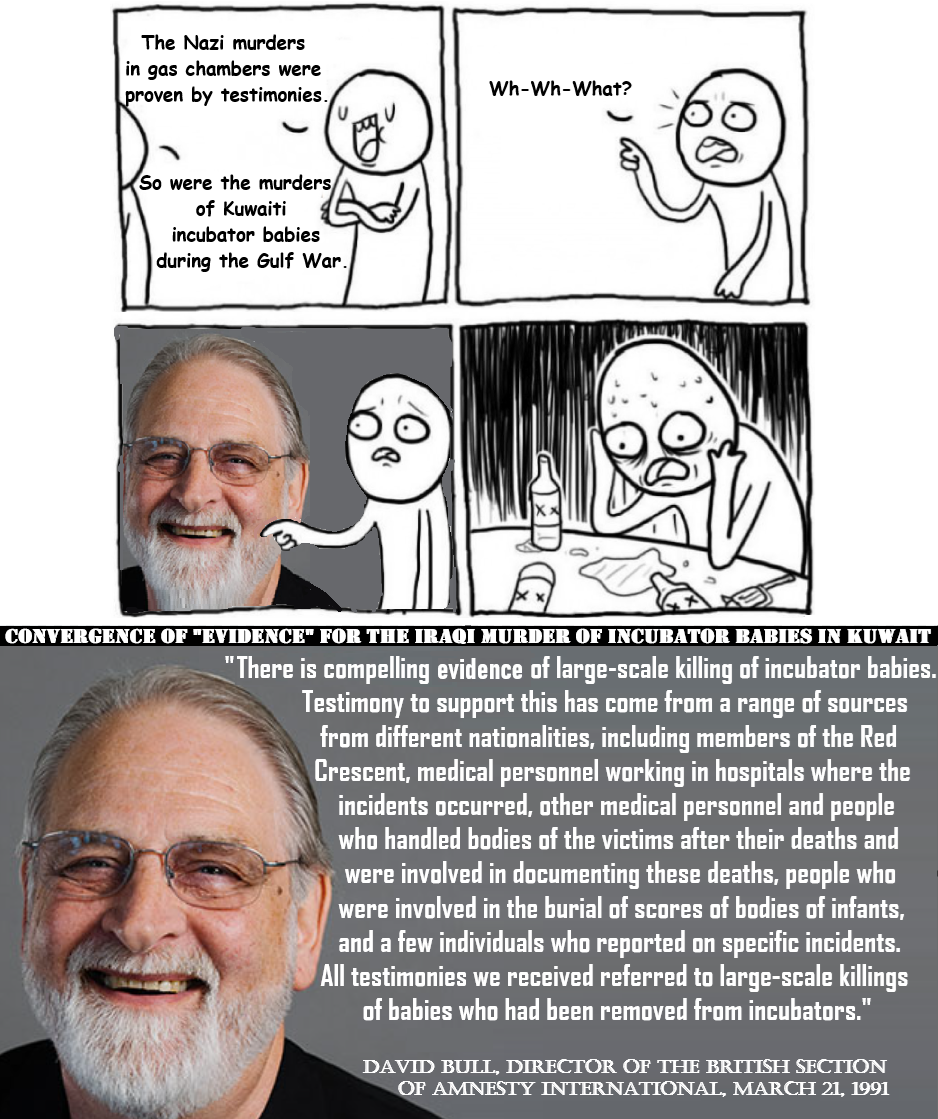
Have you already seen a single major atrocity story that lacked a convergence of testimonial 'evidence' to supposedly prove it ? :roll:

Image
"Holocaust deniers are very slick people. They justify everything they say with facts and figures."
W
Wetzelrad
Posts: 756
Joined: Wed Feb 26, 2025 6:35 am

Re: Auschwitz inmate Benjamin Jacobs saw the inside of a gas van

Post by Wetzelrad »

Callafangers wrote: Sun Sep 06, 2026 9:17 am The sheer absurdity of this 'convergence of witnesses' which establishment historians must concede as false is a harsh blow to the 'gas van' narrative, and the Holocaust as a whole.
Well, it would be nice if they conceded the story of Auschwitz gas vans was false. Instead, they put a sort of imposed silence or memory hole over it.

Wikipedia gives no hint of a gas van at Auschwitz. Neither does the Museum's Auschwitz: Nazi Death Camp. In Auschwitz: Anatomy of a Death Camp, Franciszek Piper gave a sort of rejection of gas vans by claiming that they were not "suitable" for Auschwitz (p.157). A message following up on that by Piotr Setkiewicz added that "Piper... considered those testimonies uncertain", also that they were "imprecise or even vague". Raul Hilberg excludes gas vans from Upper Silesia (pp.927,929). Seemingly all historians of the last century implicitly denied the story of gas vans at Auschwitz. They must have judged that by leaving it in limbo it would never injure the greater narrative.

But then apparently the deathcamps website revived it. Robert van Pelt picked up on it from that webpage, and in 2011 wrote about it very seriously and credulously. Mattogno wrote some words in response and rebuttal in Inside the Gas Chambers, pp.111f, but it is perhaps more important to consider the internal conflict of younger historians versus older historians. Why does van Pelt believe in Auschwitz gas vans if Hilberg did not? Likewise for Setkiewicz (who privately called the story "decisive") if Piper. Much to consider here.

I'm also interested to know if Cameron Munro addressed these witnesses at all in his 2025 book. Embarassing for him if he did, embarassing for van Pelt if he didn't.
Post Reply