SanityCheck wrote: ↑Sun Dec 01, 2024 1:14 pm
The question of whether a witness was
really there should be tested by multiple variables, not a
falsus in uno test of one variable…
In most cases the question isn’t whether holyH ‘witnesses’ were “really there”.

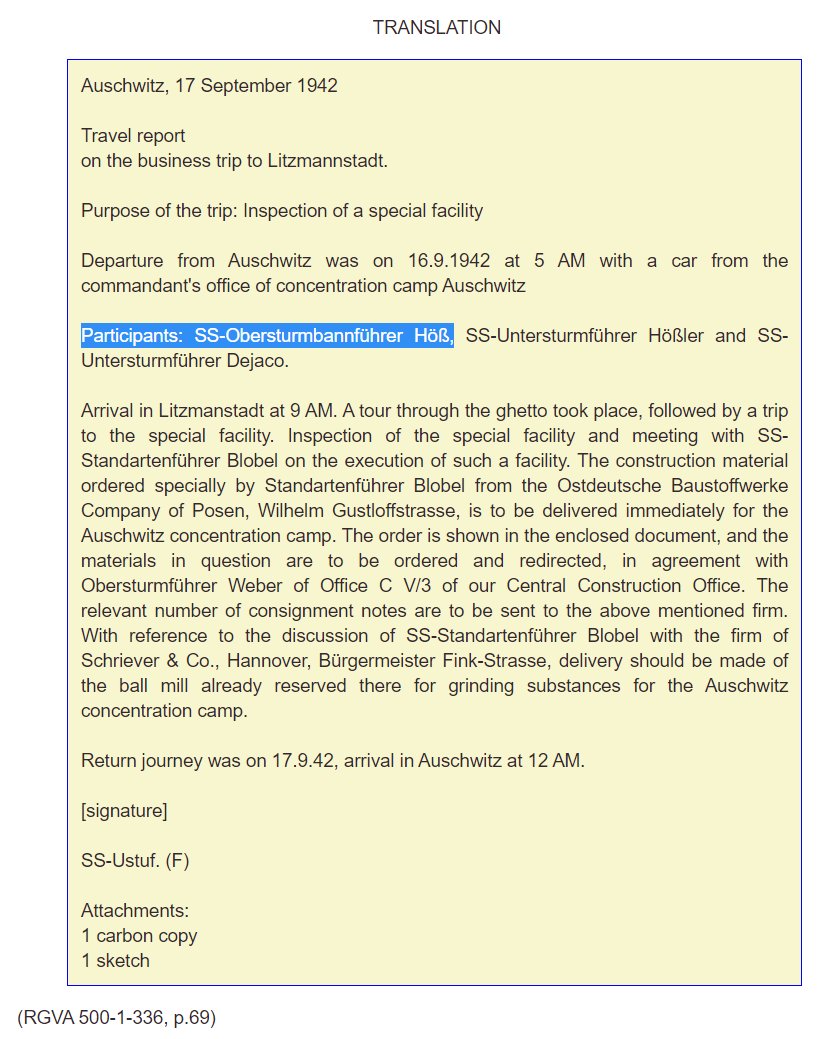
E.g. no-one doubts whether Rudolf Höß was “really” at Auschwitz.
The question is whether what they claimed to have witnessed “there” is “
really true” or not.
SanityCheck wrote: ↑Sun Dec 01, 2024 1:14 pm
…But common sense alone tells us that someone can get something wrong for even dubious reasons, such as supporting a deluded, exaggerated sense of the overall death toll…
To advance a proper case, 'revisionism' needs to stop trying to throw out entire testimonies but needs to highlight where witnesses who were demonstrably in the camps, especially Auschwitz, added on the allegedly false elements. That applies both to the camp staff (and key visitors) as well as the inmates.
The incessant grunting suspicion of 'something must be wrong' does not endear you guys to others, including some who might be otherwise persuadable.
…people recall and remember variables with differing levels of accuracy: people can be bad at names, but good with faces, or vice versa, they will not necessarily remember dimensions in the same way as they might durations, and both can easily be misremembered.
…So
there really is a shrug factor in response to 'Reder claimed an incorrect length of mass grave in one statement' when
he wasn't really too fussed over such matters in his other accounts.
Holocaust-promotion professionals are paid to defend and justify FALSE witness testimony.
They are paid to “shrug” about witness false testimony.
So what if they got core details wrong?
So what if they lied and invented nonsensical claims?
Who cares if their racist, anti-German narratives have been proven to be FALSE on significant points?
I suggest that this indifference — plus blasé approach to researching history honestly, accurately and rigorously — does not appear to be accidental.
It appears to be a co-ordinated approach by
people who make their source of income from
promoting the racist, pseudo-history called ‘THE holocaust’.
The holocaust industry’s claims of:
a.) an officially approved and planned genocide of ALL Jews in Europe called ‘the final solution’;
via
b.) an industrialised, ‘factories of death’ system of ‘extermination camps’ using poisonous gas;
has almost zero credible evidence supporting it.
1. - The
empirical evidence at the alleged camps refutes it.
2. - The
documentary evidence is either non-existent, or weak, and requires interpretation (e.g. it was supposedly discussed in top secret meetings only using euphemisms).
3. - The
‘eye-witness’ testimony is unreliable (inconsistent, self-contradictory, often nonsensical and physically impossible).
Because the empirical and documentary evidence actually refutes the narrative, the holocaust industry has had to rely upon the third (and most unreliable) category of ‘evidence’, viz.
eye-witnesses / lie-witnesses.
And where that is so hopelessly irreconcilable with reality that it can’t be defended, the paid promoters of the narrative shrug it off
(as we see here above).
This is why it can fairly be called a ‘hoax’.
I suggest it can fairly be called that because what the University lecturer from Exeter University is doing above appears to be deliberate misdirection.
SUMMARY: The holocaust industry and its paid promoters have re
lied upon unreliable, questionable,
testimonial ‘evidence’ because it has the most
EMOTIONAL APPEAL. That is why it is so important to the industry.
That is presumably why the recent holocaust industry’s book by Caroline Sturdy Colls on Treblinka II that supposedly details the archeological, empirical evidence, begins with many chapters devoted only to unreliable,
testimonial evidence (tall tales of alleged atrocities).
This explains why, when that ‘evidence’ is refuted, they say the actual detail of it isn’t so important. What IS important is that we should only react to it on an emotional level — and out of sympathy — not question it or critically analyse it.
That explains why the Exeter University lecturer reprimands skeptics just for
“suspicion [that] 'something must be wrong'”.
It also explains his appeal to emotion by warning us
(and any sympathetic CODOH readers) that this
“does not endear you guys to others”. As if studying history should be constrained by such considerations!
Q. And why is the testimonial evidence so often false and unreliable of something supposedly personally ‘witnessed’ plus supposedly so well-documented and corroborated?
A. Again the actual
empirical evidence adequately explains much of it: