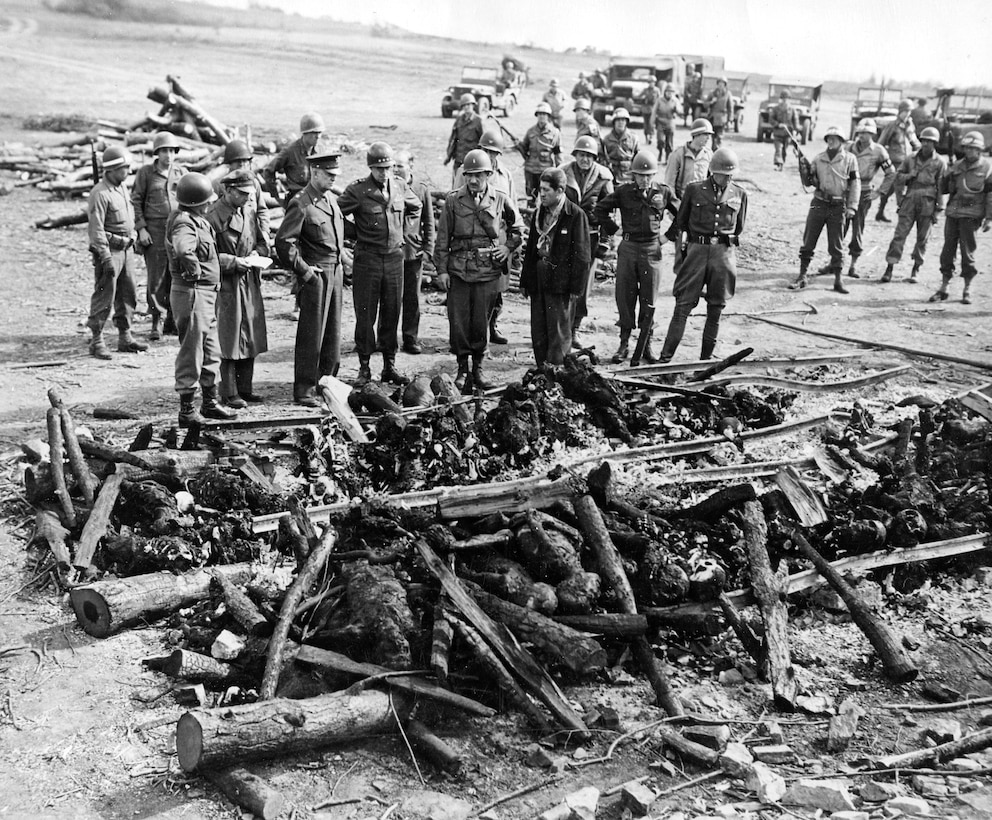
I do see 7 charred corpses in the lower part of this photo. Don't you, Keen ?
No one to debate? [Rudolf vs Vann on Jake Shields]
-
Eye of Zyclone

- Posts: 544
- Joined: Fri Apr 04, 2025 3:12 pm
Re: No one to debate? [Rudolf vs Vann on Jake Shields]
"Holocaust deniers are very slick people. They justify everything they say with facts and figures."
Re: No one to debate? [Rudolf vs Vann on Jake Shields]
Now that proves how successful the program was.SanityCheck wrote: ↑Sun Jun 21, 2026 11:28 pmNo, it really isn't.Hektor wrote: ↑Sat Jun 20, 2026 1:46 pmI find your commentary rather astonishing.SanityCheck wrote: ↑Mon Dec 16, 2024 11:56 pm...
Marxists and their heirs are almost entirely uninterested in the Holocaust. The significance of Frankfurt School Critical Theory is blown out of all proportion in Macdonald and anti-woke polemics, but one thing is certain: the reflections in Adorno's work on the Holocaust did not really feed into anything else, other than providing the one soundbite, which is relevant only to debates in literature and cultural studies about representation, not to history. Only a handful of Marxists have ever reflected in a sustained way on the Holocaust, most being entirely heterodox within those traditions, and largely marginalised compared to the anti-imperialist, anti-Zionist default norm on the far left. The groupuscules from the 1960s onwards whose veterans and the people they influenced were split on just about everything, one can find a few who refused the anti-Zionist turn, but this did not necessarily translate into a greater interest in the Holocaust as well. Much of the polarisation revolved around Jewish roots with a split between anti-Zionist Jews remaining on the far left (but usually turning into Johnny One Note obsessives) and socialist-sympathising Jews distancing themselves from the far left. And this split was all over the news in 2023-2024 with campus protests and the rhetoric of settler colonialism and decolonisation. Despite the fact that Frantz Fanon and Aime Cesaire as much as Jean-Paul Sartre and W.E.B. Du Bois routinely offered significant reflections on the close kinship of antisemitism and anti-African racism in the mid-20th Century.
....
- The 'Frankfurt School Critical Theory' is the most significant philosophical school of thought of the 20th century.
Utter twaddle.- Theodor Adorno's "Was bedeutet Aufarbeitung der Vergangenheit?" is the blue-print for destroying any meaningful cultural conservatism first in Germany and then in any other Western Country.
No, everyone across the political spectrum except neo-Nazis will fling around 'Nazi' as an insult when it suits them. ...- The Nazi-whip works due to Holocaust Narrative being the foundation of present Western thought. Marxists and their front-people frequently used the NAZI tag to 'discredit' or bash any meaningful opposition to them.
And it's quite telling that all you can say is "No" - You try the assertiveness of argument approach. The lack of real content is still revealing.
But perhaps you can come by by answering the question first: Who was the "most significant philosophical school of thought of the 20th century", if not the Frankfurt School?

Re: No one to debate? [Rudolf vs Vann on Jake Shields]
Welcome back, Dr. Terry. This analysis is atrocious. I'll start with a very simple counter, citing from Peter Novick "The Holocaustr In American Life" which summarises the role the Holocaust enjoys in modern American (viz-a-viz Western) consciousness.
Right - TickIndividuals from every point on the political com-
pass can find the lessons they wish in the Holocaust; it has become a
moral and ideological Rorschach test. The right has invoked the
Holocaust in support of anti-Communist
interventions abroad: the agent of the Holocaust was not Nazi Ger-
many but a generic totalitarianism, embodied after 1945 in the Soviet
bloc, with which there could be no compromise. On a philosophical
level, the Holocaust has been used by conservatives to demonstrate the
sinfulness of man. It has provided confirmation of a tragic worldview,
revealing the fatuousness of any transformative — or even seriously
meliorative — politics. For other segments of the right, the Holocaust
revealed the inevitable consequence of the breakdown of religion and
family values in Germany. And, as is well known, the "abortion holo-
caust" figures prominently in American debate on that question.
For leftists, the claim that American elites abandoned European
Jewry during the war has been used to demonstrate the moral bank-
ruptcy of the establishment, including liberal icons like FDR. For
liberals, the Holocaust became the locus of "lessons" that teach the
evils of immigration restriction and homophobia, of nuclear weapons
and the Vietnam War. Holocaust curricula, increasingly mandated in
public schools, frequently link the Holocaust to much of the liberal
agenda — a source of irritation to American right-wingers, including
Jewish right-wingers like the late Lucy Dawidowicz.
For the political center — on some level for all Americans — the
Holocaust has become a moral reference point. As, over the past gen-
eration, ethical and ideological divergence and disarray in the United
States advanced to the point where Americans could agree on nothing
else, all could join together in deploring the Holocaust — a low moral
consensus, but perhaps better than none at all. (This banal consensus
is indeed so broad that, in a backhanded way, it even includes that tiny
band of malicious or deluded fruitcakes who deny that the Holocaust
took place."If it happened," they say in effect, "we would deplore it asSpoiler
[ed - hi!]
much as anyone else. But it didn't, so the question doesn't arise.") And
in the United States the Holocaust is explicitly used for the purpose of
national self-congratulation: the "Americanization" of the Holocaust
has involved using it to demonstrate the difference between the Old
World and the New, and to celebrate, by showing its negation, the
American way of life.
Left - Tick
Center - Tick
Not sure if anything fruitful will be forthcoming by way of response, but things are always hopeful.
Re: No one to debate? [Rudolf vs Vann on Jake Shields]
I'm interested in further exploring this blithe dismissal of the influence of the Frankfurt School on the Holocaust Narrative.
Unfortunately, I'm currently under equipped for this debate and must get better armed.
I can say that there is overlap with The Frankfurt School and the OSS. How that bleeds over into policy and perspective I am not yet familiar, but, I will be spelunking.
There is even overlap with The Last Battle of WW2 (Nuremberg) as well.
Unfortunately, I'm currently under equipped for this debate and must get better armed.
I can say that there is overlap with The Frankfurt School and the OSS. How that bleeds over into policy and perspective I am not yet familiar, but, I will be spelunking.
There is even overlap with The Last Battle of WW2 (Nuremberg) as well.
If I were to guess why no t4 personnel were chosen to perform gassing that had experience with gassing, it would be because THERE WERE NONE.
Re: No one to debate? [Rudolf vs Vann on Jake Shields]
Not a direct Franfurt School proponent but friend and supporter of Max Horkheimer as well as teacher of Adorno was the theologian Paul Tillich:Stubble wrote: ↑Tue Jun 23, 2026 12:14 am I'm interested in further exploring this blithe dismissal of the influence of the Frankfurt School on the Holocaust Narrative.
Unfortunately, I'm currently under equipped for this debate and must get better armed.
I can say that there is overlap with The Frankfurt School and the OSS. How that bleeds over into policy and perspective I am not yet familiar, but, I will be spelunking.
There is even overlap with The Last Battle of WW2 (Nuremberg) as well.
Paul Tillich was a propagandist of the Americans:Key Connections at Frankfurt University (1929–1933)
Professor at Frankfurt: Tillich held the chair in philosophy and sociology from 1929 to 1933 (succeeding Max Scheler). He lectured on religion, culture, philosophy, and social issues, aligning with the broader intellectual milieu that birthed Critical Theory.
Support for Horkheimer: Tillich was instrumental in helping establish a chair and bringing Max Horkheimer to the university as director of the Institute for Social Research (around 1930). They co-taught a course on John Locke in the winter term 1930–31.
Relationship with Adorno: Tillich supervised Theodor Adorno’s Habilitation (second dissertation) on Kierkegaard’s aesthetics (Kierkegaard: Construction of the Aesthetic, completed around 1931–1933). Adorno also served informally as one of Tillich’s assistants. They co-led seminars on figures like Georg Simmel, Gotthold Ephraim Lessing, and Hegel.
Shared Milieu: Both Tillich (a religious socialist) and the Frankfurt School thinkers (neo-Marxist critical theorists) were engaged in analyzing modern society, capitalism, culture, and authoritarianism. They shared a critical stance toward bourgeois society and Nazism.
Tillich was dismissed from his post in April 1933 by the Nazi regime (one of the first non-Jewish professors targeted), as were many associated with the Institute. He emigrated to the U.S. shortly after; Horkheimer and Adorno followed soon thereafter.
https://archive.org/details/WarTimeRadi ... aulTillich
Tillich of course had no way of knowing, if whether what he was reporting on what was supposedly happening in Europe was true or not. He did it anyway, since he had an 'axe to grind with the Nazis' who fired him. And a knife in for German 'bourgeois society'. Politically he was a leftist short of being a Marxist Leninist. Privately he had a twisted interest in sado-masochistic pornography.Tillich' s radio addresses emphasized the nature of German collective guilt for tolerating or encouraging the Nazis. Other peoples had guilt as well. But Germans had allowed Hitler to capture the country and plunge Europe into war; they had accepted the Nazi racial policies , death trains, and murders of jews and many others. The ultimate destruction of Germany , Tillich believed, was atonement for the evil into which the Nazis had led that nation.
His theology was a mess. It's basically the watered off version of Protestantism we know today. It's essentially Agnosticism with a Christian Cloth.
So those trends are actually connected and the Holocaust Narrative is an important ingredient to it all.
Re: No one to debate? [Rudolf vs Vann on Jake Shields]
Unironically start with MacDonald's Culture Of Critique! While MacDonald himself is not (openly) a Holocaust Revisionist, it's irrelevant. As I've shown in the Novick quote, even Holocaust Deniers are opted in to, rather than out from, the morality-by-osmosis affect the Holocaust has had on the West. Which demonstrates the point neatly, much like a fish asking "what is water?", MacDonald (or rather, actual Revisionists) is assumed opted in.Stubble wrote: ↑Tue Jun 23, 2026 12:14 am I'm interested in further exploring this blithe dismissal of the influence of the Frankfurt School on the Holocaust Narrative.
Unfortunately, I'm currently under equipped for this debate and must get better armed.
I can say that there is overlap with The Frankfurt School and the OSS. How that bleeds over into policy and perspective I am not yet familiar, but, I will be spelunking.
There is even overlap with The Last Battle of WW2 (Nuremberg) as well.
I want to also briefly get out in front of one thing that supports Hektor's position, and that's this ridiculous idea that the Frankfurt School thinkers were somehow talking about National Socialism / Facism / Ethno-Nationalism as pathologies independent of the Holocaust. That it was just the political configuration and policies they found pathological! This seems to me to be indefensible and even unfalsifiable.
From the forward to "The Authoritarian Personality" by Adorno (as penned by Horkheimer) it is verbalized clearly as such:
Here we can see clearly the "Holocaust Narrative" as early as 1950 has begun to not only take root, but assume a bullseye target for the Frankfurt Theorists as a vehicle to pathologize Ethno-Nationalism, the claim to which Dr Terry laughed off as "utter twaddle", and even denied when he said "in every case you are wrong".Today the world scarcely remembers the mechanized persecution and
extermination of millions of human beings only a short span of years away in
what was once regarded as the citadel of Western civilization. Yet the con
science of many men was aroused. How could it be, they asked each other,
that in a culture of law, order, and reason, there should have survived the
irrational remnants of ancient racial and religious hatreds? How could they
explain the willingness of great masses of people to tolerate the mass ex
termination of their fellow citizens? What tissues in the life of our modern
society remain cancerous, and despite our assumed enlightenment show
the incongruous atavism of ancient peoples? And what within the individual
organism responds to certain stimuli in our culture with attitudes and acts of
destructive aggression?
Dr Terry has a lot of heavy lifting ahead of him if he wishes to continue this facade of Holocaust-Narrative-as-twaddle.
Re: No one to debate? [Rudolf vs Vann on Jake Shields]
Excellent post.HansHill wrote: ↑Tue Jun 23, 2026 12:36 pmUnironically start with MacDonald's Culture Of Critique! While MacDonald himself is not (openly) a Holocaust Revisionist, it's irrelevant. As I've shown in the Novick quote, even Holocaust Deniers are opted in to, rather than out from, the morality-by-osmosis affect the Holocaust has had on the West. Which demonstrates the point neatly, much like a fish asking "what is water?", MacDonald (or rather, actual Revisionists) is assumed opted in.Stubble wrote: ↑Tue Jun 23, 2026 12:14 am I'm interested in further exploring this blithe dismissal of the influence of the Frankfurt School on the Holocaust Narrative.
Unfortunately, I'm currently under equipped for this debate and must get better armed.
I can say that there is overlap with The Frankfurt School and the OSS. How that bleeds over into policy and perspective I am not yet familiar, but, I will be spelunking.
There is even overlap with The Last Battle of WW2 (Nuremberg) as well.
I want to also briefly get out in front of one thing that supports Hektor's position, and that's this ridiculous idea that the Frankfurt School thinkers were somehow talking about National Socialism / Facism / Ethno-Nationalism as pathologies independent of the Holocaust. That it was just the political configuration and policies they found pathological! This seems to me to be indefensible and even unfalsifiable.
From the forward to "The Authoritarian Personality" by Adorno (as penned by Horkheimer) it is verbalized clearly as such:
Here we can see clearly the "Holocaust Narrative" as early as 1950 has begun to not only take root, but assume a bullseye target for the Frankfurt Theorists as a vehicle to pathologize Ethno-Nationalism, the claim to which Dr Terry laughed off as "utter twaddle", and even denied when he said "in every case you are wrong".Today the world scarcely remembers the mechanized persecution and
extermination of millions of human beings only a short span of years away in
what was once regarded as the citadel of Western civilization. Yet the con
science of many men was aroused. How could it be, they asked each other,
that in a culture of law, order, and reason, there should have survived the
irrational remnants of ancient racial and religious hatreds? How could they
explain the willingness of great masses of people to tolerate the mass ex
termination of their fellow citizens? What tissues in the life of our modern
society remain cancerous, and despite our assumed enlightenment show
the incongruous atavism of ancient peoples? And what within the individual
organism responds to certain stimuli in our culture with attitudes and acts of
destructive aggression?
Dr Terry has a lot of heavy lifting ahead of him if he wishes to continue this facade of Holocaust-Narrative-as-twaddle.
I of course am familiar with the work referenced. I am trying to get granular. If this is going to be debated with Nick, and he has already chosen to piss on MacDonald I don't think ruminating on it is going to help.
These men of the Frankfurt School, they are not unknown to history, and, surely I can find the times, days and places that they legitimately did grab the helm of the Merry SS Holocaust and navigate her to where we are today.
They didn't act alone, of course, but to just blanket say 'they were not involved' is a grave error in my opinion.
If I were to guess why no t4 personnel were chosen to perform gassing that had experience with gassing, it would be because THERE WERE NONE.
Re: No one to debate? [Rudolf vs Vann on Jake Shields]
The Holocaust Narrative or variations of it, is the elephant in the room for the Western Intelligentsia after WW2.HansHill wrote: ↑Mon Jun 22, 2026 9:44 pmWelcome back, Dr. Terry. This analysis is atrocious. I'll start with a very simple counter, citing from Peter Novick "The Holocaustr In American Life" which summarises the role the Holocaust enjoys in modern American (viz-a-viz Western) consciousness.
Right - TickIndividuals from every point on the political com-
pass can find the lessons they wish in the Holocaust; it has become a
moral and ideological Rorschach test. The right has invoked the
Holocaust in support of anti-Communist
interventions abroad: the agent of the Holocaust was not Nazi Ger-
many but a generic totalitarianism, embodied after 1945 in the Soviet
bloc, with which there could be no compromise. On a philosophical
level, the Holocaust has been used by conservatives to demonstrate the
sinfulness of man. It has provided confirmation of a tragic worldview,
revealing the fatuousness of any transformative — or even seriously
meliorative — politics. For other segments of the right, the Holocaust
revealed the inevitable consequence of the breakdown of religion and
family values in Germany. And, as is well known, the "abortion holo-
caust" figures prominently in American debate on that question.
For leftists, the claim that American elites abandoned European
Jewry during the war has been used to demonstrate the moral bank-
ruptcy of the establishment, including liberal icons like FDR. For
liberals, the Holocaust became the locus of "lessons" that teach the
evils of immigration restriction and homophobia, of nuclear weapons
and the Vietnam War. Holocaust curricula, increasingly mandated in
public schools, frequently link the Holocaust to much of the liberal
agenda — a source of irritation to American right-wingers, including
Jewish right-wingers like the late Lucy Dawidowicz.
For the political center — on some level for all Americans — the
Holocaust has become a moral reference point. As, over the past gen-
eration, ethical and ideological divergence and disarray in the United
States advanced to the point where Americans could agree on nothing
else, all could join together in deploring the Holocaust — a low moral
consensus, but perhaps better than none at all. (This banal consensus
is indeed so broad that, in a backhanded way, it even includes that tiny
band of malicious or deluded fruitcakes who deny that the Holocaust
took place."If it happened," they say in effect, "we would deplore it asSpoiler
[ed - hi!]
much as anyone else. But it didn't, so the question doesn't arise.") And
in the United States the Holocaust is explicitly used for the purpose of
national self-congratulation: the "Americanization" of the Holocaust
has involved using it to demonstrate the difference between the Old
World and the New, and to celebrate, by showing its negation, the
American way of life.
Left - Tick
Center - Tick
Not sure if anything fruitful will be forthcoming by way of response, but things are always hopeful.
It takes a huge portion of ignorance or gullibility not to see that.
Now I take the educated guess that in the 1940s many of the top intellectuals in the West took the accusations against NS-Germany and the Jewish victim narrative with a grain of salt still. But there were already those that would have used it against any Anti-Communist, ethno-Nationalist and socially conservative thought.