I am not making a claim, I am mentioning the memoirs of a ramp Kapo at Birkenau
This is literally the claim lol
Treblinka/Malkinia and the Missing Witness Statements
Re: Treblinka/Malkinia and the Missing Witness Statements
If the physical evidence for a claim that - HAS TO EXIST - in order for the claim to be true - DOES NOT EXIST - then that claim is false.

Re: Treblinka/Malkinia and the Missing Witness Statements
I refuse to answer your questions, until you stop the abuse and answer my questions. I have requested you do that on other occasions and you have refused. You do that because you want to abuse, and you are not interested in having a debate.Keen wrote: ↑Tue Sep 23, 2025 1:39 pm
Archie, we have yet another one for "Nessie's greatest hits."
viewtopic.php?p=10366#p10366
Sanity Check - "Thus, currently revisionists can console themselves by affirming their incredulity..."
Re: Treblinka/Malkinia and the Missing Witness Statements
Liar:
viewtopic.php?t=421
viewtopic.php?p=14176#p14176Archie:
Keen, I don't think Nessie wants any of that smoke. Let's just declare you the winner by forfeit.
If the physical evidence for a claim that - HAS TO EXIST - in order for the claim to be true - DOES NOT EXIST - then that claim is false.
- pilgrimofdark
- Posts: 491
- Joined: Sat Aug 09, 2025 7:46 pm
Re: Treblinka/Malkinia and the Missing Witness Statements
bombsaway posted this quote elsewhere regarding the Nurska Street transit camp in Malkinia:
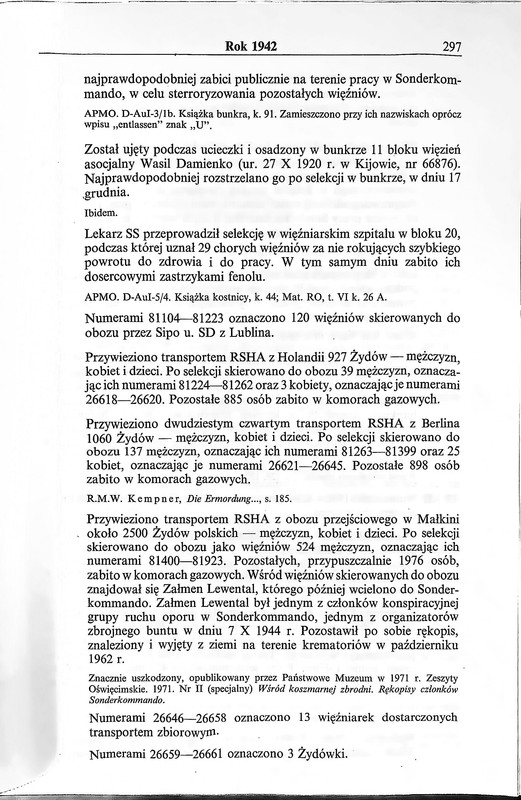
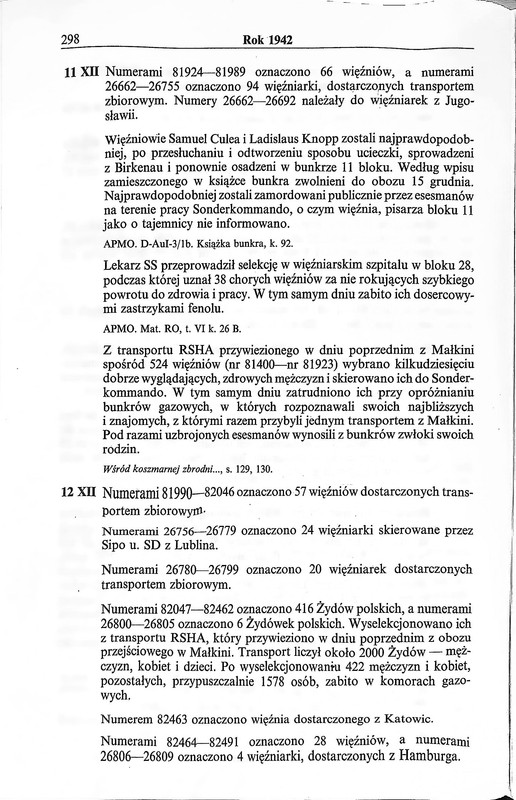 The relevant sentences about Malkinia transit camp:
The next footnote is to the Ringelblum Archive volume on Accounts from the Eastern Borderlands, page 70 of the Polish edition. The English version has numerous reports that mention Malkinia, but I didn't find reference to this transit camp along Nurska Street or in the eastern part of the town.
These are the pages referenced by the Virtual Shtetl author for Malkinia, from Kalendarium wydarzeń w KL Auschwitz.Probably some of the Jews of Małkinia moved eastwards to the territories that were soon under the Soviet occupation right after the outbreak of World War II. Then, as it was situated close to the German-Soviet border, in October-November 1939, Małkinia became a place where people moved from one occupation zone to another. In 1941–1942 there was a transit camp in Małkinia for the Jewish population, set up by Germans in the eastern part of the town, along Nurska Street. According to memories, it was under the open sky. [note 1.9]
[note 1.9] Czech D., Kalendarium wydarzeń w KL Auschwitz, Oświęcim 1992, p. 297-298.
Spoiler
Spoiler
There is no mention on these pages of the eastern part of the town, along Nurska Street, where this 1941-1942 transit camp was located.Approximately 2,500 Polish Jews—men, women, and children—were brought in an RSHA transport from the transit camp in Małkinia.
[...]
From the RSHA transport that had arrived the previous day from Małkinia—comprising 524 prisoners (Nos. 81400–81923)—several dozen healthy, physically fit men were selected and assigned to the Sonderkommando. On that very day, they were put to work emptying the gas bunkers, where they recognized their own loved ones and acquaintances—those with whom they had arrived together in the same transport from Małkinia.
[...]
They were selected from an RSHA transport that had arrived the previous day from the transit camp in Małkinia. The transport consisted of approximately 2,000 Jews—men, women, and children.
The next footnote is to the Ringelblum Archive volume on Accounts from the Eastern Borderlands, page 70 of the Polish edition. The English version has numerous reports that mention Malkinia, but I didn't find reference to this transit camp along Nurska Street or in the eastern part of the town.
Re: Treblinka/Malkinia and the Missing Witness Statements
If those are the transport numbers, I'm assuming they are, perhaps we could review the billet and see where it stopped. If it stopped on the Eastern part of town, near the open air transit camp, that would be the dunk. I don't know where to find transport documents though, because I'm a rather blunt tool from time to time.
If I were to guess why no t4 personnel were chosen to perform gassing that had experience with gassing, it would be because THERE WERE NONE.
- pilgrimofdark
- Posts: 491
- Joined: Sat Aug 09, 2025 7:46 pm
Re: Treblinka/Malkinia and the Missing Witness Statements
The Virtual Shtetl paragraph above seems to be conflating various sources and time periods.
The eyewitness reports regarding Malkinia in the Ringelblum Archive Accounts from the Borderlands, 1939-1941 relate to when Malkinia was a German-controlled border station between the German and Soviet territories.
A little east of Malkinia was a "no man's land" of about 3 km that established separation between the Germans and Soviets.
In this strip, Jews camped out, unable to cross either border. The Germans encouraged the Jews to leave and didn't want them back, and the Soviets didn't keep the border open at all times to allow the free flow of Jewish refugees to the east. Seems like most were attempting to flee to Bialystok.
Eyewitnesses report hundreds to thousands of people at a time in these open fields. The vast majority were Jews, and small numbers of Poles who came to do business (selling coffee to refugees, smuggling, extortion, etc.).
The accounts don't mention any "transit camp" at all. There seems to be nothing official run by the Germans.
There are reports that Jews were taken aside at the Malkinia station and searched and robbed by German border guards. Then they were just set free to walk east.
They either walked northeast following the railroad tracks.
Or they walked directly east towards Zawisty. This follows a route "along Nurska street" and leads east out of Malkinia.
All were attempting to make it to the first two stops on the Soviet side: Zareby Koscielne, then Czyzew. From there, they traveled on to Bialystok.
Jews were just out in the open fields, staying for days before they could move on. Some were permitted across the border legally, others crossed illegally through the forests. Some got caught and sent back.
A recent journal article on Malkinia was also published in January. It serves as a decent summary of information about the "no man's land."
The accounts I read are in the second volume of the Ringeblum Archive books. They used to be freely accessible online, but not right now as they're "migrating to a new digital repository."
Bottom line: there seems to be no "transit camp" in 1939-1941, just a border region where Jews were attempting to cross into the Soviet Union. Then after the German invasion, this open field or forest route became obsolete since it was now all German territory. If there was a real "transit camp" in Malkinia in 1942, it was likely something different.
The eyewitness reports regarding Malkinia in the Ringelblum Archive Accounts from the Borderlands, 1939-1941 relate to when Malkinia was a German-controlled border station between the German and Soviet territories.
A little east of Malkinia was a "no man's land" of about 3 km that established separation between the Germans and Soviets.
In this strip, Jews camped out, unable to cross either border. The Germans encouraged the Jews to leave and didn't want them back, and the Soviets didn't keep the border open at all times to allow the free flow of Jewish refugees to the east. Seems like most were attempting to flee to Bialystok.
Eyewitnesses report hundreds to thousands of people at a time in these open fields. The vast majority were Jews, and small numbers of Poles who came to do business (selling coffee to refugees, smuggling, extortion, etc.).
The accounts don't mention any "transit camp" at all. There seems to be nothing official run by the Germans.
There are reports that Jews were taken aside at the Malkinia station and searched and robbed by German border guards. Then they were just set free to walk east.
They either walked northeast following the railroad tracks.
Or they walked directly east towards Zawisty. This follows a route "along Nurska street" and leads east out of Malkinia.
All were attempting to make it to the first two stops on the Soviet side: Zareby Koscielne, then Czyzew. From there, they traveled on to Bialystok.
Jews were just out in the open fields, staying for days before they could move on. Some were permitted across the border legally, others crossed illegally through the forests. Some got caught and sent back.
A recent journal article on Malkinia was also published in January. It serves as a decent summary of information about the "no man's land."
The accounts I read are in the second volume of the Ringeblum Archive books. They used to be freely accessible online, but not right now as they're "migrating to a new digital repository."
Bottom line: there seems to be no "transit camp" in 1939-1941, just a border region where Jews were attempting to cross into the Soviet Union. Then after the German invasion, this open field or forest route became obsolete since it was now all German territory. If there was a real "transit camp" in Malkinia in 1942, it was likely something different.
Re: Treblinka/Malkinia and the Missing Witness Statements
Who picked up the tab for transports 81400 and 81923?
If I'm reading you last post right, then it sounds like the specific thing I'm told is a fever dream may have indeed happened.
Also, this part about jews camping in the dmz or cordon or what have you may merit it's own thread, probably best put in the research subforum.
On a personal note, reminder, you are a B E A S T Sir. I don't know how you find this stuff, but it is awesome!
If I'm reading you last post right, then it sounds like the specific thing I'm told is a fever dream may have indeed happened.
Also, this part about jews camping in the dmz or cordon or what have you may merit it's own thread, probably best put in the research subforum.
On a personal note, reminder, you are a B E A S T Sir. I don't know how you find this stuff, but it is awesome!
If I were to guess why no t4 personnel were chosen to perform gassing that had experience with gassing, it would be because THERE WERE NONE.
- pilgrimofdark
- Posts: 491
- Joined: Sat Aug 09, 2025 7:46 pm
Re: Treblinka/Malkinia and the Missing Witness Statements
Well, credit to BA for posting the Virtual Shtetl link first.
And he recommended people check those sources. That's all I did. I'm glad I grabbed copies of the RA books when they were available.
My research process boils down to shamelessly pilfer the Index and Bibliographies of books, journal articles, websites, etc.
The earlier post refers to prisoner registration numbers at Auschwitz. They're also listed in Mattogno's The Real Auschwitz Chronicle under "1.2. List of Registered Prisoners Compiled by Kazimierz Smolen."
The source Virtual Shtetl cites is Danuta Czech's 1992 Kalendarz Wydarzen W KL Auschwitz. Seems like it's available in several books or one book with all the volumes.
I'm not sure if it differs from her 1990 Kalendarium wydarzen w obozie Koncentracyjnm Auschwitz-Birkenau 1939–1945 or The Auschwitz Chronicle: 1939–1945.
If someone has the English version handy, they could check the entries for December 10 through December 11, 1942.
And he recommended people check those sources. That's all I did. I'm glad I grabbed copies of the RA books when they were available.
My research process boils down to shamelessly pilfer the Index and Bibliographies of books, journal articles, websites, etc.
The earlier post refers to prisoner registration numbers at Auschwitz. They're also listed in Mattogno's The Real Auschwitz Chronicle under "1.2. List of Registered Prisoners Compiled by Kazimierz Smolen."
The source Virtual Shtetl cites is Danuta Czech's 1992 Kalendarz Wydarzen W KL Auschwitz. Seems like it's available in several books or one book with all the volumes.
I'm not sure if it differs from her 1990 Kalendarium wydarzen w obozie Koncentracyjnm Auschwitz-Birkenau 1939–1945 or The Auschwitz Chronicle: 1939–1945.
If someone has the English version handy, they could check the entries for December 10 through December 11, 1942.
Re: Treblinka/Malkinia and the Missing Witness Statements
Wait, so, the Germans robbed people, sent them into the buffer for a few days, rearrested them, then shipped them to Auschwitz?
Consider my mind blown. I have a hard time wrapping my mind around just how diabolical the nazis were sometimes.
Consider my mind blown. I have a hard time wrapping my mind around just how diabolical the nazis were sometimes.
If I were to guess why no t4 personnel were chosen to perform gassing that had experience with gassing, it would be because THERE WERE NONE.
- pilgrimofdark
- Posts: 491
- Joined: Sat Aug 09, 2025 7:46 pm
Re: Treblinka/Malkinia and the Missing Witness Statements
There's a change after Operation Barbarossa began.
This is a summary of the narrative based on the RA accounts from a handful of people.
Fall 1939 - Summer 1941
Poland is partitioned. Jews want to leave the German zone for the Soviet.
Malkinia is one route to cross the border.
Jews take the train from Warsaw to Malkinia. Once they get off at the station, Germans pull them aside and into the station building, and rob them before letting them go.
Jews start wandering east down Nurska Street or northeast along the railroad tracks.
The Soviet border is closed. The Jews sit in open fields waiting for days before the Soviets periodically open the border to let refugees through.
Some sneak across the border successfully. Some get caught sneaking across and are sent back to the border zone on the German side.
Some Jews finally get across the border and head to Bialystok or Lvov. Some give up and head back home.
Hundreds to thousands of Jews were sitting in this border area at a time, based on the observations of people attempting to cross. Tons of refugees in Bialystok.
1941 Post-Barbarossa
One account records Jews in this border zone observing the German invasion.
December 1942
According to Czech/Mattogno, Kazimierz Smolen records two transports of Jews arriving in Auschwitz. These are the ones supposedly from Malkinia, but what's the source of that?
In Mis-Chronicling Auschwitz, Mattogno takes Czech to task for citing no sources for these Malkinia transports. Maybe there is no source cited in Auschwitz Chronicle or Kalendarium, but there is a source in Kalendarz.
Wśród koszmarnej zbrodni. Rękopisy członków Sonderkommando, pages 129, 130. That's published in English as Amidst a Nightmare of Crime: Manuscripts of Members of Sonderkommando.
She's referencing the Zalmen/Salmen Lewental Auschwitz scroll/diary found in 1962. Czech and Jadwiga Bezwinska edited it for the Polish/English book.
This is a summary of the narrative based on the RA accounts from a handful of people.
Fall 1939 - Summer 1941
Poland is partitioned. Jews want to leave the German zone for the Soviet.
Malkinia is one route to cross the border.
Jews take the train from Warsaw to Malkinia. Once they get off at the station, Germans pull them aside and into the station building, and rob them before letting them go.
Jews start wandering east down Nurska Street or northeast along the railroad tracks.
The Soviet border is closed. The Jews sit in open fields waiting for days before the Soviets periodically open the border to let refugees through.
Some sneak across the border successfully. Some get caught sneaking across and are sent back to the border zone on the German side.
Some Jews finally get across the border and head to Bialystok or Lvov. Some give up and head back home.
Hundreds to thousands of Jews were sitting in this border area at a time, based on the observations of people attempting to cross. Tons of refugees in Bialystok.
1941 Post-Barbarossa
One account records Jews in this border zone observing the German invasion.
December 1942
According to Czech/Mattogno, Kazimierz Smolen records two transports of Jews arriving in Auschwitz. These are the ones supposedly from Malkinia, but what's the source of that?
In Mis-Chronicling Auschwitz, Mattogno takes Czech to task for citing no sources for these Malkinia transports. Maybe there is no source cited in Auschwitz Chronicle or Kalendarium, but there is a source in Kalendarz.
Wśród koszmarnej zbrodni. Rękopisy członków Sonderkommando, pages 129, 130. That's published in English as Amidst a Nightmare of Crime: Manuscripts of Members of Sonderkommando.
She's referencing the Zalmen/Salmen Lewental Auschwitz scroll/diary found in 1962. Czech and Jadwiga Bezwinska edited it for the Polish/English book.
[6]
[...] it is true [...] he heard that they are leading [...] in this way also [Warsaw ?] [Jews] were led [...] from the whole [neighbourhood]. From our neighbourhood were sent to known [camps] [...] unfit, what was [our?] [...] straight into the jaws of death [...] they found themselves in [the transport?] innocent [...] people who [...] we really did not know [a thing?] we did not know about Auschwitz all about [...] labour camp [...] conditions [...] but [...] [about] the camp we meanwhile got to know [...] various [people] just [from the camp], people who had been there for whole months, this [misled?] us all [...] till the last moment in the end [...] they were frightened [...] station Malkinia which [...] no [transport?] was brought [...] [at night?] they passed [...] [as far as] the station Malkinia, where the train stopped [.]
[7]
[...] they were dishonoured [...] with knives [...] naked girls [...] in a dreadful manner [...] clubs were inserted into the lower part of their bodies until [...] they died in terrible pain and suffering [...] older people [...] the sadists dragged forth [...] forced them to rape [...] children [...] also [they?] [...] were taken [...] and wives from their families [...]
[ 8 ]
[...] but [...] at five o’clock [...] after several hours of standing [there appeared] [...] SS men with policemen to lead out [...] people were thrown [...]
[9]
[...] who have not [...] simply the sick remained [...] as usual [...] in sight of [...] were thrown into the cloacae [...] people [...] looked at [the departing?] [...] were sent [...] back with [the transport?] to Auschwitz [...] others [...]
- pilgrimofdark
- Posts: 491
- Joined: Sat Aug 09, 2025 7:46 pm
Re: Treblinka/Malkinia and the Missing Witness Statements
I don't know if it's worth writing up "Malkinia observations from Ringelblum Archive documents," but this is a few final mentions from the Accounts from the Borderlands, 1939-1941 volume.
I thought it was possible the references to Zawisty weren't of the town directly east of Malkinia but Zawisty Podlesne, which is northeast along the railroad tracks. However, one account relates that their group walked from Malkinia to Rostki, a town further directly east along Nurska street (past Zawisty). So at least some Jews were heading directly east along the road, but there are more accounts that state their route was northeast following the rails.
There was no camp at Malkinia. Jews report being taken into the station building and inspected/robbed. There was no official camp in the "no man's land." Eventually, huts were built by the Jews living there, but there was no German presence east of Malkinia. The Jews organized a sort of Council to negotiate with the Germans and Soviets, but it was ad hoc.
Crossing the German-Soviet Border
Once in the "no mans land," Jews were semi-trapped. Some crossed to the Soviet side illegally, which was the fastest but most dangerous way. Soviet soldiers could shoot at the illegal crossers, or arrest them and send them back.
A few times, Jews in the "no man's land" attempted to storm the border, but it only resulted in beatings by the Soviet guards and retreat.
The Soviets didn't have an official policy on allowing Jews through the border legally. Instead, a few times a week, the Soviet border guards would wander away from their posts. Then, as many Jews as possible would run across. Once the guards returned, anyone on the Soviet side could remain there; anyone on the German side would remain there.
This whole situation is somewhat similar to 1938, when Germany dumped a bunch of Polish Jews on the border and let Poland and Jewish aid organizations figure it out. They seem to have a practice of releasing Jews at a border, not really caring if they manage to survive or instead starve to death.
Lewental's Camp
Lewental seems to be the sole source for this Malkinia death/transit camp?
His fragmentary account is a litany of atrocities usually attributed to Treblinka, so it's possible he's conflating. If he wasn't sent to a transit camp in/near Malkinia, he shouldn't have memories of it. Maybe he's reporting hearsay, not his own memories.
However, there's no source (USHMM, Yad Vashem) that agrees with the Auschwitz Museum and Lewental that Jews from Ciechanow were sent to Malkinia or any transit camp in December 1942. They're usually reported to have been sent directly to Auschwitz.
I thought it was possible the references to Zawisty weren't of the town directly east of Malkinia but Zawisty Podlesne, which is northeast along the railroad tracks. However, one account relates that their group walked from Malkinia to Rostki, a town further directly east along Nurska street (past Zawisty). So at least some Jews were heading directly east along the road, but there are more accounts that state their route was northeast following the rails.
There was no camp at Malkinia. Jews report being taken into the station building and inspected/robbed. There was no official camp in the "no man's land." Eventually, huts were built by the Jews living there, but there was no German presence east of Malkinia. The Jews organized a sort of Council to negotiate with the Germans and Soviets, but it was ad hoc.
Crossing the German-Soviet Border
Once in the "no mans land," Jews were semi-trapped. Some crossed to the Soviet side illegally, which was the fastest but most dangerous way. Soviet soldiers could shoot at the illegal crossers, or arrest them and send them back.
A few times, Jews in the "no man's land" attempted to storm the border, but it only resulted in beatings by the Soviet guards and retreat.
The Soviets didn't have an official policy on allowing Jews through the border legally. Instead, a few times a week, the Soviet border guards would wander away from their posts. Then, as many Jews as possible would run across. Once the guards returned, anyone on the Soviet side could remain there; anyone on the German side would remain there.
This whole situation is somewhat similar to 1938, when Germany dumped a bunch of Polish Jews on the border and let Poland and Jewish aid organizations figure it out. They seem to have a practice of releasing Jews at a border, not really caring if they manage to survive or instead starve to death.
Lewental's Camp
Lewental seems to be the sole source for this Malkinia death/transit camp?
His fragmentary account is a litany of atrocities usually attributed to Treblinka, so it's possible he's conflating. If he wasn't sent to a transit camp in/near Malkinia, he shouldn't have memories of it. Maybe he's reporting hearsay, not his own memories.
However, there's no source (USHMM, Yad Vashem) that agrees with the Auschwitz Museum and Lewental that Jews from Ciechanow were sent to Malkinia or any transit camp in December 1942. They're usually reported to have been sent directly to Auschwitz.