Auschwitz Crematorium 1 topics
- Fred Ziffel
- Posts: 321
- Joined: Sun Dec 01, 2024 11:02 am
Re: Auschwitz Crematorium 1 topics
Here are some more supplicate data to my last post
- Attachments
-
- 4573rjtr.JPG (29.98 KiB) Viewed 8612 times
-
- wyrwyt5hw.JPG (35.77 KiB) Viewed 8612 times
-
- A hole nonsense.JPG (11.94 KiB) Viewed 8612 times
I do not believe anything one is not allowed to question
- Fred Ziffel
- Posts: 321
- Joined: Sun Dec 01, 2024 11:02 am
Re: Auschwitz Crematorium 1 topics
folks, listen to this guy called Dragon Man in CO, USA at his personal Nazi museum. It almost makes me want to go there and get kicked out by calling out his lies
The BS oozes from his mouth
Link:
The BS oozes from his mouth
Link:
I do not believe anything one is not allowed to question
- borjastick
- Posts: 378
- Joined: Sat Sep 28, 2024 11:49 am
- Location: Europe
Re: Auschwitz Crematorium 1 topics
Fred I just watched this video and wonder if this is a world record of bullshit and crap spoken by anyone about the holocaust. This bloke is so full of shit even his eyes are brown. My guess is is believes it all but has never stopped once to think about it or question things. I also doubt if every article he claims is genuine is actually so.
When he got to the picture of the lines of women, men and younger boys etc and started on about the older and the women were about to be gassed I realised he is incapable of rational thought. Then it got worse when he talked of bars of soap made from human fat. Good grief this was debunked many years back.
And all the while his non stop 100mph diatribe was flowing the visitors lapped it up and happily bought the lies.
Disgusting stuff.
When he got to the picture of the lines of women, men and younger boys etc and started on about the older and the women were about to be gassed I realised he is incapable of rational thought. Then it got worse when he talked of bars of soap made from human fat. Good grief this was debunked many years back.
And all the while his non stop 100mph diatribe was flowing the visitors lapped it up and happily bought the lies.
Disgusting stuff.
Of the four million jews under German control, six million died and five million survived!
- Fred Ziffel
- Posts: 321
- Joined: Sun Dec 01, 2024 11:02 am
Re: Auschwitz Crematorium 1 topics
I sent his daughter who handles the books via snail mail info on why the soap and Zyklon cans are fakes. He is BSing people and knows it
I do not believe anything one is not allowed to question
- Fred Ziffel
- Posts: 321
- Joined: Sun Dec 01, 2024 11:02 am
Re: Auschwitz Crematorium 1 topics
At Crem 1
Gosh, do I get to state the German had to source and deal with all the logistics of 70,000 urns? or is it antisemitic?
Gosh, do I get to state the German had to source and deal with all the logistics of 70,000 urns? or is it antisemitic?
- Attachments
-
- u3554yh.JPG (64.76 KiB) Viewed 8477 times
-
- aus urn doc.JPG (129.17 KiB) Viewed 8477 times
-
- ccc.JPG (73.41 KiB) Viewed 8477 times
I do not believe anything one is not allowed to question
- Fred Ziffel
- Posts: 321
- Joined: Sun Dec 01, 2024 11:02 am
Re: Auschwitz Crematorium 1 topics
I have been working on a project about the Crem 1 and the building's various issues in regard to what the museum calls a kill center.
I brainstormed and came up with everything I can come up with as an At-Your- Fingertips of the issues of this building narrative.
I am at the Editing phase and am hoping the good folks here can look it over and give input.
What type edits I seek?
-- Other issues not listed by me that could make arguments stronger
-- Any inaccuracies of what I have posted about Crem 1. My goal is to make this a solid argument package
-- Any bad wording or bad grammar
-- Do you have a photo I may be interested in to enhance this package?
I will wait and see if anyone wishes to assist and then go back to the main file and make needed changes. Then, I will upload for anyone who finds worth in this argument package for their use. I will let you all know when the final PDF is posted.
Link to file (thanks Stubble): https://odysee.com/@Ziffel2923:e/Auschw ... oria-One:a
thanks
I brainstormed and came up with everything I can come up with as an At-Your- Fingertips of the issues of this building narrative.
I am at the Editing phase and am hoping the good folks here can look it over and give input.
What type edits I seek?
-- Other issues not listed by me that could make arguments stronger
-- Any inaccuracies of what I have posted about Crem 1. My goal is to make this a solid argument package
-- Any bad wording or bad grammar
-- Do you have a photo I may be interested in to enhance this package?
I will wait and see if anyone wishes to assist and then go back to the main file and make needed changes. Then, I will upload for anyone who finds worth in this argument package for their use. I will let you all know when the final PDF is posted.
Link to file (thanks Stubble): https://odysee.com/@Ziffel2923:e/Auschw ... oria-One:a
thanks
I do not believe anything one is not allowed to question
Re: Auschwitz Crematorium 1 topics
I'm glad to see the Urns mentioned. I'm not an expert on krema one, or anything really I suppose. It looks like you hit all of tge main points.
With the swinging door, I'm still unsure how exterminationists get around that one. The physical proximity to the SS hospital and the Commandant's house, as well as the canteen also strike me as queer.
I've also often wondered where the coal bunker was, and how often they took delivery. If I recall correctly, the time during the operation of krema I is one of the only windows we have regarding extant coal delivery documentation.
That's all I've got man.
With the swinging door, I'm still unsure how exterminationists get around that one. The physical proximity to the SS hospital and the Commandant's house, as well as the canteen also strike me as queer.
I've also often wondered where the coal bunker was, and how often they took delivery. If I recall correctly, the time during the operation of krema I is one of the only windows we have regarding extant coal delivery documentation.
That's all I've got man.
If I were to guess why no t4 personnel were chosen to perform gassing that had experience with gassing, it would be because THERE WERE NONE.
Re: Auschwitz Crematorium 1 topics
Here are a few notes.Fred Ziffel wrote: ↑Sat Jan 10, 2026 4:45 am I am at the Editing phase and am hoping the good folks here can look it over and give input.
You might want to reword some of this page. According to both Pressac and Rudolf, it was the Germans that bricked over the original doorway.After the war, the doorway was modified to a location that would make no common sense.
https://www.historiography-project.com/ ... tz/157.php
Which doesn't change your arguments, it's just a piece of info the exclusion of which could mislead readers.
Well, it doesn't exactly "verify" it. The doorway symbol in the floorplan drawing conventionally depicts a double swing door, so that should be the default assumption, but it's always possible that it was wrong in some way. We know that what was planned and what was constructed did not always match. Verification would require finding physical traces of the hinge in the wall or something like that.Image on the right within the red square verifies it to be a double swing door
Though I would say it approaches near-certainty with your inclusion of the two or three other drawings that show the same thing.
I might exclude this for one reason. Since all blue-stained buildings were new construction while Crema I was a much older building, the pH of the concrete/mortar probably would have inhibited Iron Blue formation there. So while photo comparisons of this type are usually compelling, there is actually a good reason against it for this instance. Though I'm open to being proven wrong.There is no question the Majdanek bunker was exposed to Zyklon B due to the blue staining on walls and ceiling, yet the blue staining from Zyklon B exposure is absent from the Auschwitz gas chamber walls and ceiling.
Yes, you're missing the argument that the whole theory of the case is based on a reconstruction that was not admitted to be a reconstruction until decades later. In any other situation this would be called overt fraud. Maybe this is trite, but it's still a great point in my opinion. Here is a pertinent quote from Dwork/Van Pelt.Fred Ziffel wrote: ↑Sat Jan 10, 2026 4:45 am Other issues not listed by me that could make arguments stronger
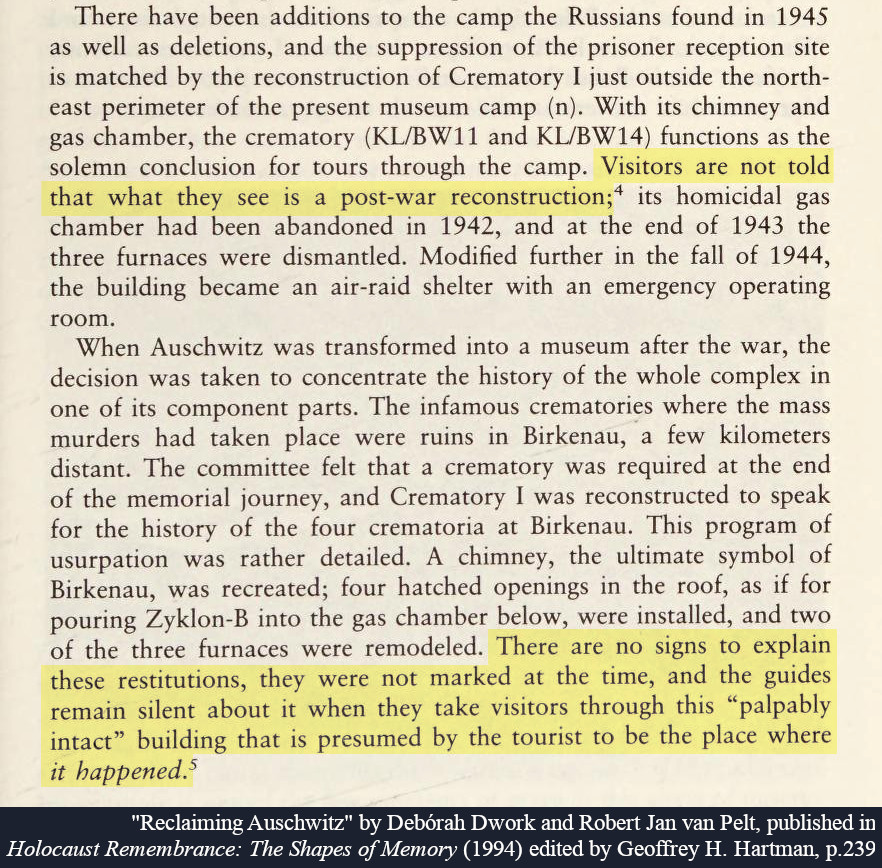
You also left out the common argument about the Zyklon holes being positioned according to the postwar layout, which to me is highly persuasive for it being a fraud. Best depicted here:
https://archive.org/details/germar-rudo ... 9/mode/1up
Some other things. It deserves a punchy intro slide, IMO. An attention getter. Also some of your strongest arguments are near the bottom of the document and your weakest ones at the top, which is bad for modern attention spans.
It could be useful to draw up a short and simple timeline somewhere in the document. The average reader needs help putting all the events in order.
- Prewar - It was a Polish ammo depot.
- 1940 - Converted to crematorium.
- 1942-3 - Alleged gassings in the morgue.
- 1944 - Converted to air raid shelter.
- 1947 - Soviet reconstruction.
I'm sure there is more to be said about this location, but I have nothing novel to add.
- Fred Ziffel
- Posts: 321
- Joined: Sun Dec 01, 2024 11:02 am
Re: Auschwitz Crematorium 1 topics
I have taken the Majdanek and Crem 1 blue staining comparison off the presentation
Yours is a very good argument except one thing. True those are existing walls and ceilings. However, except for one wall
See this blueprint drawing dated Nov 30, 1940. The so-called gas chamber was L shape, Room is now the old urn room
one portion of the wall is not existing. Far as I can tell, the wall indicated was constructed sometime from Dec 1940 to Feb 24, 1941. what would be the wall's sensibility to HCN exposure since it is a newer wall?
Just throwing this out there
I will cover other comments soon, thanks for your inputs
I will post more photos in next post
Yours is a very good argument except one thing. True those are existing walls and ceilings. However, except for one wall
See this blueprint drawing dated Nov 30, 1940. The so-called gas chamber was L shape, Room is now the old urn room
one portion of the wall is not existing. Far as I can tell, the wall indicated was constructed sometime from Dec 1940 to Feb 24, 1941. what would be the wall's sensibility to HCN exposure since it is a newer wall?
Just throwing this out there
I will cover other comments soon, thanks for your inputs
I will post more photos in next post
- Attachments
-
- ccccc.JPG (122.21 KiB) Viewed 8041 times
-
- bbb.JPG (45.66 KiB) Viewed 8041 times
-
- bbbbbb.JPG (59.38 KiB) Viewed 8041 times
Last edited by Fred Ziffel on Tue Jan 27, 2026 7:02 am, edited 1 time in total.
I do not believe anything one is not allowed to question
- Fred Ziffel
- Posts: 321
- Joined: Sun Dec 01, 2024 11:02 am
Re: Auschwitz Crematorium 1 topics
Here is the best I can do inside the 1944 airlock or what I call a blast suppression
Inside the red lines is the urn room wall or the wall that is the subject of this investigation. Not likely I can get a better photo of this portion since the open door blocks the wall. I see no blue staining from the exposure to Zyklon B on the wall inside or outside the air lock
Inside the red lines is the urn room wall or the wall that is the subject of this investigation. Not likely I can get a better photo of this portion since the open door blocks the wall. I see no blue staining from the exposure to Zyklon B on the wall inside or outside the air lock
- Attachments
-
- dddd.JPG (70.96 KiB) Viewed 8038 times
-
- dd.JPG (93.41 KiB) Viewed 8038 times
I do not believe anything one is not allowed to question
Re: Auschwitz Crematorium 1 topics
Good catch. Yes, I suppose the big flaw in my argument is that it's possible any of the interior walls could have been newly built or plastered after 1939. Since that one wall seems to be definitely known as new, it was well-suited for the formation of Prussian Blue.Fred Ziffel wrote: ↑Tue Jan 27, 2026 6:46 am Yours is a very good argument except one thing. True those are existing walls and ceilings. However, except for one wall
That being the case, I would save the slide and use the known new wall to bolster it. Say "the blue staining from Zyklon B exposure is absent from the Auschwitz gas chamber walls and ceiling, even from a wall which is known to have been freshly-built during the German occupation, for which the chemical conditions would especially favor stain formation."
This is a highly consequential fact, IMO.
- Fred Ziffel
- Posts: 321
- Joined: Sun Dec 01, 2024 11:02 am
Re: Auschwitz Crematorium 1 topics
Sorry I am late with this, I went over each of the suggestions and counter arguments. I will add updated to Odyusee soon today
You said
You might want to reword some of this page. According to both Pressac and Rudolf, it was the Germans that bricked over the original doorway.
Fair enough. I added another slide for this. My argument is it was walled up after sept 21 1944. Why? there is a window opposite the location of the swinging door, Not a good shelter if all you have in this area is a window and a swinging door to protect
you said
Well, it doesn't exactly "verify" it. The doorway symbol in the floorplan drawing conventionally depicts a double swing door, so that should be the default assumption, but it's always possible that it was wrong in some way. We know that what was planned and what was constructed did not always match. Verification would require finding physical traces of the hinge in the wall or something like that.
These type of drawing have 2 purposes 1. Instructions of what is to be done. 2. After everyone get paid and goes home the drawing become data of what was done. All trades have access to these drawings. I added a slide of the Sept 21 1944 drawing. It seems it was part of a legit looking notebook the Germans kept. I shall stick to my guns here. see slide
you said
Yes, you're missing the argument that the whole theory of the case is based on a reconstruction that was not admitted to be a reconstruction until decades later. In any other situation this would be called overt fraud. Maybe this is trite, but it's still a great point in my opinion. Here is a pertinent quote from Dwork/Van Pelt.
Great find, and it was added
you said
You also left out the common argument about the Zyklon holes being positioned according to the postwar layout, which to me is highly persuasive for it being a fraud. Best depicted here
I think I covered that in slide called “Ceiling Hole Arrangement.
you said
Some other things. It deserves a punchy intro slide, IMO. An attention getter. Also some of your strongest arguments are near the bottom of the document and your weakest ones at the top, which is bad for modern attention spans.
Can give me heading(s) I can refer to? And I will see what I can do
You said
It could be useful to draw up a short and simple timeline somewhere in the document. The average reader needs help putting all the events in order.
• Prewar - It was a Polish ammo depot.
• 1940 - Converted to crematorium.
• 1942-3 - Alleged gassings in the morgue.
• 1944 - Converted to air raid shelter.
• 1947 - Soviet reconstruction.
Done, I also added more details of other events. Now 2nd page
You said
Possibly also list out all the modifications involved in the "reconstruction" in one place, to create a full picture in the reader's mind. They created ceiling holes, doorway, chimney, furnaces, and removed walls. Perhaps more.
I have something like this on another PP. I list each modification from Nov 1940 to April 1942 and then from April 1942 to Sept 1944. I cover all the modifications. It is however 4 pages. I can post here if you wish to look.
As for Ventilation at this building, I have read it but it seems to be a bit of a messy and long discussion so I opt to skip it. If you have an idea that will fit in two slides, let me see and perhaps I will add it, however at this time I do not have a lot of will to want to cover that.
Stubble suggested
The staff hospital and cafeteria located too close to building
I added a slide to show that as it is a good argument
Any issues?
You said
You might want to reword some of this page. According to both Pressac and Rudolf, it was the Germans that bricked over the original doorway.
Fair enough. I added another slide for this. My argument is it was walled up after sept 21 1944. Why? there is a window opposite the location of the swinging door, Not a good shelter if all you have in this area is a window and a swinging door to protect
you said
Well, it doesn't exactly "verify" it. The doorway symbol in the floorplan drawing conventionally depicts a double swing door, so that should be the default assumption, but it's always possible that it was wrong in some way. We know that what was planned and what was constructed did not always match. Verification would require finding physical traces of the hinge in the wall or something like that.
These type of drawing have 2 purposes 1. Instructions of what is to be done. 2. After everyone get paid and goes home the drawing become data of what was done. All trades have access to these drawings. I added a slide of the Sept 21 1944 drawing. It seems it was part of a legit looking notebook the Germans kept. I shall stick to my guns here. see slide
you said
Yes, you're missing the argument that the whole theory of the case is based on a reconstruction that was not admitted to be a reconstruction until decades later. In any other situation this would be called overt fraud. Maybe this is trite, but it's still a great point in my opinion. Here is a pertinent quote from Dwork/Van Pelt.
Great find, and it was added
you said
You also left out the common argument about the Zyklon holes being positioned according to the postwar layout, which to me is highly persuasive for it being a fraud. Best depicted here
I think I covered that in slide called “Ceiling Hole Arrangement.
you said
Some other things. It deserves a punchy intro slide, IMO. An attention getter. Also some of your strongest arguments are near the bottom of the document and your weakest ones at the top, which is bad for modern attention spans.
Can give me heading(s) I can refer to? And I will see what I can do
You said
It could be useful to draw up a short and simple timeline somewhere in the document. The average reader needs help putting all the events in order.
• Prewar - It was a Polish ammo depot.
• 1940 - Converted to crematorium.
• 1942-3 - Alleged gassings in the morgue.
• 1944 - Converted to air raid shelter.
• 1947 - Soviet reconstruction.
Done, I also added more details of other events. Now 2nd page
You said
Possibly also list out all the modifications involved in the "reconstruction" in one place, to create a full picture in the reader's mind. They created ceiling holes, doorway, chimney, furnaces, and removed walls. Perhaps more.
I have something like this on another PP. I list each modification from Nov 1940 to April 1942 and then from April 1942 to Sept 1944. I cover all the modifications. It is however 4 pages. I can post here if you wish to look.
As for Ventilation at this building, I have read it but it seems to be a bit of a messy and long discussion so I opt to skip it. If you have an idea that will fit in two slides, let me see and perhaps I will add it, however at this time I do not have a lot of will to want to cover that.
Stubble suggested
The staff hospital and cafeteria located too close to building
I added a slide to show that as it is a good argument
Any issues?
- Attachments
-
- t54yttr.JPG (136.1 KiB) Viewed 7861 times
-
- ghjg.JPG (127.81 KiB) Viewed 7861 times
-
- BP of 1944 drawing.JPG (113.97 KiB) Viewed 7861 times
I do not believe anything one is not allowed to question
Re: Auschwitz Crematorium 1 topics
Looks good and makes sense.
I hope that in the long run you will put all your presentations in one place, whether it's on that account or elsewhere.
What your slide doesn't explain is that the actual distance of hole A to the wall of the laying out room matches the distance of hole D to the wall of the airlock, and the same for C and B. You can kind of arrive at this same impression by looking at the drawings you include, but it's much more obvious when you show the numbers.Fred Ziffel wrote: ↑Mon Feb 02, 2026 8:32 am you said
You also left out the common argument about the Zyklon holes being positioned according to the postwar layout, which to me is highly persuasive for it being a fraud. Best depicted here
I think I covered that in slide called “Ceiling Hole Arrangement.
Well, I think the modifications to the walls, doorway, and ceiling holes are all more consequential than what you start off with, which is three slides about the 70,000 sign. The 70,000 sign is interesting but not the most interesting or convincing evidence. But I suppose those slides also serve to introduce the crematorium generally, so maybe it's one half dozen either way. It's your choice how you want to order it.Fred Ziffel wrote: ↑Mon Feb 02, 2026 8:32 am you said
Some other things. It deserves a punchy intro slide, IMO. An attention getter. Also some of your strongest arguments are near the bottom of the document and your weakest ones at the top, which is bad for modern attention spans.
Can give me heading(s) I can refer to? And I will see what I can do
I hope that in the long run you will put all your presentations in one place, whether it's on that account or elsewhere.
- Fred Ziffel
- Posts: 321
- Joined: Sun Dec 01, 2024 11:02 am
Re: Auschwitz Crematorium 1 topics
I could introduce the Rudolf or Mattogno model on that hole location issue. Let me put something together
I shall look into the sign issue also. I will try to take off at least one
Thanks for your input, it is always valuable to me
I shall look into the sign issue also. I will try to take off at least one
Thanks for your input, it is always valuable to me
I do not believe anything one is not allowed to question
- Fred Ziffel
- Posts: 321
- Joined: Sun Dec 01, 2024 11:02 am
Re: Auschwitz Crematorium 1 topics
unfortunately for you guys, I have a new argument I want to put out for peer review
It is about the accuracy of the April 10 1942 blue print drawing of Auschwitz Crem 1.
I use the characteristics of one door Da Wooden Door (and Urn Room door) to show accuracy for the swinging door
Look it over and let me know what you think
It is about the accuracy of the April 10 1942 blue print drawing of Auschwitz Crem 1.
I use the characteristics of one door Da Wooden Door (and Urn Room door) to show accuracy for the swinging door
Look it over and let me know what you think
- Attachments
-
- test slide.JPG (137.99 KiB) Viewed 5484 times
I do not believe anything one is not allowed to question